Unit conversion sits at the quiet centre of every reliable time, speed, and distance calculation, yet it is the step candidates most often rush past under exam pressure. A single mismatched unit can turn a perfectly reasoned solution into a wrong answer, because the arithmetic itself never forgives inconsistency. This lesson builds directly on the foundational relationship between speed, distance, and time introduced earlier, and it prepares you for average speed work by making sure every quantity you handle speaks the same measurement language.
The core skill here is fluency in moving between kilometres per hour and metres per second, the two units that dominate competitive examination questions. Beyond the mechanical multiplication or division, you will develop the instinct to scan a problem first and decide which unit the answer demands before touching a calculator. That habit alone prevents a large share of careless errors, and it sharpens the reasoning you will need when relative speed and train problems arrive in later lessons.
Treat this material as a calibration exercise rather than a memorisation drill. Once the conversion factor becomes second nature, you stop losing marks to formatting and start spending your attention on the actual logic of each question. The worked examples, comparison tables, and practice prompts below are designed to make that transition deliberate and permanent.
On This Page
Why Unit Consistency Decides the Answer
Every formula in this topic assumes that the quantities you substitute share a coherent measurement system. Speed measured in kilometres per hour cannot be multiplied by time measured in seconds without first reconciling the two scales. Examiners exploit this gap deliberately, mixing units inside a single question to test whether you notice the mismatch before you compute.
The Silent Error That Costs Marks
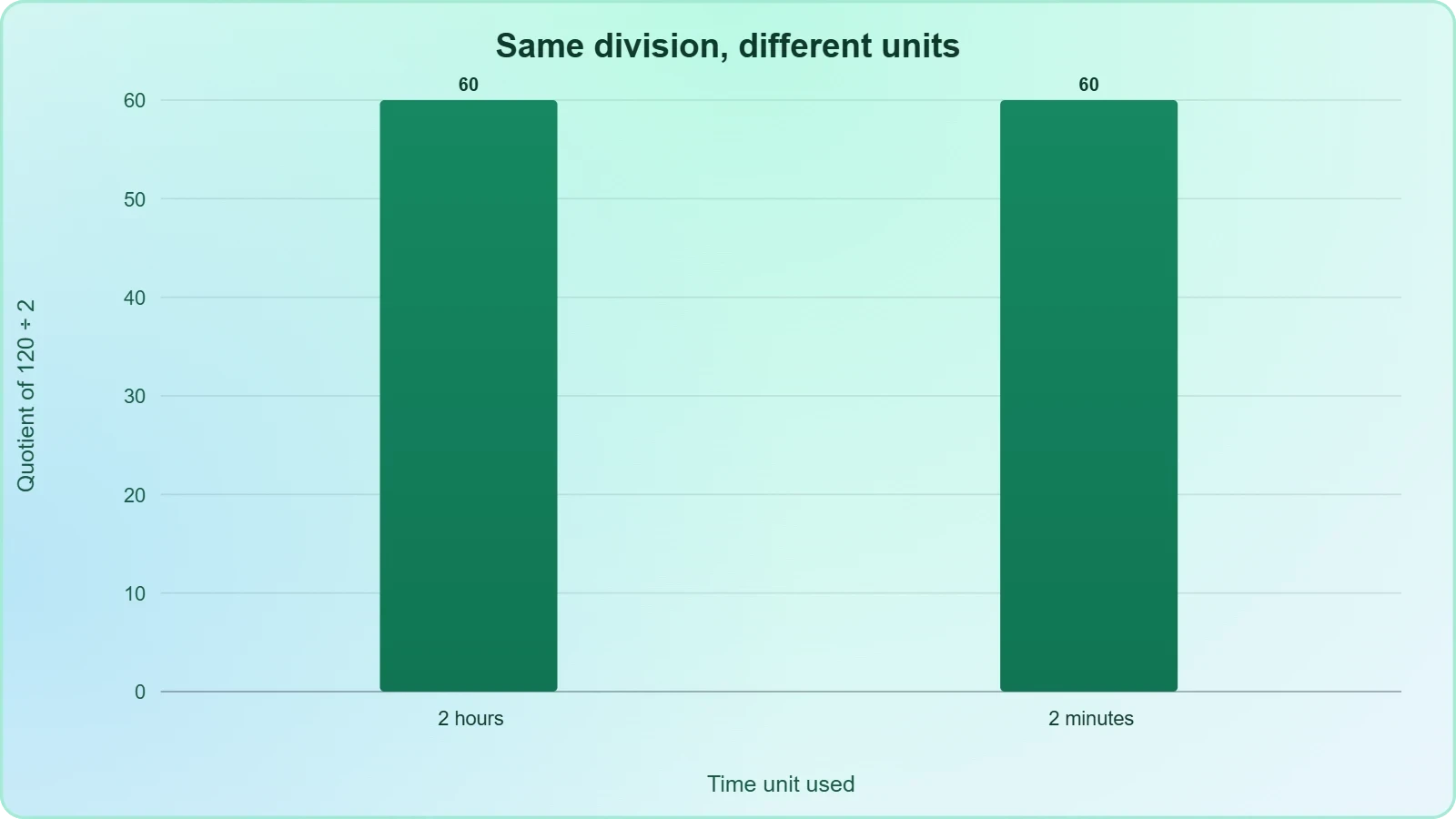
A candidate who divides 120 by 2 and reports 60 has performed flawless arithmetic on incompatible inputs. If the distance was 120 kilometres and the time was 2 hours, the answer is 60 km/h and all is well. If the time was 2 minutes, the same division produces a meaningless figure that looks plausible on paper.
Unit consistency is therefore a verification step, not a formality. Before solving, list every given quantity with its unit, identify the unit the question requests, and convert whatever disagrees. This short discipline takes seconds and eliminates an entire category of avoidable mistakes that plague otherwise capable students.
Reading the Question Before the Numbers
Strong solvers read the final line of a problem first, because the requested unit dictates the entire conversion strategy. A question asking for speed in metres per second invites you to convert distance and time early, keeping the working clean. A question asking for time in hours suggests converting speed to kilometres per hour instead.
This backward reading habit also reveals traps. When a problem states a distance in metres but a speed in kilometres per hour, the mismatch is a signal, not an accident. Recognising that signal early lets you choose the conversion path that minimises intermediate rounding and keeps the final answer exact.
The km/h to m/s Conversion and Its Reciprocal
The conversion between kilometres per hour and metres per second rests on two simple facts: one kilometre equals one thousand metres, and one hour equals three thousand six hundred seconds. Dividing the first by the second produces the familiar factor of five-eighteenths, which converts km/h into m/s. Its reciprocal, eighteen-fifths, converts m/s back into km/h.
Deriving the Factor Rather Than Memorising It
Memorisation fades under stress, but derivation survives. Rebuilding the factor from first principles takes only a moment and guarantees you never invert it by accident. The derivation also reinforces why the factor is smaller than one, a point many students find counterintuitive until they see the arithmetic.
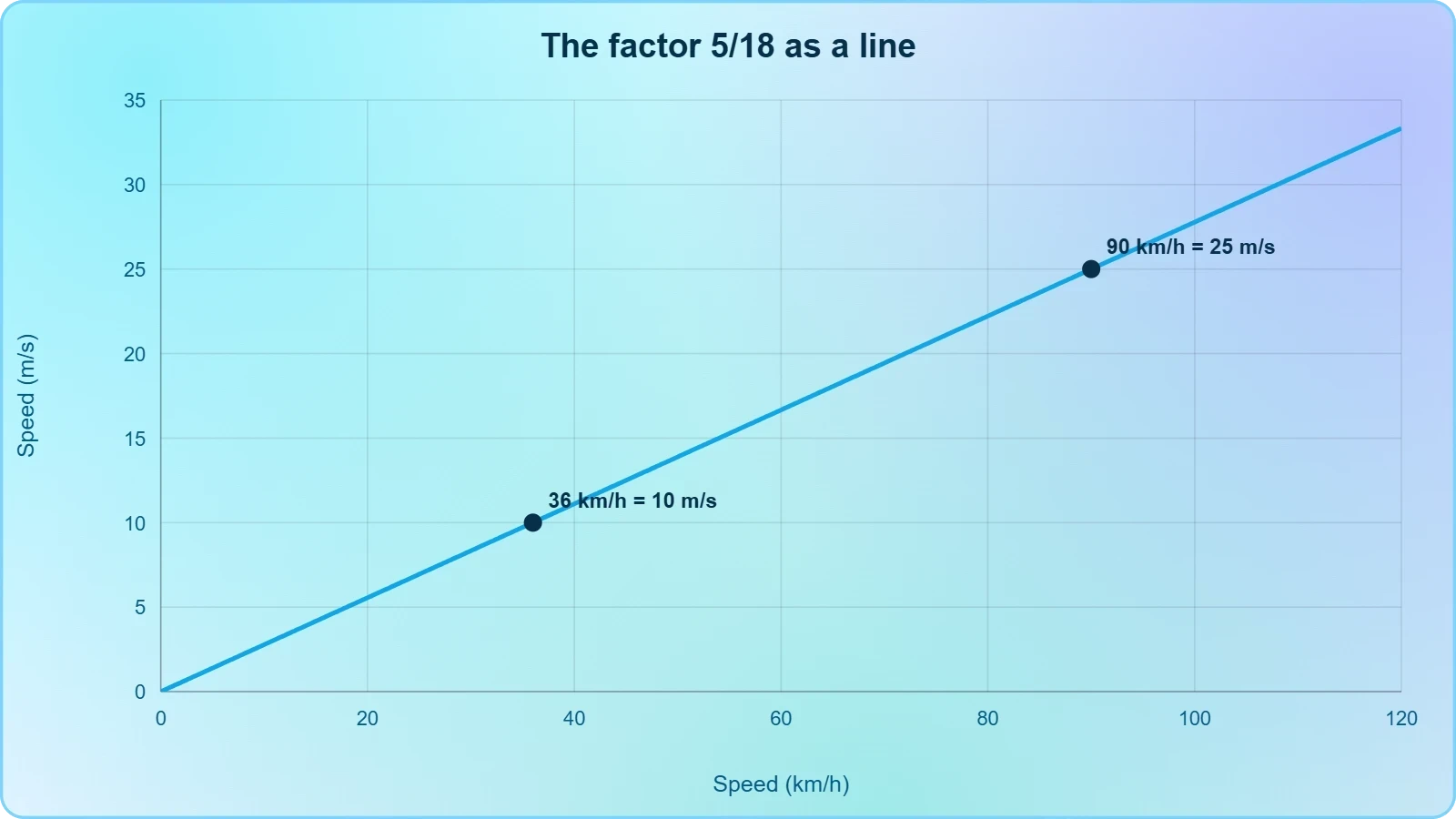
Reading the equation aloud clarifies the logic: a speed of one kilometre per hour covers a thousand metres in three thousand six hundred seconds, which simplifies to five-eighteenths of a metre each second. Because a metre per second is a faster pace, the numerical value shrinks when expressed in that unit.
Applying the Factor in Both Directions
To move from km/h to m/s, multiply by five-eighteenths. To move from m/s to km/h, multiply by eighteen-fifths, which is equivalent to multiplying by 3.6. Both operations are exact, so no rounding is required unless the problem explicitly demands a decimal answer.
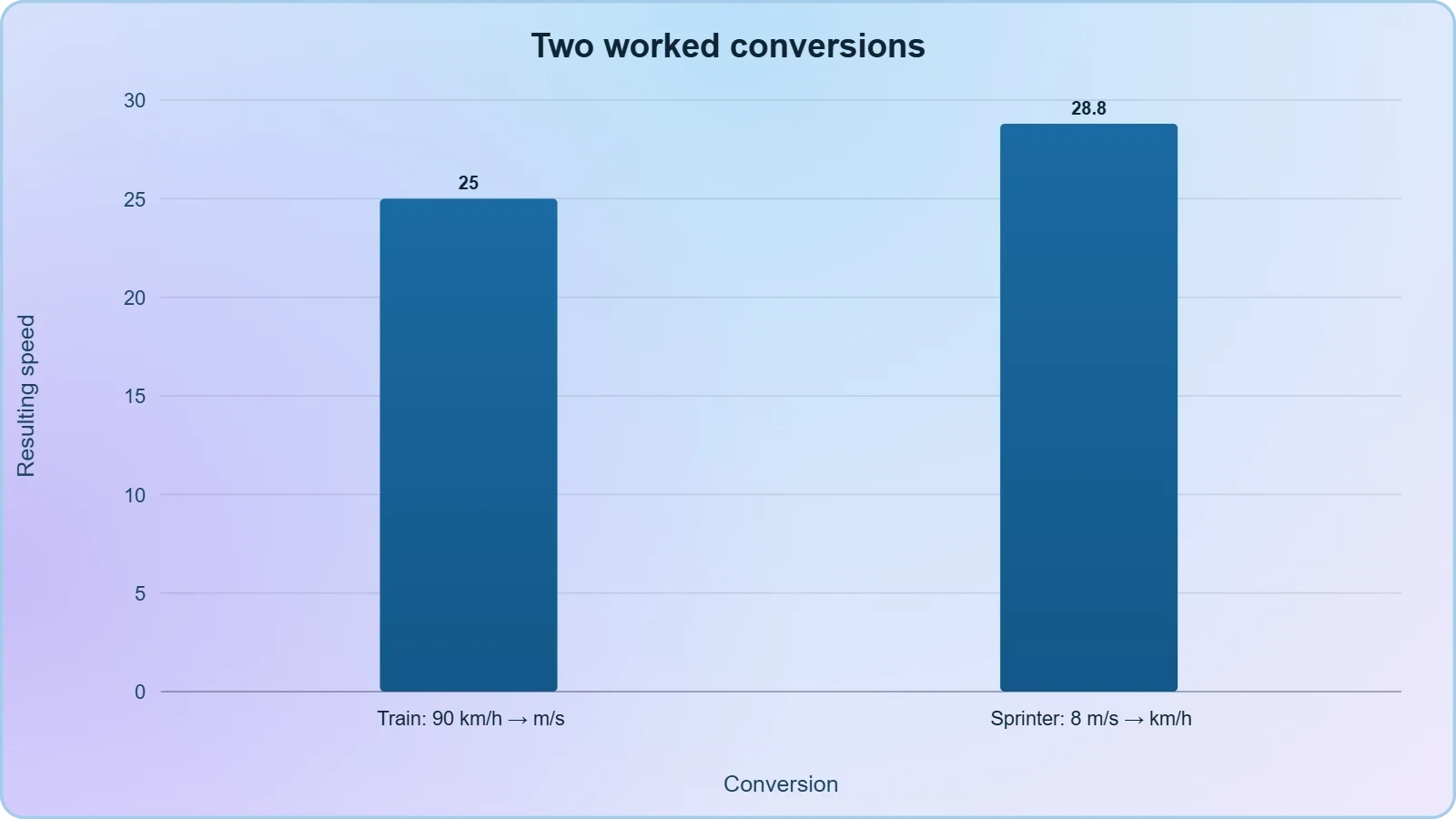
Consider a train travelling at 90 km/h. Multiplying by five-eighteenths yields 25 m/s, a clean result that makes subsequent distance calculations straightforward. Reversing the process, a sprinter at 8 m/s moves at 28.8 km/h, a figure that helps compare athletic speeds with vehicle speeds on a common scale.
Building Speed Through Benchmarked Values
Fluent converters recognise certain speeds instantly, and that recognition saves valuable seconds during timed papers. Knowing that 36 km/h equals 10 m/s, or that 72 km/h equals 20 m/s, lets you bypass the arithmetic entirely on common exam figures. These anchor points form a mental ladder you can climb in either direction.
Anchor Values Worth Committing to Memory
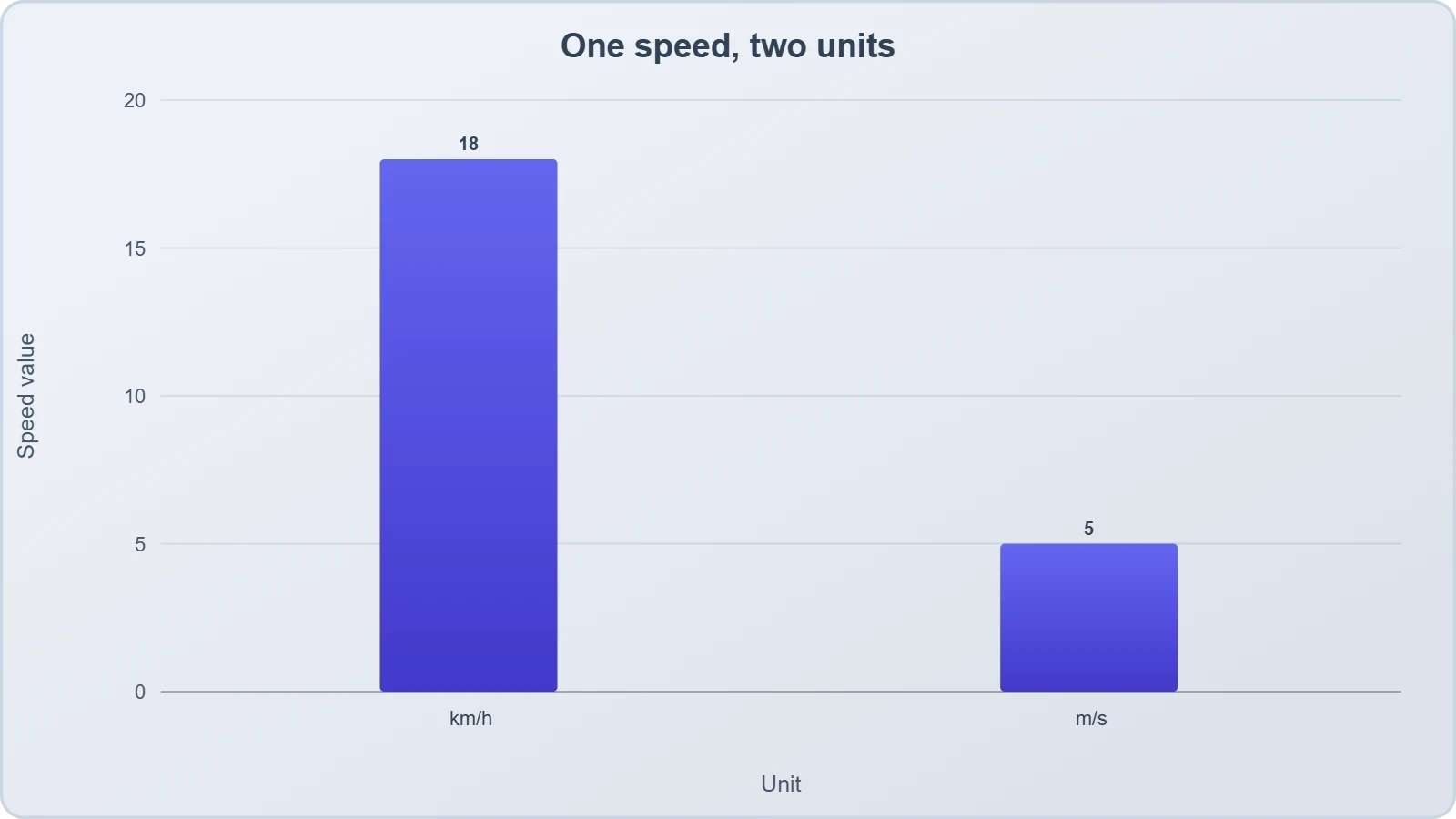
The ladder begins at 18 km/h, which is exactly 5 m/s, and climbs through 36, 54, 72, and 90 km/h, corresponding to 10, 15, 20, and 25 m/s respectively. Each rung adds eighteen kilometres per hour and five metres per second, preserving the constant ratio throughout.
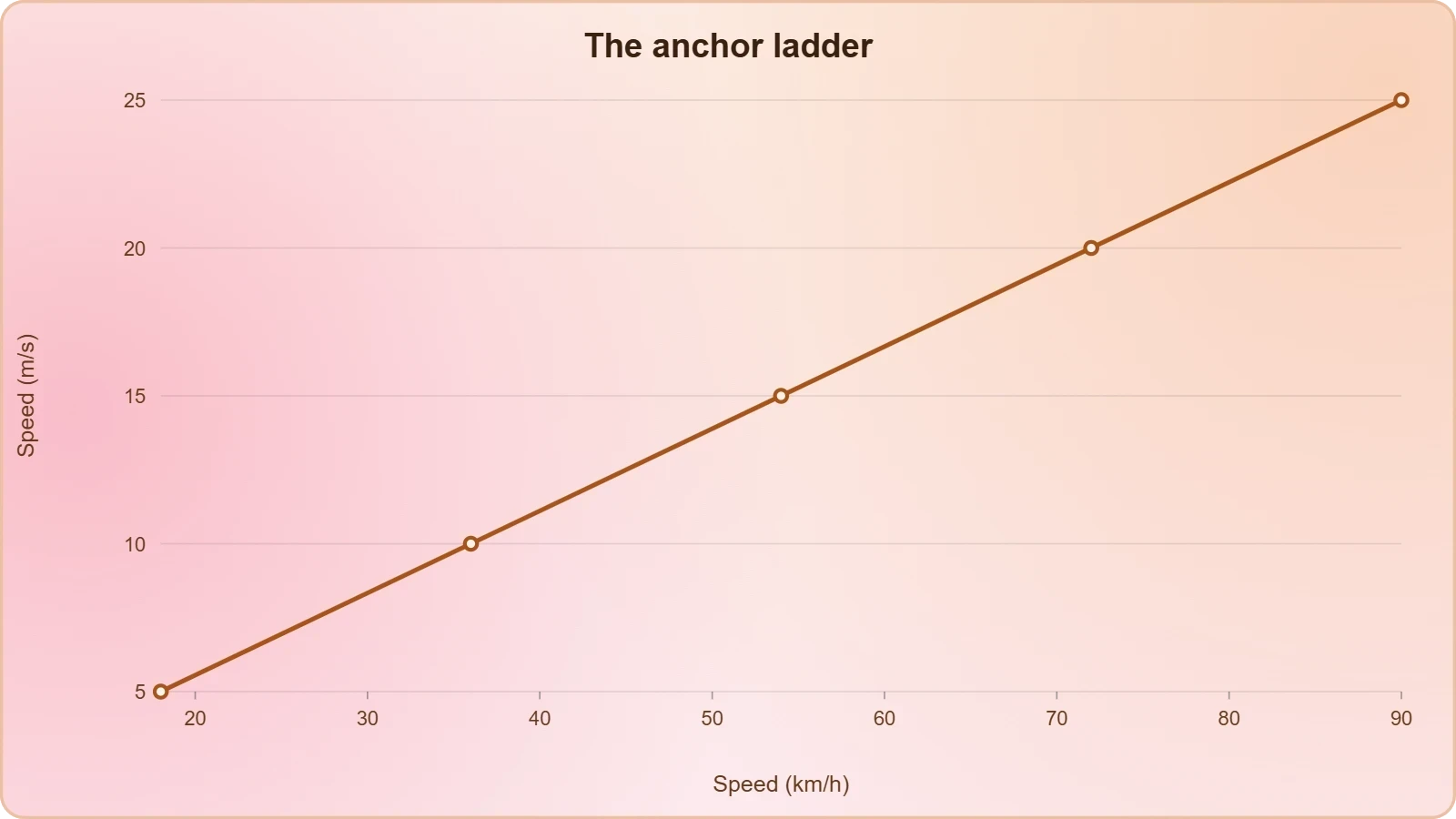
Once these anchors are secure, unfamiliar speeds can be estimated by interpolation. A speed of 45 km/h sits midway between 36 and 54, so it converts to roughly 12.5 m/s. This estimation technique is invaluable in multiple-choice sections where approximate reasoning eliminates wrong options quickly.
Converting Distances and Times Alongside Speed
Speed conversions rarely appear alone. A problem may give distance in kilometres and time in minutes, demanding two separate conversions before any division occurs. Handling these systematically, converting time to hours or distance to metres first, keeps the working transparent and reduces the chance of a hidden mismatch.
For instance, a cyclist covering 4.5 kilometres in 15 minutes travels at 18 km/h, since fifteen minutes is a quarter of an hour. Expressed in metres per second, that same speed is 5 m/s. Both answers are correct; the question's requested unit determines which one you report.
Choosing the Right Unit Before You Compute
Strategic unit selection separates confident solvers from hesitant ones. Rather than converting everything reflexively, examine the question's structure and pick the path that produces the fewest intermediate steps. Sometimes metres and seconds are cleaner; sometimes kilometres and hours are. The choice is a decision, not a default.
Matching Units to the Question's Demand
When a problem asks how long a train takes to pass a platform, the answer is usually requested in seconds, so converting the train's speed to metres per second early is efficient. When a problem asks for journey time in hours, keeping speed in kilometres per hour avoids unnecessary back-and-forth.
This matching principle also governs distance. Platform lengths and train lengths are typically given in metres, while intercity distances appear in kilometres. Aligning your working units with the given data reduces conversion count and, by extension, reduces the opportunity for error.
Avoiding Mixed-Unit Traps in Word Problems
Examiners construct traps by pairing a speed in km/h with a time in minutes, or a distance in metres with a speed in km/h. The trap is invisible unless you consciously audit every unit before substituting into the formula. A quick scan of all given quantities, written with their units, exposes the mismatch immediately.
Once exposed, the fix is straightforward: convert the odd quantity to match the others, then proceed. The discipline of writing units beside every number, even in rough work, is the single most effective defence against this class of error in competitive examinations.
Worked Examples That Mirror Exam Conditions
Applying the conversion factor inside realistic problems cements the skill far better than isolated drills. The examples below progress from direct conversion to a compound problem requiring both speed and distance adjustments. Work each one before reading the solution, and note where your own unit choices diverge from the presented method.
A Direct Conversion Under Time Pressure
A car travels at 108 km/h. Express this speed in metres per second. Multiplying by five-eighteenths gives 30 m/s, since 108 divided by 18 equals 6, and 6 multiplied by 5 equals 30. The arithmetic is clean because 108 is a multiple of 18.
Notice how recognising the divisibility shortcut accelerates the calculation. Candidates who spot that 108 divides neatly by 18 avoid long multiplication entirely. This kind of numerical awareness, built through practice, is what separates a comfortable solver from a rushed one.
A Compound Problem With Two Conversions
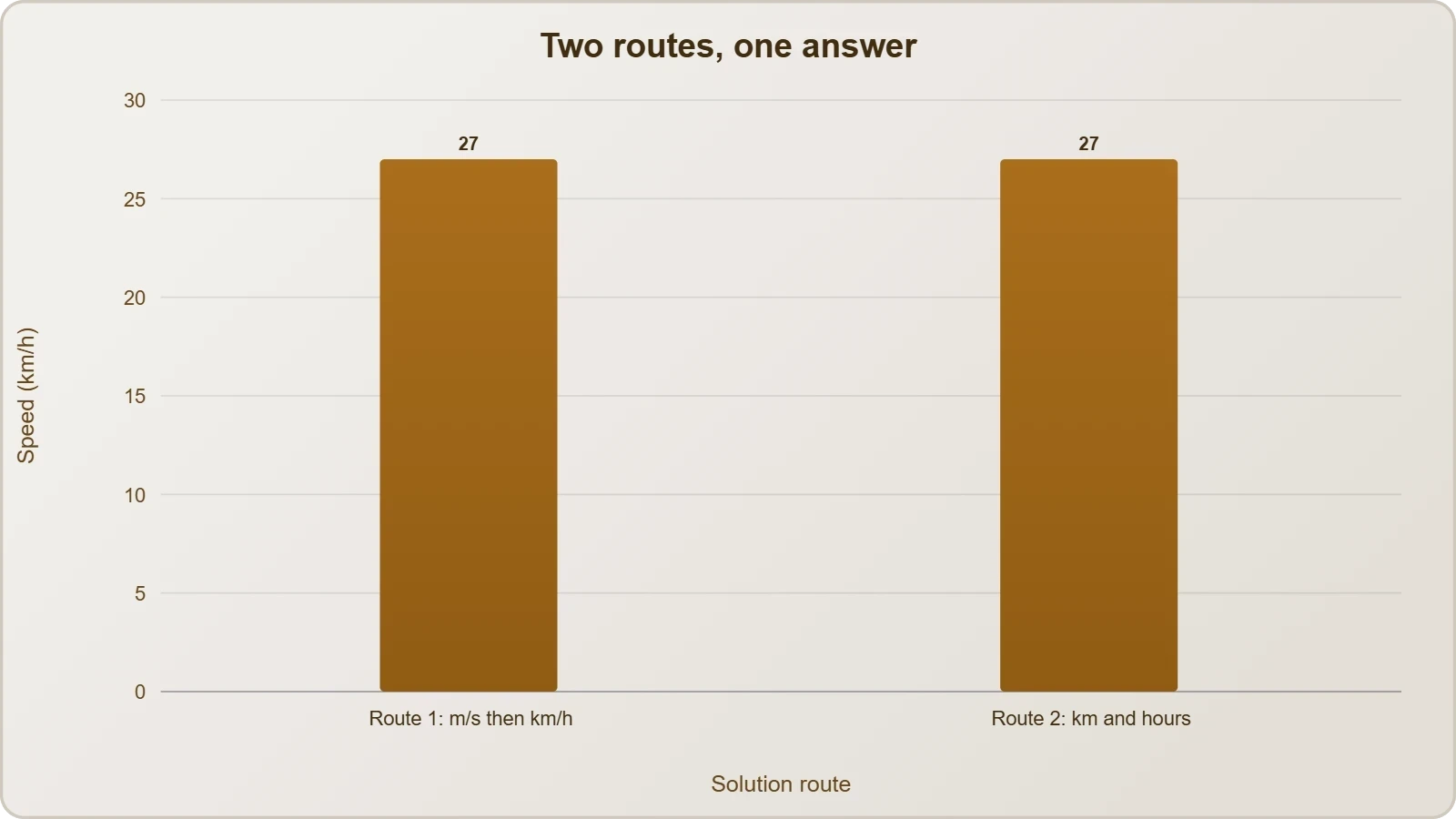
A cyclist rides 900 metres in 2 minutes. Find the speed in km/h. First convert 2 minutes to 120 seconds, giving 7.5 m/s. Then multiply by eighteen-fifths to obtain 27 km/h. Both conversions are necessary, and each is exact.
Alternatively, convert 900 metres to 0.9 kilometres and 2 minutes to one-thirtieth of an hour, then divide 0.9 by one-thirtieth to reach 27 km/h directly. Two valid routes, one answer. Choosing between them is a matter of personal fluency, and both should feel available.
Preparing for Average Speed and Beyond
The next lesson introduces average speed, where multiple speeds combine across a journey. That topic depends entirely on the conversions practised here, because averaging speeds expressed in different units produces nonsense. A firm grip on unit consistency now makes the average speed formulas intuitive rather than mysterious.
How Unit Fluency Supports Later Topics
Average speed problems frequently present one leg of a journey in km/h and another in m/s, demanding conversion before any averaging occurs. Relative speed problems, arriving shortly after, compound this requirement by involving two moving objects whose units must align. Trains add length conversions in metres to the mix.
Each of these later topics assumes that conversion is automatic. If you still pause to recall the factor, the cognitive load of the harder problem overwhelms you. Building fluency now is an investment that pays dividends across the remaining eight lessons of this course.
A Short Self-Check Before Moving On
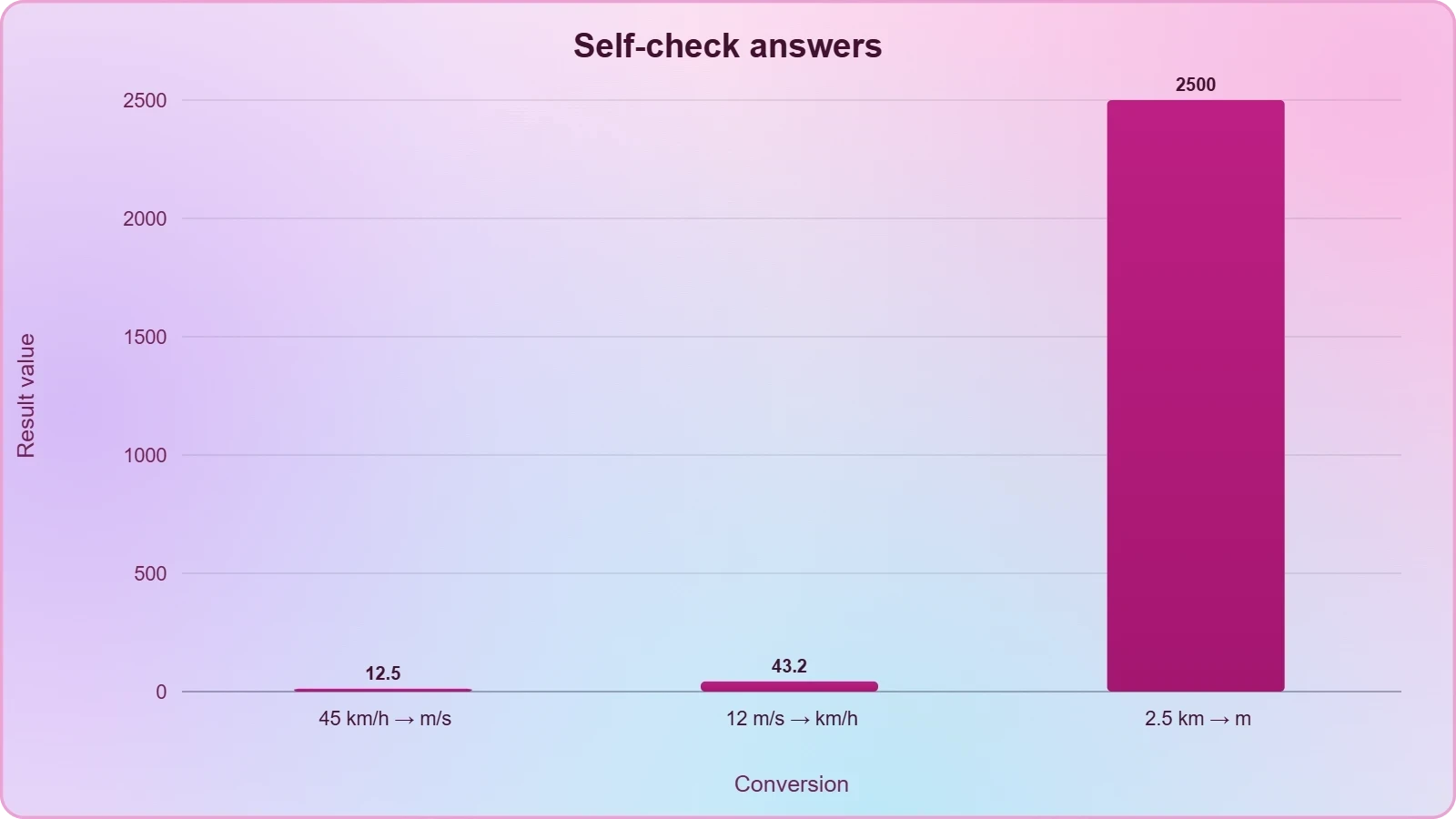
Test yourself with three quick conversions: 45 km/h to m/s, 12 m/s to km/h, and 2.5 kilometres to metres. The answers are 12.5 m/s, 43.2 km/h, and 2500 metres. If any felt slow, revisit the anchor ladder and the derivation before proceeding.
Speed matters as much as accuracy in competitive settings. Set a thirty-second timer and attempt five conversions; if you complete them correctly within the limit, you are ready for average speed. If not, repeat the drill until the factor feels reflexive rather than recalled.
Consolidating the Conversion Habit
Unit conversion is a small skill with outsized consequences. It occupies seconds of working time yet determines whether every subsequent calculation stands or collapses. Treating it as a deliberate first step, rather than an afterthought, transforms the reliability of your answers across the entire quantitative aptitude section.
Building a Personal Conversion Routine
Adopt a fixed sequence: read the requested unit, list all given quantities with units, convert mismatches, then compute. This routine becomes automatic within a few practice sessions and removes the hesitation that costs marks under examination timing. Consistency in method produces consistency in results.
Keep a short reference card with the factor, the anchor ladder, and the common traps. Review it before each practice set until the contents live in memory. The card is a scaffold, not a crutch, and it should retire itself once fluency arrives.
Where This Lesson Leads
With conversions secure, average speed becomes a matter of applying formulas to aligned quantities rather than wrestling with units. The next lesson builds directly on this foundation, introducing the weighted averaging that governs journeys at varying speeds. Arrive prepared, and the formulas will feel like natural extensions of what you already know.
Return to the anchor ladder whenever a problem feels sluggish. Fluency is built through repetition, and each conversion you perform correctly strengthens the reflex. The remaining lessons in this course assume that reflex exists, so invest the practice time now and carry the benefit forward.
Also Read
- No links available.
From our network :
- How to design postgres partitions with native and hash methods
- JD Vance Charlie Kirk: Tribute and Political Strategy
- Limits: The Squeeze Theorem Explained
- How to migrate to postgres using logical replication and cutover
- Limit Superior and Inferior
- Bitcoin price analysis: Market signals after a muted weekend
- How to secure postgres connections across VPC, VPN, and cloud
- Bitcoin Hits $100K: Crypto News Digest
- The Diverse Types of Convergence in Mathematics
RESOURCES
- No results found.