Train-crossing problems occupy a distinctive place in quantitative aptitude because they translate a familiar physical event into a precise arithmetic relationship. When a locomotive sweeps past a signal pole or rumbles across a platform, the distance it must cover is not simply the length of the object it passes. Instead, the engine's own length becomes part of the journey, and recognising this subtlety separates confident solvers from candidates who lose marks through careless assumptions. This lesson isolates that single idea and builds a dependable method around it.
The governing principle is elegantly simple: a train clears a stationary point when its entire body has passed that point, so the effective distance equals the train's length. When the obstacle has measurable length of its own, such as a platform or a bridge, the two lengths combine into one continuous stretch that the train must traverse. Because the object is stationary, the relative speed of the train equals its actual speed, which means the previous lesson's relative-motion framework collapses neatly into a single moving body. Mastering this reduction is the central aim here.
Every worked example in this lesson follows the same disciplined sequence: identify what is moving, determine the total distance to be covered, confirm the speed in compatible units, and apply the fundamental relation linking time, speed, and distance. Candidates who internalise this order of operations rarely stumble, even under examination pressure. The quizzes that follow each section are designed to test exactly this procedural fluency rather than memorised formulas.
On This Page
- The Foundational Logic Behind Train-Crossing Problems
- Unit Conversions That Protect Accuracy
- Crossing Poles: The Simplest Case
- Crossing Platforms and Bridges: Combining Lengths
- Reverse Problems: Finding Length or Speed
- Examination Strategy and Common Pitfalls
- Consolidating the Method and Preparing for Moving Trains
The Foundational Logic Behind Train-Crossing Problems
Before any formula is applied, the solver must visualise the physical event with precision. A train is not a point; it is an extended body with a definite length, and that length governs how long the crossing takes. Treating the engine as a dimensionless particle is the single most common error in this topic, and it produces answers that are systematically too small. The correct mental picture places the front of the train at the start of the obstacle and the rear at the finish.
Why the Train's Own Length Enters the Calculation
Consider a pole standing beside the track. The crossing begins the instant the locomotive's nose reaches the pole and ends only when the guard's van clears it. During that interval, the train has travelled a distance exactly equal to its own length, no more and no less. This is why a longer train takes proportionally longer to pass the same fixed point, holding speed constant.
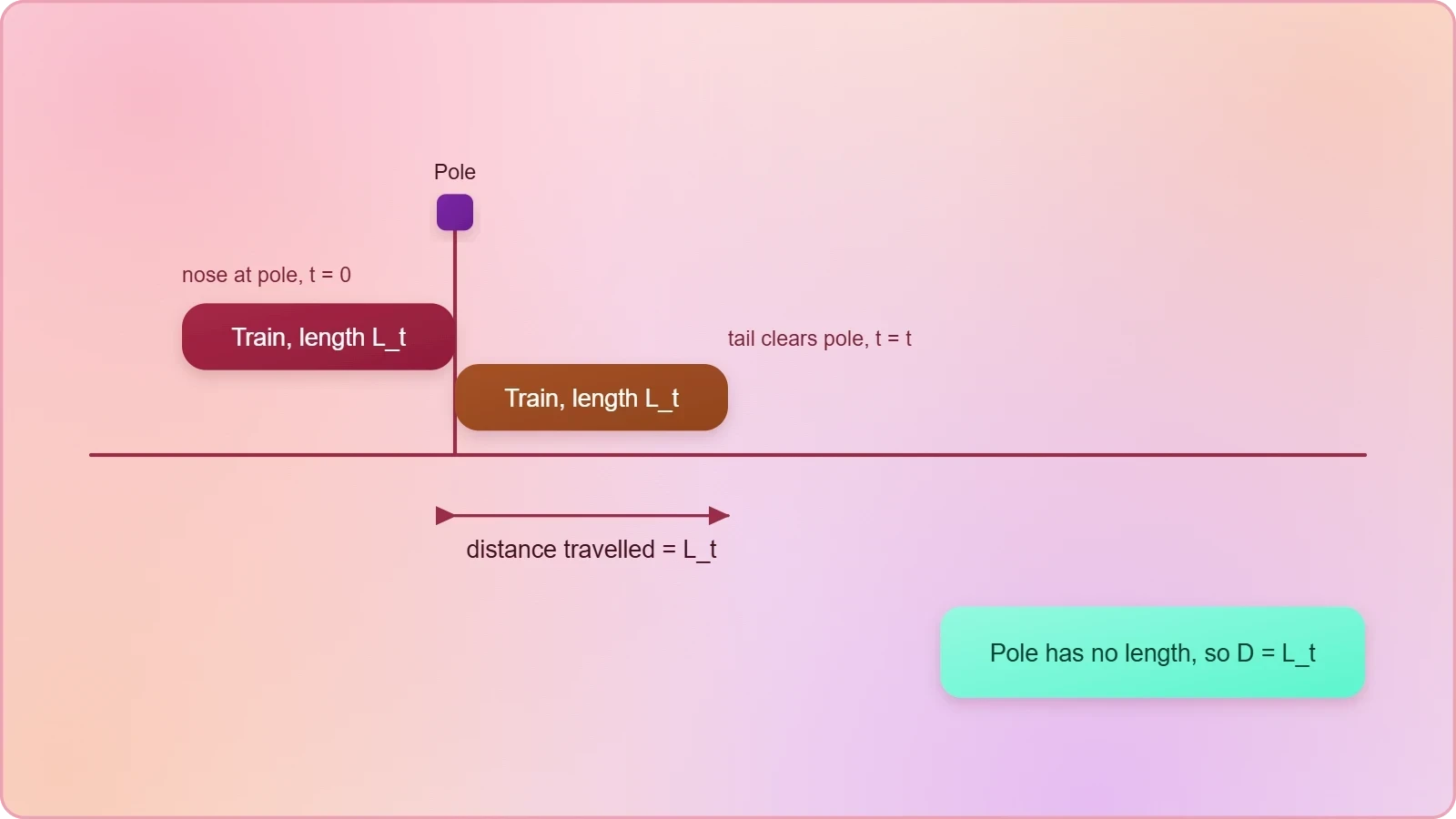
The same reasoning extends naturally to any stationary object of negligible width, including a signal post, a milestone, or a standing observer. In each case the distance covered equals the train's length alone. Recognising this equivalence allows one compact statement to cover a whole family of apparently different questions, which is precisely the economy competitive examinations reward.
Extending the Logic to Objects With Length
A platform, bridge, or tunnel differs from a pole because it possesses length along the direction of travel. The train must first reach the near end and then completely clear the far end, so the total distance becomes the sum of the train's length and the platform's length. This additive relationship is the backbone of nearly every problem in this lesson.
Formally, if the train length is ##L_t## and the platform length is ##L_p##, the distance covered during a complete crossing is given by the following expression, which students should be able to derive from first principles rather than recall mechanically.
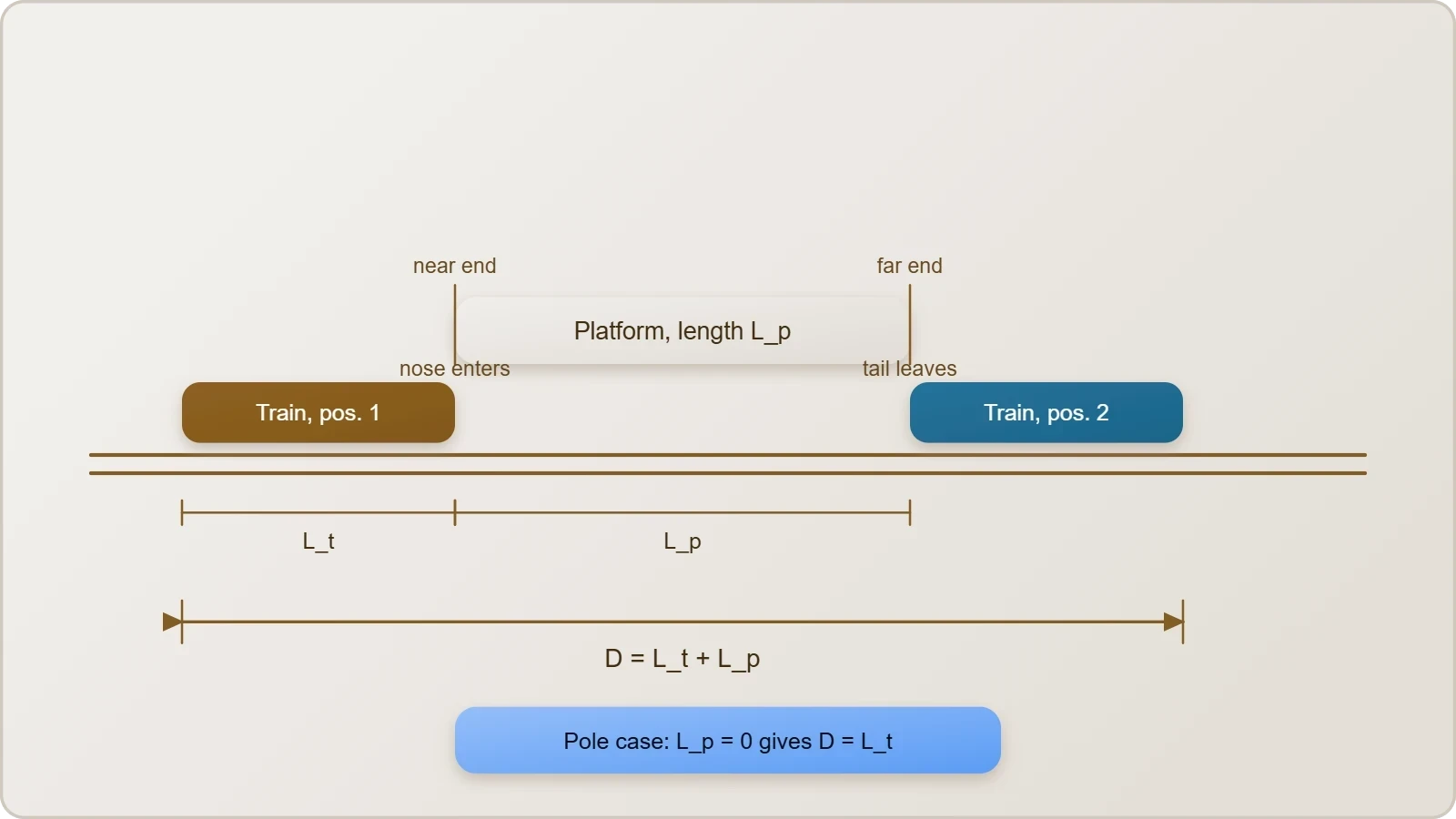
When the obstacle is a pole, the platform term vanishes and the expression reduces to ##D = L_t##, confirming that the general case contains the special case. This containment is a hallmark of well-structured quantitative reasoning and gives candidates confidence that one formula suffices across the entire topic.
Unit Conversions That Protect Accuracy
Examination questions habitually mix kilometres per hour with metres, and this mismatch is a fertile source of avoidable errors. The conversion factor between the two systems is not arbitrary; it follows directly from the definitions of the kilometre and the hour. Candidates who understand its origin convert fluently, while those who merely memorise it often invert the factor under pressure.
Deriving the Kilometre-Per-Hour to Metre-Per-Second Factor
One kilometre equals one thousand metres, and one hour equals three thousand six hundred seconds. Dividing the first by the second yields the familiar multiplier, which converts a speed expressed in kilometres per hour into metres per second. The derivation is short enough to reproduce mentally during an examination, removing any dependence on rote recall.
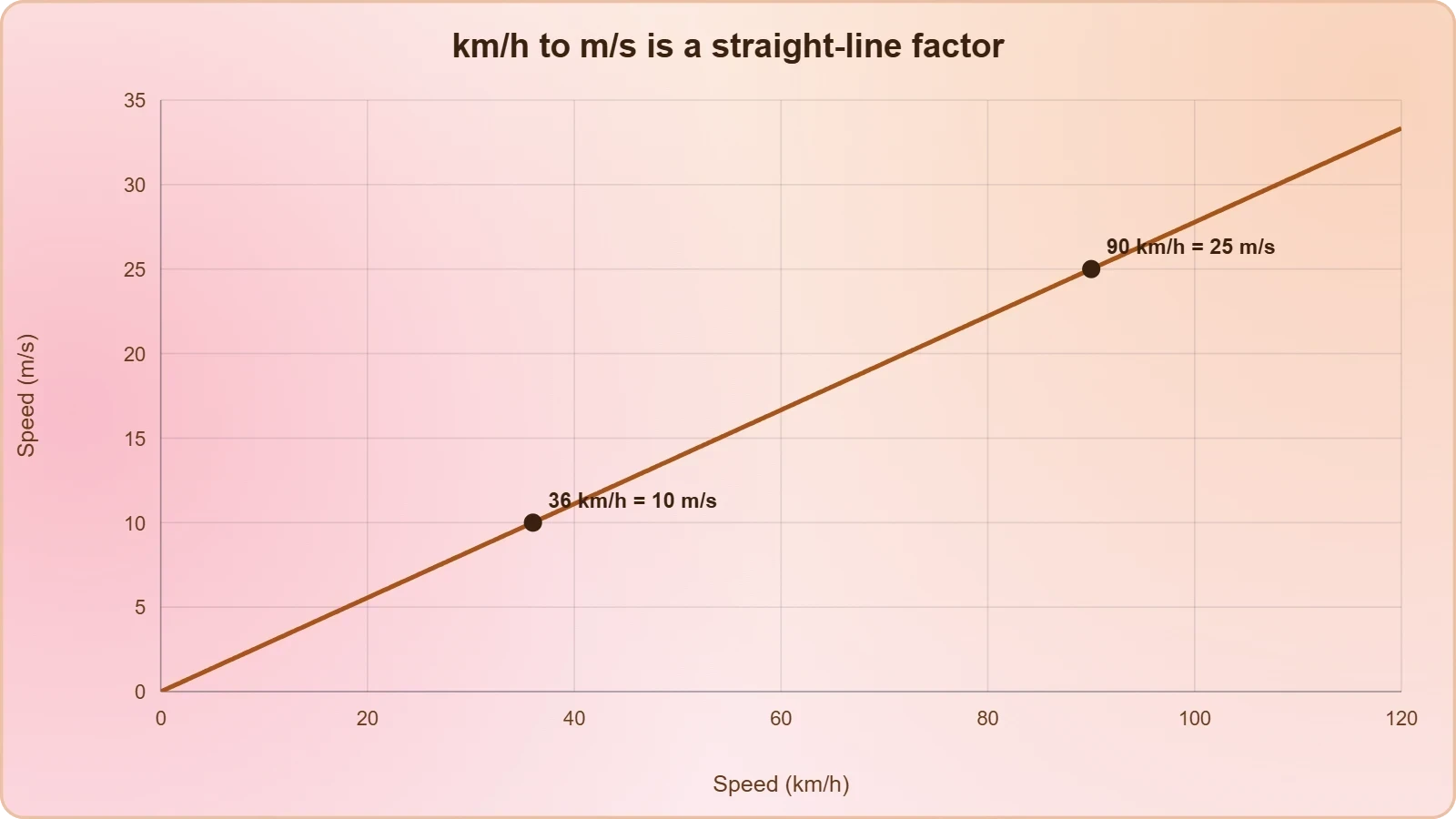
Conversely, converting from metres per second back to kilometres per hour requires multiplying by ##\frac{18}{5}##. Students should practise both directions until the operation becomes automatic, because questions frequently supply the train's speed in one system and demand an answer expressed in the other.
Choosing Consistent Units Before Computing
A reliable habit is to convert everything to metres and seconds at the very start of a solution. Train lengths and platform lengths are almost always given in metres, so aligning the speed to metres per second eliminates the risk of a hidden mismatch. This single discipline prevents a large proportion of arithmetic slips in timed conditions.
Where a question deliberately supplies mixed units, the conversion step should be written explicitly rather than performed silently. Examiners award method marks for visible reasoning, and a clearly stated conversion demonstrates that the candidate understands the underlying structure rather than guessing at an answer.
Crossing Poles: The Simplest Case
The pole problem is the cleanest entry point because only one length matters. Once the train's speed is expressed in metres per second and its length in metres, the crossing time follows immediately from the fundamental relation. This simplicity makes the pole question an ideal diagnostic: a candidate who errs here will almost certainly struggle with platforms.
Applying the Fundamental Relation
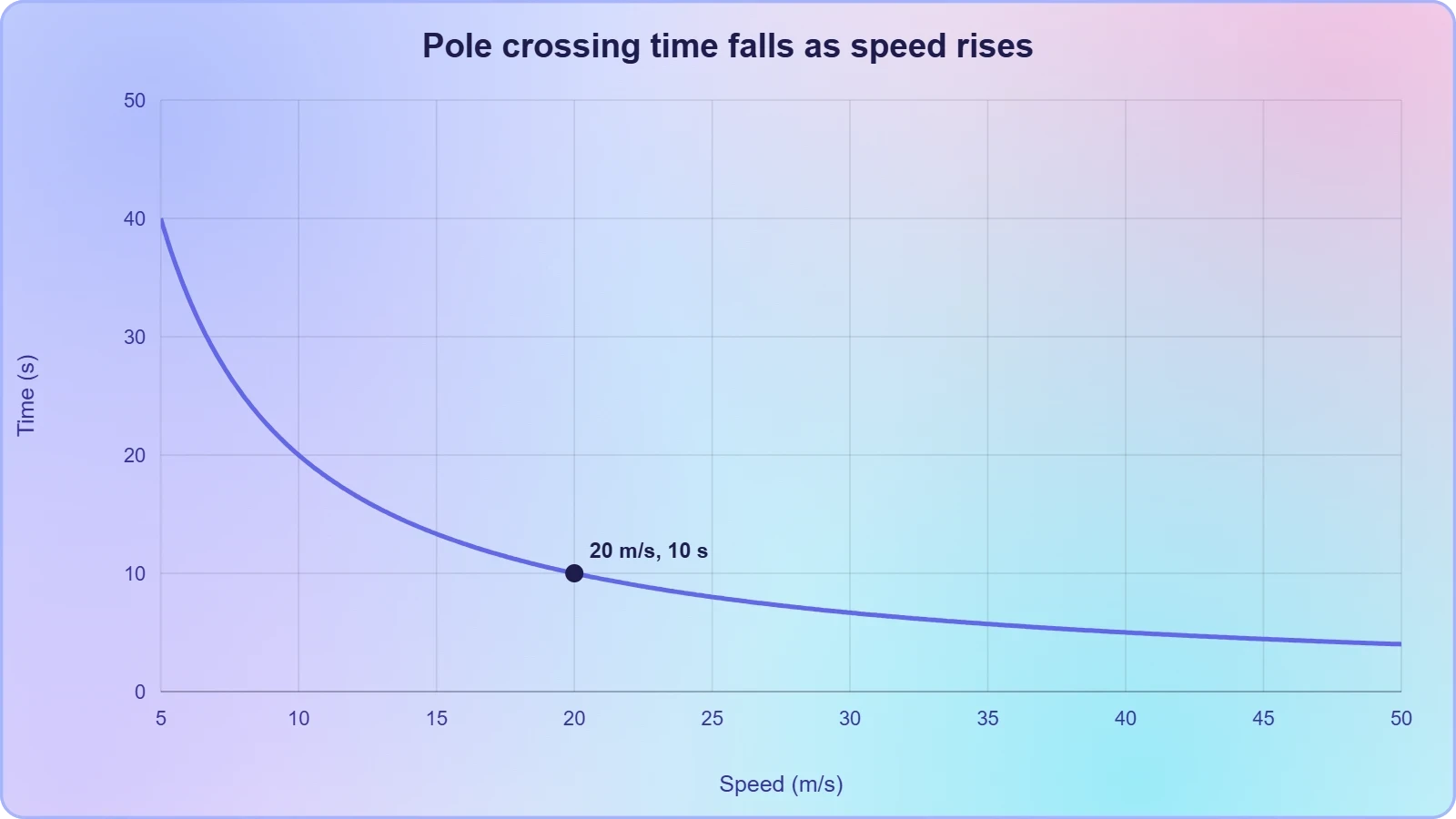
The relation connecting the three quantities is stated below, and it governs every problem in this lesson regardless of the obstacle involved. Time is obtained by dividing the effective distance by the speed, provided both are expressed in compatible units. Rearranging the same relation yields the length or the speed when the other two quantities are known.
For a pole, the distance ##D## is simply the train's length ##L_t##, so the crossing time becomes ##t = \frac{L_t}{v}##. A train of length two hundred metres moving at twenty metres per second therefore clears the pole in ten seconds, a calculation that should take only a moment once the units align.
Worked Example With a Signal Post
Suppose a train one hundred and fifty metres long passes a signal post in six seconds. The speed is found by dividing length by time, giving twenty-five metres per second, which converts to ninety kilometres per hour. Notice how the conversion appears only at the final step, keeping the intermediate arithmetic clean and easy to verify.
# Pole crossing: distance equals train length only
train_length_m = 150
time_s = 6

speed_mps = train_length_m / time_s
speed_kmph = speed_mps * 18 / 5

print(f"Speed = {speed_mps} m/s = {speed_kmph} km/h")
# Output: Speed = 25.0 m/s = 90.0 km/h
Encoding the logic as a short script reinforces the structure of the method and guards against arithmetic slips during practice. Candidates preparing for computer-based tests may find such snippets useful for generating their own verification checks, though the examination itself demands mental or handwritten computation.
Crossing Platforms and Bridges: Combining Lengths
Platform problems introduce the additive distance that defines this lesson. The train must cover its own length plus the platform's length, and every subsequent calculation flows from that single adjustment. Once the combined distance is established, the problem reduces to the same division used for poles, which is why the earlier section deserves careful attention.
Setting Up the Combined Distance
A train of length ##L_t## crossing a platform of length ##L_p## travels a total distance of ##L_t + L_p##. If the crossing takes time ##t##, the speed satisfies ##v = \frac{L_t + L_p}{t}##. This single equation can be rearranged to find any unknown, making it the workhorse of the entire topic.
Questions often supply the crossing time for a pole and the crossing time for a platform, then ask for the platform's length. Subtracting the two distances isolates the platform term, and the resulting difference divided by the appropriate time yields the required answer. Recognising this pattern saves valuable minutes in timed papers.
Worked Example With a Platform
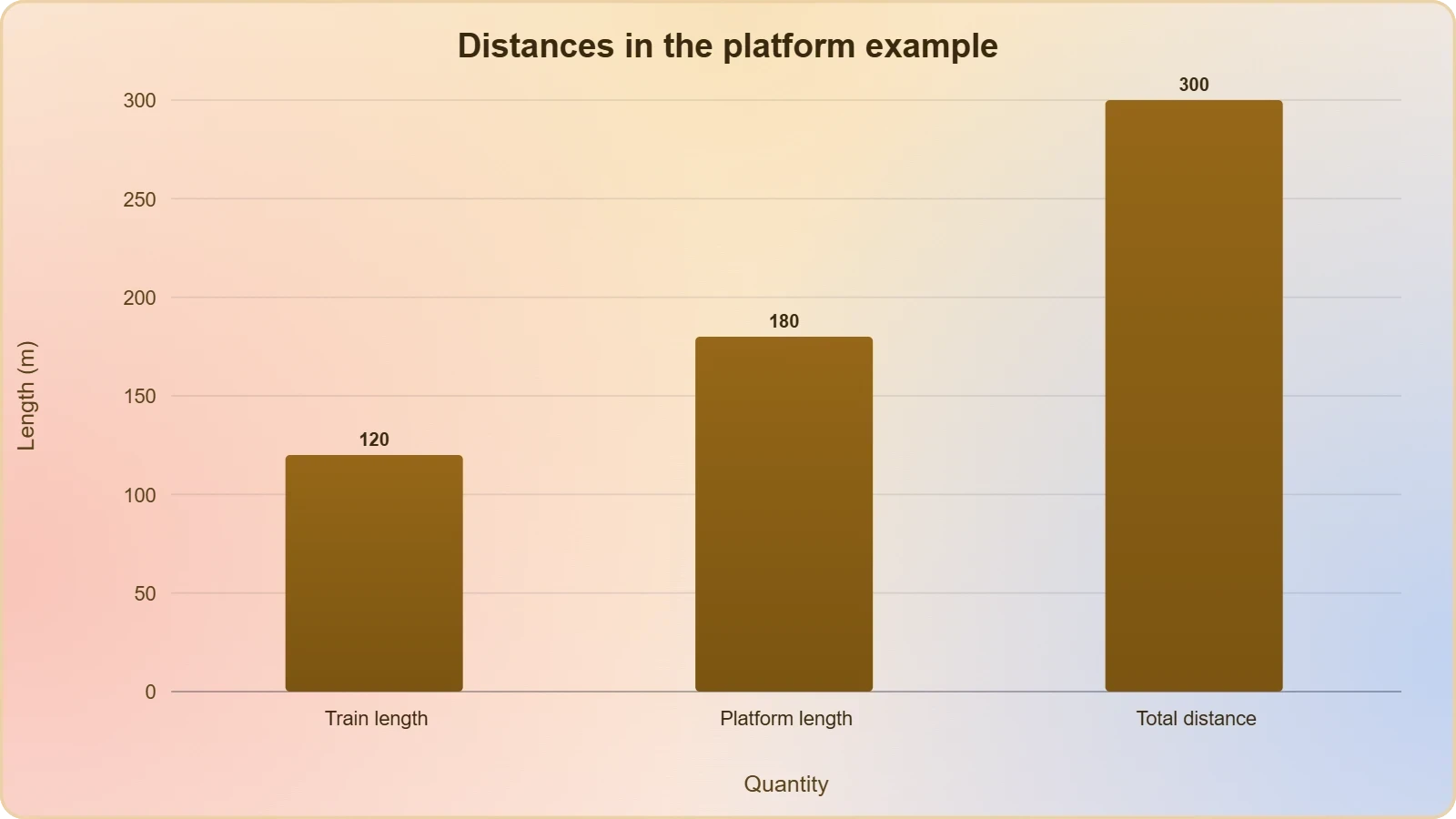
Consider a train one hundred and twenty metres long that passes a pole in eight seconds and a platform in twenty seconds. The speed is fifteen metres per second, so the platform crossing covers three hundred metres in total, leaving a platform length of one hundred and eighty metres. The reasoning is transparent and easily replicated.
Reverse Problems: Finding Length or Speed
Examiners frequently invert the standard question, supplying the crossing times and asking for the train's length or speed. These reverse problems reward candidates who treat the fundamental relation as a flexible tool rather than a fixed recipe. The algebra is elementary, but the setup demands careful reading of what is known and what is sought.
Two Equations From Two Crossings
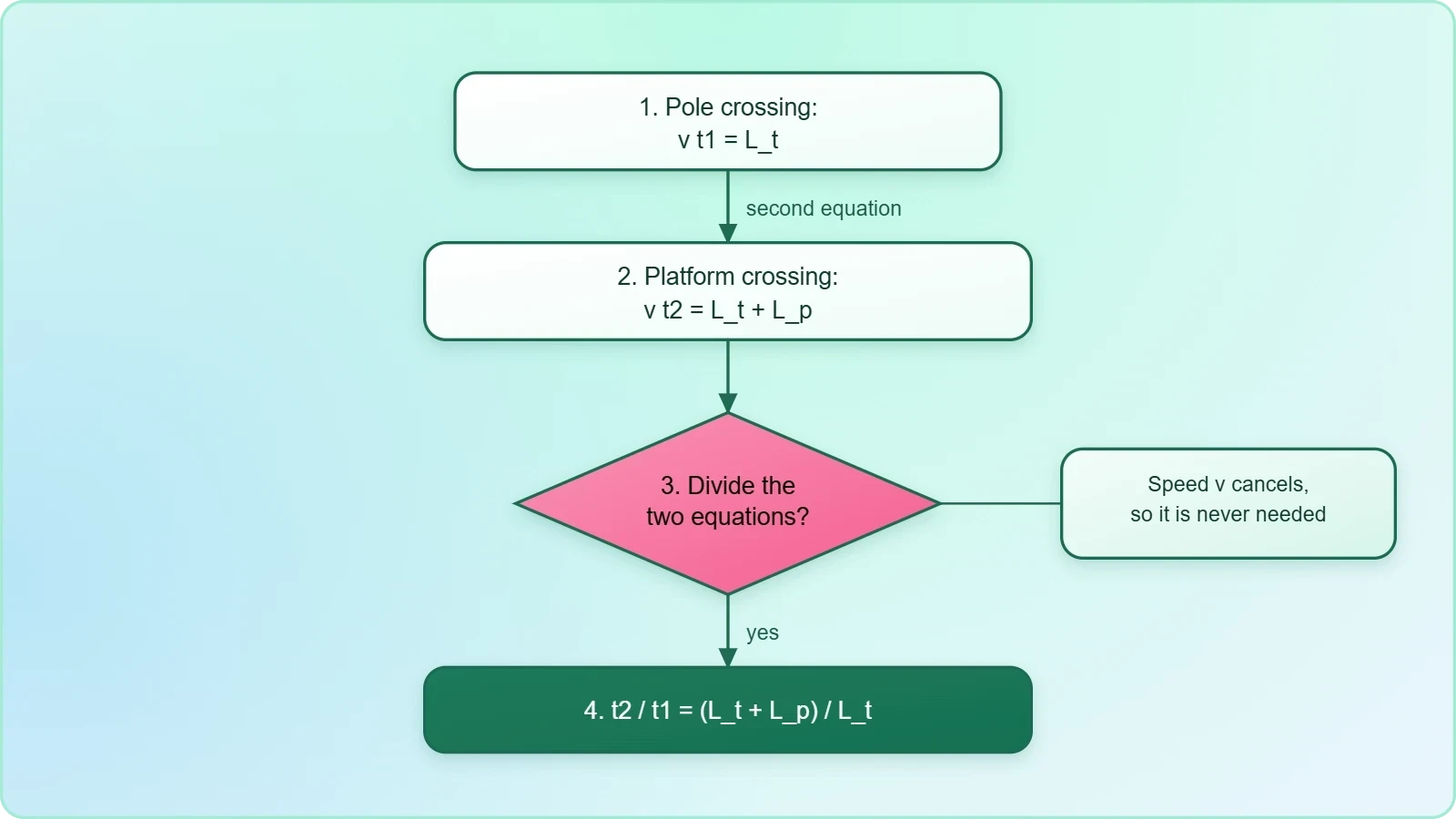
When both the pole crossing time and the platform crossing time are given, two equations emerge from the same unknown speed. Dividing one by the other eliminates the speed and exposes the ratio of the distances, which in turn yields the train's length. This technique is elegant and appears regularly in competitive papers.
Let the pole time be ##t_1## and the platform time be ##t_2##. Then ##v t_1 = L_t## and ##v t_2 = L_t + L_p##, so the ratio ##\frac{t_2}{t_1}## equals ##\frac{L_t + L_p}{L_t}##. Solving this proportion for ##L_t## completes the problem without ever computing the speed explicitly.
Worked Example With Unknown Length
A train crosses a pole in five seconds and a two-hundred-metre platform in fifteen seconds. The ratio of times is three, so the total distance is three times the train's length, meaning the platform contributes twice the train's length. The train is therefore one hundred metres long, and its speed is twenty metres per second.
Examination Strategy and Common Pitfalls
Accuracy in this topic depends as much on disciplined reading as on algebraic skill. Questions conceal crucial details in a single word, and a misread obstacle type can invalidate an otherwise flawless calculation. The strategy below distils the habits that consistently separate high scorers from candidates who run out of time.
Reading the Question With Precision
Identify whether the obstacle is a pole, a platform, a bridge, or a tunnel, because each determines the effective distance. Note whether the train's length is given or must be derived, and check whether the speed is supplied in kilometres per hour or metres per second. These three checks take seconds and prevent most errors.
Watch for phrases such as "completely crosses" or "just clears", which signal that the full train length must be included. Occasionally a question asks how long the train takes to pass a point after its engine has entered a platform, which requires a different distance entirely. Careful parsing of the wording is therefore non-negotiable.
Verifying Answers Before Moving On
A quick sanity check catches most mistakes: a train crossing a platform should always take longer than crossing a pole at the same speed. If the computed platform time is shorter, the distance or the units have been mishandled. This simple comparison costs almost nothing and protects valuable marks.
Candidates should also confirm that the final answer is expressed in the unit the question demands. A correct computation reported in the wrong unit may still be marked wrong in automated tests. Building the verification habit during practice ensures it becomes automatic under examination conditions.
Consolidating the Method and Preparing for Moving Trains
The method developed across this lesson rests on one durable insight: the effective distance depends on what the train must completely pass. Stationary objects of negligible width contribute nothing to the distance, while objects with length add their full extent. Every formula encountered here is a direct consequence of that single principle, applied with consistent units.
A Compact Summary of the Procedure
Begin by classifying the obstacle and writing the effective distance. Convert the speed to metres per second if any length is given in metres. Apply the fundamental relation to find the unknown, then verify that the answer is plausible and expressed in the required unit. This four-step sequence handles every problem in the lesson.
Practise with varied numbers until the sequence becomes reflexive, because speed of execution matters as much as correctness in competitive settings. The quizzes accompanying this lesson are calibrated to build that fluency progressively, moving from single-step pole questions to multi-step platform and reverse problems.
Looking Ahead to Trains Crossing Each Other
The next lesson extends the framework to two moving bodies, where the relative speed of the previous lesson returns to prominence. The distance logic remains identical, but the speed term becomes a sum or difference depending on direction. Candidates who have mastered the present material will find that transition natural and well within reach.
For now, consolidate the stationary-object case thoroughly, since it supplies the distance reasoning on which all subsequent train problems depend. A firm grasp of poles and platforms is the foundation on which the more intricate relative-motion cases are built, and that foundation deserves deliberate, repeated practice.
Also Read
- No links available.
From our network :
- How to migrate to postgres using logical replication and cutover
- How to secure postgres connections across VPC, VPN, and cloud
- Limits: The Squeeze Theorem Explained
- How to design postgres partitions with native and hash methods
- Bitcoin Hits $100K: Crypto News Digest
- JD Vance Charlie Kirk: Tribute and Political Strategy
- Limit Superior and Inferior
- The Diverse Types of Convergence in Mathematics
- Bitcoin price analysis: Market signals after a muted weekend
RESOURCES
- No results found.