Boats and streams problems translate one of the oldest intuitions in physics into a compact arithmetic discipline: a vessel never travels through still water alone, because the river itself is always moving beneath it. Every competitive examination that tests quantitative aptitude eventually asks candidates to reason about this quiet tug-of-war between a boat's own effort and the current's persistent push. The lesson that follows treats that relationship as a small, elegant system rather than a bag of tricks, so that each formula emerges from a single mental picture instead of arriving as a memorised fragment.
This seventh lesson in the time, speed and distance sequence deliberately narrows its focus. Earlier sessions established how uniform motion behaves and how trains negotiate crossings with other trains, where relative speed governs every outcome. Here the same relative-speed logic reappears in a fluid setting, but the direction of the medium now matters, and that single change reshapes the algebra in ways examiners love to probe. Candidates who understand why upstream speed subtracts and downstream speed adds will rarely misapply either.
By the close of this lesson, a reader should be able to convert a word problem into two clean equations, recover the boat's still-water speed and the stream's rate from any pair of journey times, and recognise the classic traps involving equal distances and fixed time budgets. The treatment stays deliberately practical, anchored to examination patterns, yet it preserves the underlying reasoning so that unfamiliar variants remain solvable rather than intimidating.
On This Page
The Physical Picture Behind Boats and Streams
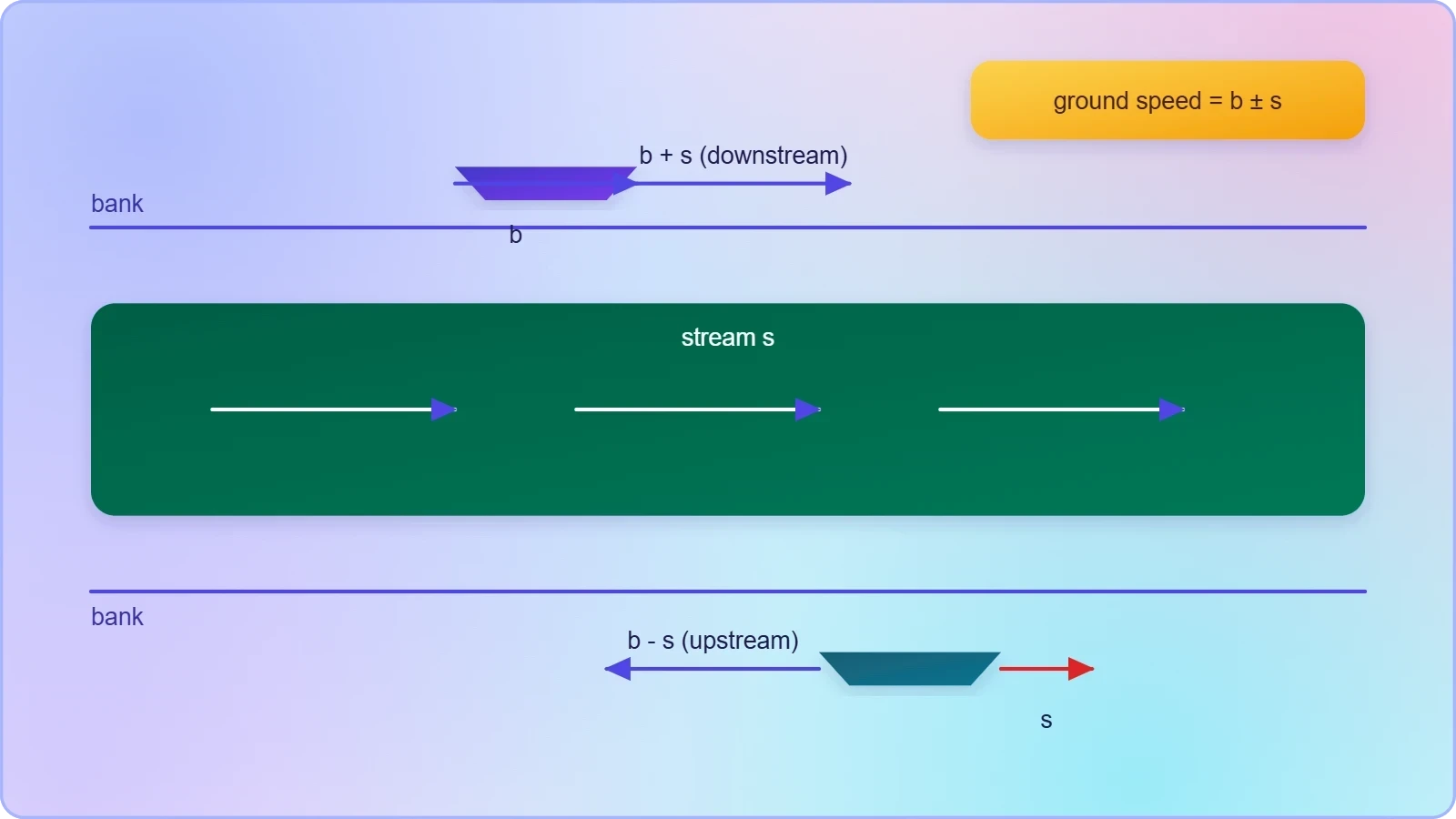
Imagine standing on a riverbank watching a rowing boat head upstream. The rower pulls steadily, yet the boat advances more slowly than it would on a lake, because the current continuously cancels part of that effort. Turn the boat around and the same stroke now benefits from the water's motion, producing a visibly faster passage downstream. This asymmetry is the entire subject in miniature.
Defining Still-Water Speed and Stream Speed
The boat's speed in still water, conventionally written ##b##, represents the rate the vessel would achieve against no current at all. The stream speed, written ##s##, describes how fast the water itself moves relative to the bank. Both quantities are measured in the same units, typically kilometres per hour, and both are assumed constant throughout a problem unless stated otherwise.
When the boat points downstream, the two velocities align, so the effective ground speed becomes ##b + s##. Pointing upstream reverses the water's contribution, giving ##b - s##. These two expressions are the foundation on which every subsequent calculation rests, and they remain valid only while ##b > s##, since a boat slower than the current cannot make headway upstream at all.
Why Relative Motion Explains Everything
The reasoning mirrors the train-crossing problems from the previous lesson, where two moving bodies combined or opposed their speeds depending on direction. A stream is simply another moving frame, and the boat's motion relative to the bank is the vector sum of its own velocity and the water's. Recognising this continuity prevents the topic from feeling like an isolated set of rules.
Because distance, speed and time remain linked by the familiar relation ##d = v \times t##, each direction yields its own equation. Downstream journeys satisfy ##d = (b + s)t_{down}##, while upstream journeys satisfy ##d = (b - s)t_{up}##. Two such equations, drawn from a single round trip, are usually sufficient to determine both unknowns completely.
Deriving the Two Master Equations
Every standard problem in this topic reduces to a pair of simultaneous equations, and deriving them once from first principles removes the need for rote recall. Suppose a boat covers a fixed distance ##d## downstream in time ##t_1## and returns upstream in time ##t_2##. Writing the two distance relations side by side produces a system that can be solved by simple addition and subtraction.
Adding and Subtracting the Directional Speeds
Adding the downstream and upstream speeds eliminates the stream term entirely, yielding twice the still-water speed. Subtracting them eliminates the boat term, leaving twice the stream speed. This symmetry is why the averaging formulas in the table above work, and it explains why examiners so often supply a downstream speed and an upstream speed as the raw data.
Once these two values are known, any further question becomes straightforward substitution. A candidate asked for the time to cover a new distance, or for the distance covered in a given interval, simply selects the appropriate directional speed and applies the distance relation. The algebra never grows beyond this point.
Working Through a Complete Example
Consider a boat that travels sixty kilometres downstream in three hours and returns the same distance upstream in five hours. Downstream speed is therefore twenty kilometres per hour, and upstream speed is twelve. Applying the identities gives a still-water speed of sixteen and a stream speed of four, both comfortably consistent with the original data.
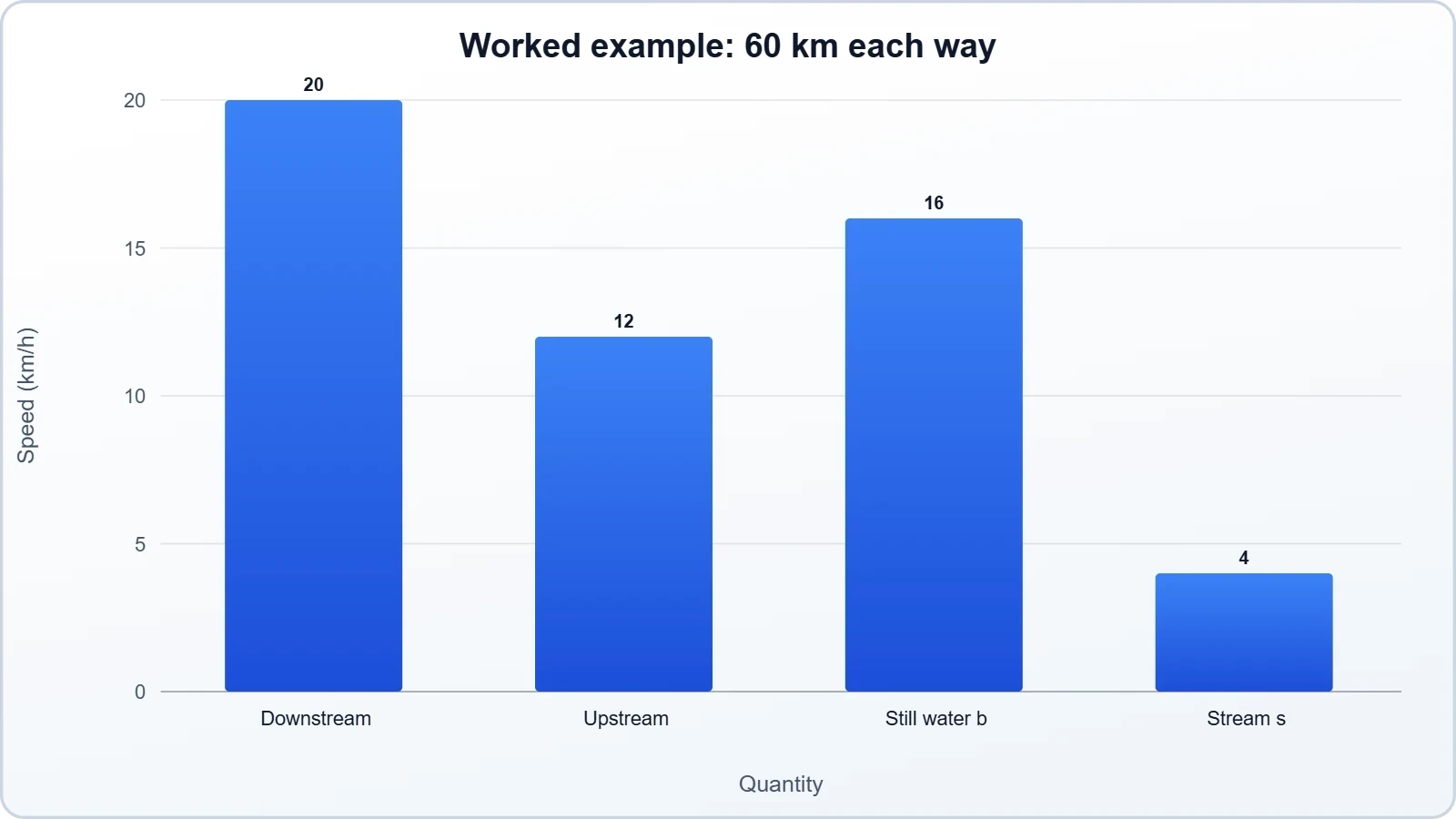
Verification matters here, because a careless sign error can produce a plausible but wrong stream speed. Substituting sixteen and four back into the directional expressions returns twenty and twelve, confirming the solution. Candidates who habitually perform this check catch most arithmetic slips before they cost marks in a timed paper.
Average Speed on a Round Trip
A common examination twist asks for the average speed over a complete out-and-back journey rather than the speed in either direction. Candidates instinctively average the two directional speeds, which is wrong whenever the times differ. The correct treatment uses total distance divided by total time, and the resulting expression is the harmonic mean of the two speeds.
The Harmonic Mean Result
If the downstream speed is ##b+s## and the upstream speed is ##b-s##, and the one-way distance is ##d##, the total time is the sum of the two directional times. Dividing the round-trip distance by that total produces a compact formula worth remembering, because it appears repeatedly in aptitude papers.
This result carries an important qualitative message: the average round-trip speed is always less than the still-water speed whenever a current exists. The upstream leg, being slower, occupies more time, and time-weighted averaging therefore pulls the mean downward. Recognising this immediately eliminates several multiple-choice distractors.
Applying the Formula Under Time Pressure
Suppose a boat's still-water speed is ten kilometres per hour and the stream runs at two. The round-trip average becomes ##(100 - 4)/10##, or 9.6 kilometres per hour, comfortably below ten. A candidate who instead averaged twelve and eight would answer ten and fall straight into the trap the examiner designed.
Speed of execution matters in competitive settings, so the formula should be internalised rather than rederived. Nevertheless, understanding its origin protects against misapplication when a problem supplies times instead of speeds, a variation that demands a return to first principles rather than blind substitution.
Unit Conversions and Consistency Checks
Stream problems frequently mix units, offering a distance in kilometres, a time in minutes, and a speed in metres per second. The arithmetic is trivial once the units align, yet misalignment is among the most common sources of lost marks. A disciplined conversion step before any equation is written pays for itself many times over.
Converting Between Kilometres and Metres per Second
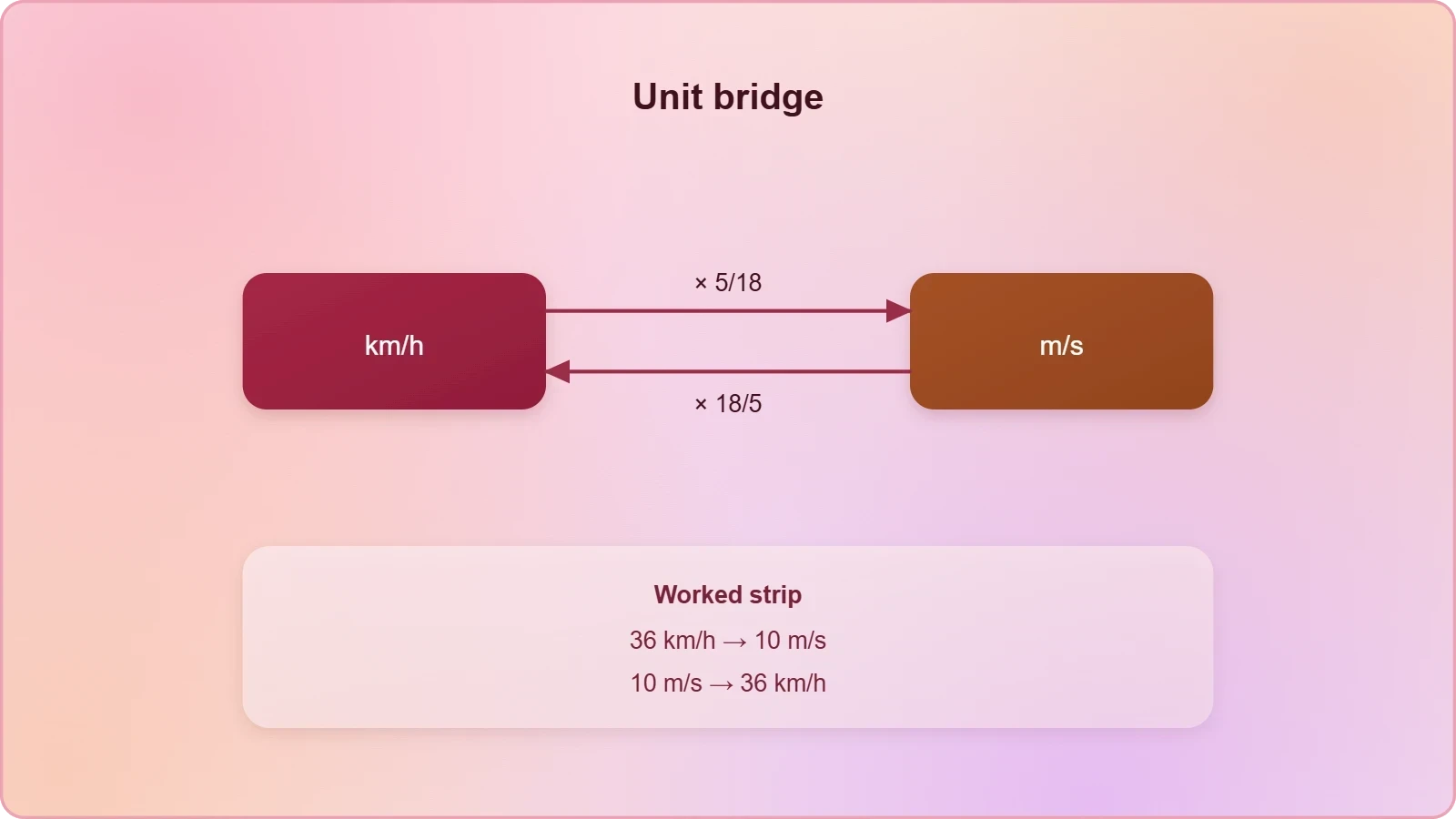
The standard bridge between the two systems is the factor ##\frac{5}{18}##, which converts kilometres per hour into metres per second. Multiplying by ##\frac{18}{5}## reverses the operation. Candidates should apply this conversion at the very start, before setting up equations, so that every quantity in the working shares a single unit.
def solve_boat_stream(downstream_kmh, upstream_kmh):
    """Return still-water speed and stream speed from directional speeds."""
    boat = (downstream_kmh + upstream_kmh) / 2
    stream = (downstream_kmh - upstream_kmh) / 2
    if stream < 0:
        raise ValueError("Upstream speed cannot exceed downstream speed")
    return boat, stream

def kmh_to_ms(speed_kmh):
    return speed_kmh * 5 / 18

boat, stream = solve_boat_stream(20, 12)
print(f"Boat: {boat} km/h, Stream: {stream} km/h")
print(f"Boat in m/s: {kmh_to_ms(boat):.2f}")
Sanity Checks Before Submitting an Answer
Three quick checks catch nearly every error. First, the still-water speed must exceed the stream speed, otherwise upstream travel is impossible. Second, the downstream speed must exceed the still-water speed, and the upstream speed must fall below it. Third, the average of the two directional speeds must equal the still-water speed exactly.
These constraints are not merely academic; they reflect the physical reality that a current can only assist or oppose, never do both simultaneously. A candidate who internalises them develops an instinct for implausible answers, which is precisely the instinct that separates confident scorers from those who second-guess every response.
Classic Examination Patterns and Traps
Examiners recycle a small number of structural patterns, and familiarity with them converts a daunting section into a predictable one. The most frequent asks for the still-water speed given two directional speeds, or for the stream speed given a round-trip time and a still-water speed. Both yield to the identities already established.
Equal Distances With Unequal Times
When a problem states that a boat takes twice as long upstream as downstream over the same distance, the ratio of speeds is immediately known. If the upstream time is double, the upstream speed is half the downstream speed, and the ratio ##(b-s):(b+s)## equals one to two. Solving this ratio yields the relationship between boat and stream speeds directly.
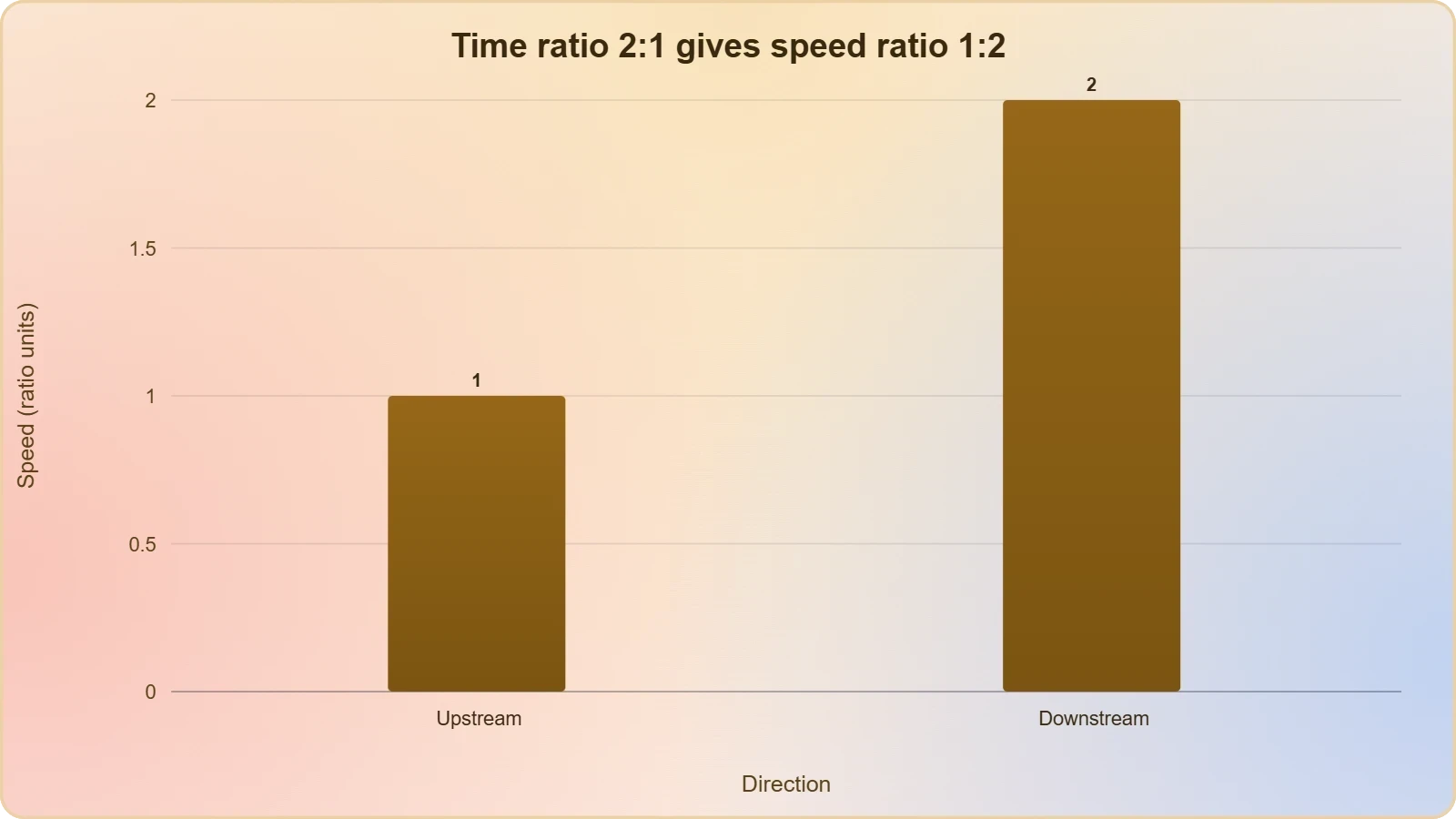
This ratio technique generalises beautifully. A time ratio of ##m:n## implies a speed ratio of ##n:m##, and combining that with the sum or difference of the directional speeds determines both unknowns. Candidates who master this shortcut save considerable time on multi-part questions where the arithmetic would otherwise be laborious.
Boats Meeting and Overtaking on a River
Two boats moving in opposite directions on the same river approach each other at a combined speed that includes both boats' still-water speeds but cancels the stream entirely. This elegant cancellation surprises many candidates, yet it follows directly from the vector addition: one boat gains the current while the other loses it by an identical amount.
Boats travelling in the same direction, by contrast, separate at a rate equal to the difference of their still-water speeds, again with the stream cancelling. These results connect naturally to the relative-motion reasoning of the previous lesson and anticipate the circular-track problems that follow, where meeting and passing recur in a closed loop.
Practice Set and Consolidation
Consolidation requires active retrieval rather than passive review, so the closing section offers a short set of representative problems. Each one targets a distinct pattern from the lesson, and each can be solved in under ninety seconds once the underlying identities are secure. Attempt them before reading the guidance that follows.
Five Targeted Problems
A boat covers thirty kilometres downstream in two hours and returns in three hours; find both speeds. A second problem gives a still-water speed of fourteen and a stream of three, asking for the round-trip average. A third supplies only a time ratio of three to five over equal distances and demands the ratio of boat to stream speed.
The fourth asks how long a boat with still-water speed nine takes to travel twenty-four kilometres upstream when the stream runs at three. The fifth involves two boats approaching from opposite banks, requiring the time until they meet. Working through all five builds the fluency that timed examinations demand.
Connecting Forward to Circular Tracks
The relative-motion machinery developed here transfers almost unchanged to the next lesson, where boats or runners traverse a closed circular track. Meeting and overtaking on a loop depend on the same additive and subtractive logic, with the circumference replacing the river's length as the governing distance.
Before moving on, ensure that the two master equations, the harmonic mean result, and the cancellation principle for opposing boats are all reproducible from memory. These four ideas constitute the durable core of the topic, and everything else in examination papers is a variation upon them.
Also Read
- No links available.
From our network :
- The Diverse Types of Convergence in Mathematics
- How to secure postgres connections across VPC, VPN, and cloud
- JD Vance Charlie Kirk: Tribute and Political Strategy
- Bitcoin price analysis: Market signals after a muted weekend
- Limit Superior and Inferior
- Bitcoin Hits $100K: Crypto News Digest
- How to design postgres partitions with native and hash methods
- How to migrate to postgres using logical replication and cutover
- Limits: The Squeeze Theorem Explained
RESOURCES
- No results found.