Race problems occupy a distinctive corner of quantitative aptitude because they translate the familiar mechanics of speed and distance into the language of competition. Instead of asking simply when two travellers meet, a race question asks who wins, by how much, and under what negotiated conditions. The vocabulary itself carries precision: a runner "beats" an opponent by a stated margin, or concedes a "head start" measured in metres or seconds. Mastering this vocabulary is the first step toward solving such questions with confidence and speed.
What makes races genuinely interesting is that they combine two separate ideas students have already met. The first is uniform motion along a fixed course, where distance equals speed multiplied by time. The second is relative motion, where the gap between two competitors changes at a rate determined by the difference of their speeds. A race problem is essentially a controlled experiment in both, and the examiner's skill lies in disguising which concept applies. Recognising the disguise quickly is the real skill being tested.
This lesson builds directly on circular track work, where meeting and passing points were analysed through relative speed. Here the track becomes a straight course with a finish line, and the questions shift toward margins of victory and negotiated advantages. Every formula below is derived rather than memorised, because examiners constantly vary the framing. By the end, you should be able to convert any race statement into a clean ratio of speeds and solve it in under a minute.
On This Page
The Language of Races: Beats, Dead Heats, and Margins
A race is formally defined as a contest over a fixed distance in which competitors start together and the first to reach the finish line wins. The winner's time and the loser's time differ, and that difference generates every quantity the examiner can ask about. Before touching formulas, students must internalise three terms: beat, dead heat, and margin. Each term describes a distinct relationship between the competitors' finishing moments.
Defining "Beats By" in Distance and in Time
When we say A beats B by 10 metres in a 100-metre race, we mean that at the instant A crosses the finish line, B is exactly 10 metres behind. B has therefore covered only 90 metres in the same elapsed time. This single observation converts immediately into a ratio of speeds, because time is common to both runners. The ratio of distances covered in equal time equals the ratio of their speeds.

The same result can be expressed in time instead of distance. If A beats B by 2 seconds, then B requires 2 seconds more than A to complete the full course. Both statements describe the same underlying speed ratio, and examiners freely switch between them. A useful habit is to translate every "beats by time" statement into a distance statement before solving, or vice versa, whichever yields cleaner numbers.
Dead Heats and the Meaning of a Tie
A dead heat occurs when two competitors reach the finish line at precisely the same instant. In speed terms, this means their speeds are equal over the course, assuming identical starting conditions. Questions involving dead heats usually introduce a handicap that breaks the tie, asking what adjustment would have produced a winner. The mathematics is trivial once the tie is recognised as an equality of times.
Examiners sometimes disguise a dead heat inside a conditional statement, such as "A would have won had the race been 5 metres longer." Such phrasing signals that the speeds differ but the finishing times coincided over the stated distance. Setting the two time expressions equal and solving for the unknown distance or speed is the standard route. Careful reading, not computation, is where most marks are lost here.
Head Starts: Concessions Measured in Metres or Seconds
A head start is a negotiated advantage given to one competitor before the race begins, and it appears in two flavours. A start in metres places the favoured runner ahead of the starting line, so the course is shortened for them. A start in seconds releases the favoured runner earlier, so they run for longer. Both flavours reduce to the same algebra once the concession is expressed as a distance or a time offset.
Converting a Metre Start into a Speed Ratio
Suppose A gives B a start of 20 metres in a 200-metre race, and A still wins by 10 metres. At the moment A finishes, B has covered 200 minus 20 minus 10, which is 170 metres. The ratio of speeds is therefore 200 to 170, or 20 to 17. The concession simply shifts B's effective starting point, and the finishing margin is measured from B's adjusted position.
The common error is to subtract the head start twice or to forget that the margin is measured at A's finishing instant. A disciplined approach writes down, for each runner, the distance actually covered when the winner finishes. Those two distances, divided by the common time, give the speed ratio directly. Every metre-start problem yields to this single method, however elaborate the wording.
Converting a Time Start into a Distance Offset
A start in seconds is subtler because the runners are not on the course simultaneously for the whole race. If A gives B a start of 3 seconds and still wins by 5 metres, then B ran for 3 seconds longer than A yet covered 5 metres less. The speed ratio follows from equating the two runners' times over their respective distances, with the 3-second offset inserted explicitly.
Let A's speed be ##v_A## and B's speed be ##v_B##, with course length ##D##. A's time is ##D/v_A##, while B's time is ##(D-5)/v_B##, and the difference is 3 seconds. One equation, two unknowns, so a second condition is always supplied, usually the margin in a different race or a stated ratio. Solving the pair is mechanical once the offset is written correctly.
The Master Ratio: Distances Covered in Equal Time
Every race problem, however dressed, rests on one principle: when two bodies move for the same duration, the distances they cover are in the same ratio as their speeds. This principle is the engine of the entire topic. Once a question is reduced to a statement about distances covered in a common interval, the arithmetic becomes simple proportion. The examiner's difficulty lies entirely in identifying that common interval.
Deriving the Ratio from First Principles
Let A and B run a course of length ##D## with speeds ##v_A## and ##v_B##, where ##v_A > v_B##. A finishes at time ##t_A = D/v_A##. At that instant B has covered ##v_B \cdot t_A##, which equals ##D \cdot v_B / v_A##. The margin of victory is therefore the difference between ##D## and this quantity, a clean expression in the speed ratio alone.
This formula shows that the margin scales linearly with course length for a fixed speed ratio. Double the distance and the margin doubles, a fact examiners exploit when asking about longer races between the same runners. It also shows that the margin is zero precisely when the speeds are equal, confirming the dead heat case. Memorising the derivation is far safer than memorising the formula.
Chaining Ratios Across Multiple Races
Many questions describe three runners and two separate races, then ask for a comparison between the first and third. The technique is to chain ratios: if A beats B in ratio ##a:b## and B beats C in ratio ##b:c##, then A beats C in ratio ##a:c##. The middle runner acts as a bridge, and the common term cancels. This is the same ratio-chaining logic used in work and time problems.
The trap is that the two races may have different lengths, so the ratios must first be normalised to a common course. A ratio of 100:90 in a 100-metre race is identical to 200:180 in a 200-metre race, but mixing them carelessly produces nonsense. Always express each ratio as speeds, not as raw distances, before chaining. Once normalised, the chain is straightforward and the answer emerges in one line.
Games and the Handicap System
The word "game" in this topic refers to a contest where a handicap is imposed to equalise unequal competitors, making the outcome genuinely uncertain. A handicap is not a courtesy but a mathematical adjustment designed so that the adjusted speeds produce a dead heat. Questions about games therefore ask what handicap would make the contest fair, or what handicap was applied given the observed result. The logic is the inverse of the beats problem.
Designing a Fair Handicap
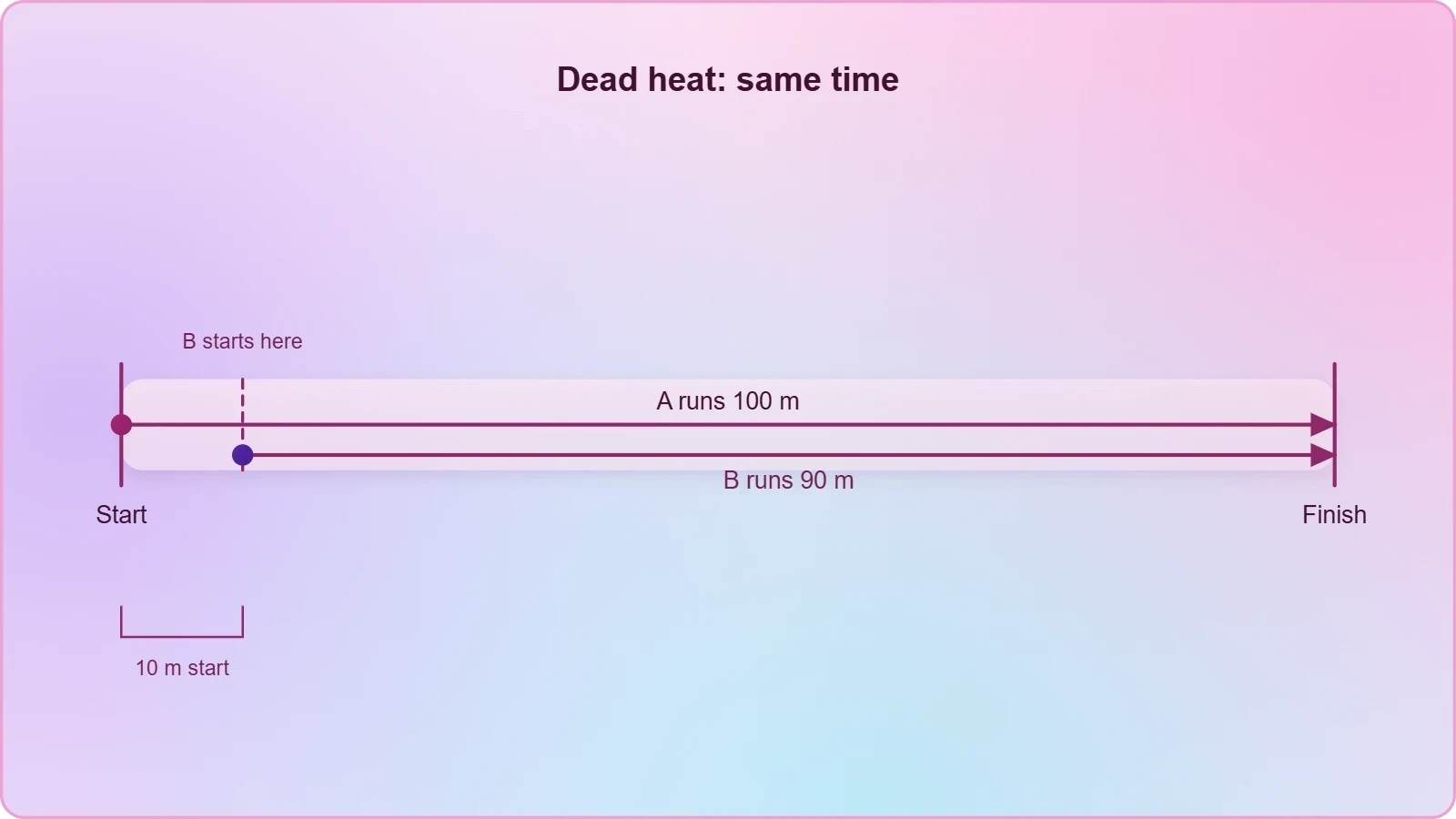
Suppose A is known to be faster than B by a ratio of 10:9 over 100 metres. To make the race fair, A must concede enough advantage that both finish together. Giving B a start of 10 metres achieves exactly this, since B then runs 90 metres while A runs 100, matching the speed ratio. The fair handicap is therefore the margin A would otherwise win by.
If the handicap is expressed in time rather than distance, the calculation requires the actual speeds, not merely their ratio. A start of ##t## seconds is fair when ##t## equals the difference in finishing times over the full course. This is why time handicaps demand one absolute speed value, while distance handicaps need only the ratio. Examiners test this distinction frequently, and it separates careful solvers from hurried ones.
Reading a Handicap Result Backwards
Sometimes the question supplies the handicap and the outcome, then asks for the intrinsic speed ratio. For instance, A gives B 15 metres in a 150-metre race and wins by 5 metres. B's covered distance at A's finish is 150 minus 15 minus 5, which is 130 metres. The speed ratio is 150:130, or 15:13, and the handicap has been decoded.
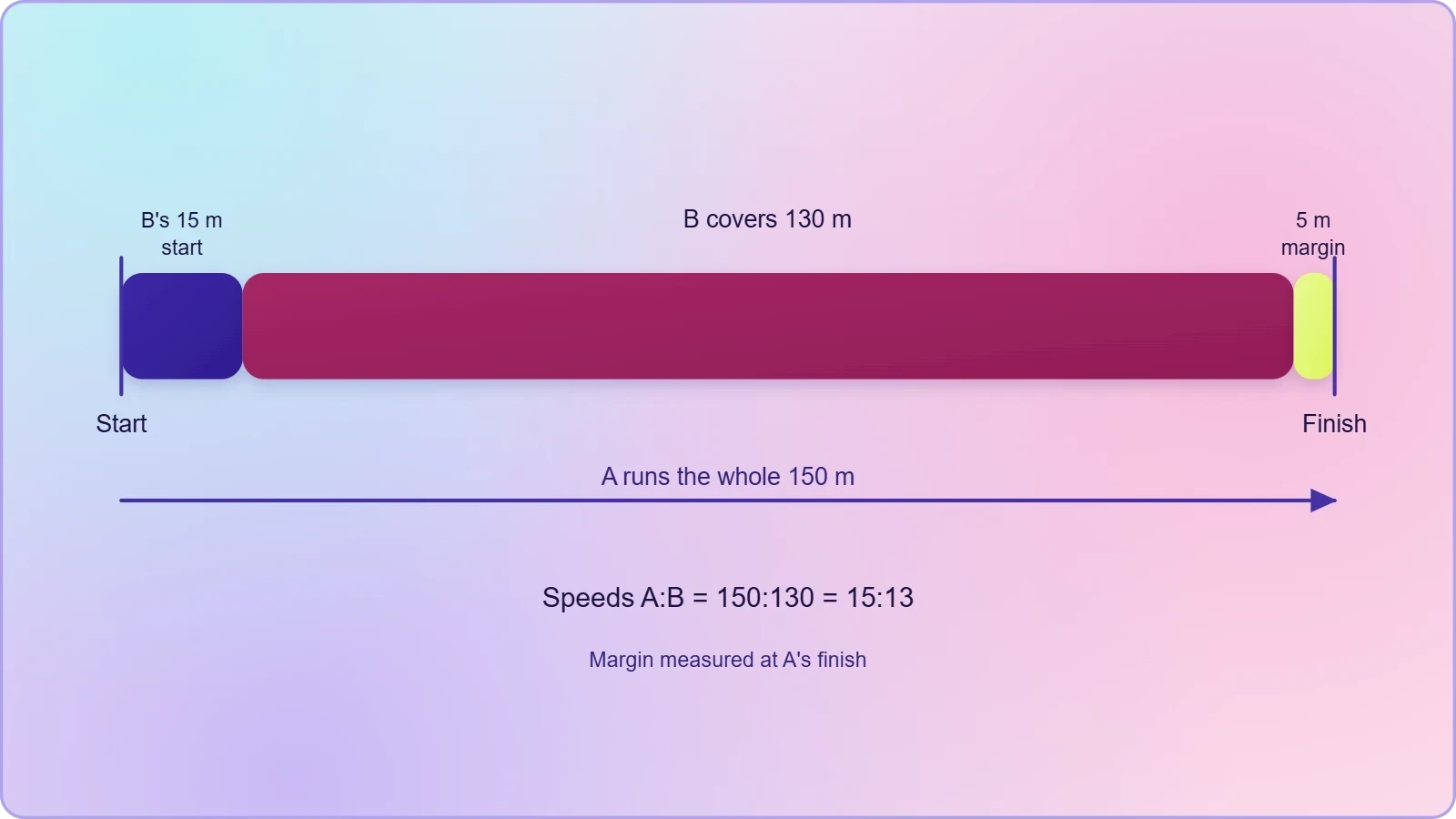
This backward reading is the most examinable skill in the lesson because it combines interpretation with arithmetic. The discipline required is to track three quantities separately: the course length, the concession, and the observed margin. Confusing any two of them produces a plausible but wrong ratio. Writing the three numbers explicitly before computing eliminates the error almost entirely.
Worked Problems and Exam Technique
Speed in the examination hall comes from pattern recognition, not from raw computation. Race questions fall into a small number of recurring templates, and each template has a standard opening move. The solver who recognises the template within ten seconds gains a decisive advantage over one who starts writing equations immediately. This section catalogues the templates and demonstrates the opening moves with fully worked examples.
Template One: The Single Race with a Stated Margin
A runner covers 500 metres in the time another covers 450 metres. The first beats the second by how much in a 1000-metre race? The speed ratio is 10:9, so in 1000 metres the slower runner covers 900 metres. The margin is therefore 100 metres. The entire problem dissolves in two lines once the ratio is extracted.
Notice that the original 500-metre figures were irrelevant beyond establishing the ratio. Examiners deliberately supply numbers that do not match the final course length to test whether the solver understands the principle. A solver who mechanically scales the 50-metre margin to 100 metres without checking the ratio may still succeed, but only by luck. Understanding the ratio makes the result certain.
Template Two: The Handicap with a Residual Margin
A gives B 40 metres in a 400-metre race and beats B by 20 metres. What start should A give B to make the race a dead heat? At A's finish, B has covered 400 minus 40 minus 20, which is 340 metres. The speed ratio is 400:340, or 20:17. For a dead heat, B must cover 17/20 of the course while A covers the whole, so B's start must be 60 metres.
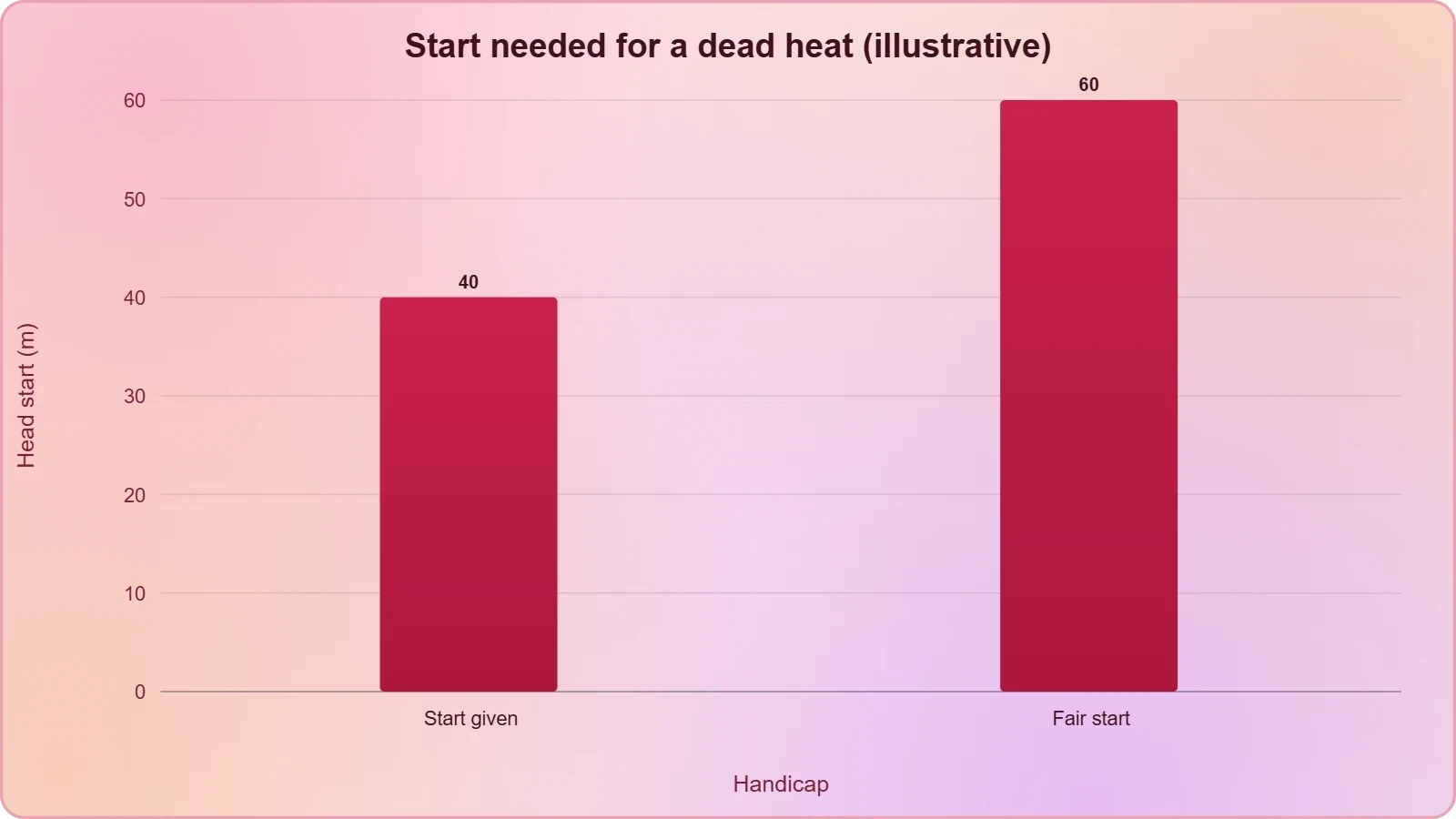
The final step deserves attention: the fair start equals the course length multiplied by one minus the speed ratio. Here that is 400 times 3/20, which is 60 metres. This compact formula, derived from the ratio, handles every variant of the template. Deriving it once and reusing it under time pressure is far more reliable than re-deriving it in the exam hall.
From Races to the Final Lesson: Preparing for Timed Solving
Race problems reward a particular kind of preparation: the kind that builds reflexes rather than knowledge. The concepts in this lesson are few, but the framings are many, and fluency comes from repeated exposure to varied wording. A student who has solved thirty race problems across all templates will recognise the structure of a new one almost instantly. That recognition is worth more than any formula sheet.
Common Errors and How to Eliminate Them
The most frequent error is measuring the margin at the wrong instant, typically at the loser's finish rather than the winner's. The second is double-counting the head start, subtracting it once as a concession and again as part of the margin. The third is chaining ratios without normalising them to a common course length. Each error has a simple antidote: write the three quantities explicitly before computing.
A fourth error deserves mention because it is subtle. When a time start is involved, solvers often treat the offset as a distance and divide it by a speed, producing a dimensionally confused result. The offset must be added to or subtracted from a time, never a distance. Checking the units of every intermediate quantity catches this error immediately and costs only a few seconds.
Setting Up for Exam-Focused Problem Solving
The next lesson turns to exam-focused problem solving and time management, where the techniques from this lesson become tools under pressure. Races will reappear there as one component of a mixed set, and the ability to classify a question in seconds will determine how many can be attempted. Practising classification separately from solving is therefore a worthwhile investment now.
A practical routine is to take ten race problems, classify each without solving, and check the classifications against the solutions. This trains the recognition reflex in isolation. Once classification is reliable, solving follows quickly because the opening move is already known. The final lesson will build on exactly this foundation, adding pacing and selection strategy on top.
Race problems ultimately test a single intellectual habit: the willingness to translate words into ratios before reaching for algebra. Every template in this lesson, from the simple margin to the fair handicap, yields to that habit. Students who internalise it will find the topic among the most reliable sources of marks in the quantitative section. The next lesson will show how to deploy it under the clock.
Also Read
- No links available.
From our network :
- How to secure postgres connections across VPC, VPN, and cloud
- How to migrate to postgres using logical replication and cutover
- The Diverse Types of Convergence in Mathematics
- Bitcoin Hits $100K: Crypto News Digest
- JD Vance Charlie Kirk: Tribute and Political Strategy
- How to design postgres partitions with native and hash methods
- Limits: The Squeeze Theorem Explained
- Limit Superior and Inferior
- Bitcoin price analysis: Market signals after a muted weekend
RESOURCES
- No results found.