Circular track problems occupy a distinctive place in the quantitative aptitude syllabus because they transform the familiar arithmetic of speed and time into geometry-driven reasoning. Instead of asking simply how long two travellers take to cover a fixed stretch of road, these questions ask when runners, cyclists, or hands of a clock will coincide again on a closed loop. The shift sounds minor, yet it changes the entire problem architecture: distance becomes circumference, direction becomes decisive, and the notion of a "meeting" splits into two separate phenomena that examiners love to test.
This lesson builds directly on the relative speed machinery developed in the preceding session on boats and streams, where currents either aided or opposed a vessel's motion. On a circular track, that same additive and subtractive logic returns, but now the opposing or assisting force is another moving body rather than a river. Mastering this distinction allows candidates to convert an intimidating visual scenario into a clean arithmetic statement within seconds, which is precisely the speed advantage competitive examinations reward.
By the end of this lesson, you will be able to compute first meeting times, identify the exact points where runners coincide, determine how many distinct meeting points exist for a given speed ratio, and handle the classic clock-hand variants that appear in nearly every aptitude paper. Each concept is paired with worked reasoning and a targeted quiz so that the underlying logic, not memorised formulas, becomes your reliable tool under exam pressure.
On This Page
Why Circular Motion Changes the Arithmetic of Speed
On a straight road, two bodies moving in the same direction with different speeds will meet exactly once, and only if the faster one starts behind. A closed loop removes that constraint entirely, because motion repeats indefinitely and every lap resets the geometry. The result is an infinite sequence of meetings governed by a single repeating interval, which candidates must learn to calculate rather than enumerate.
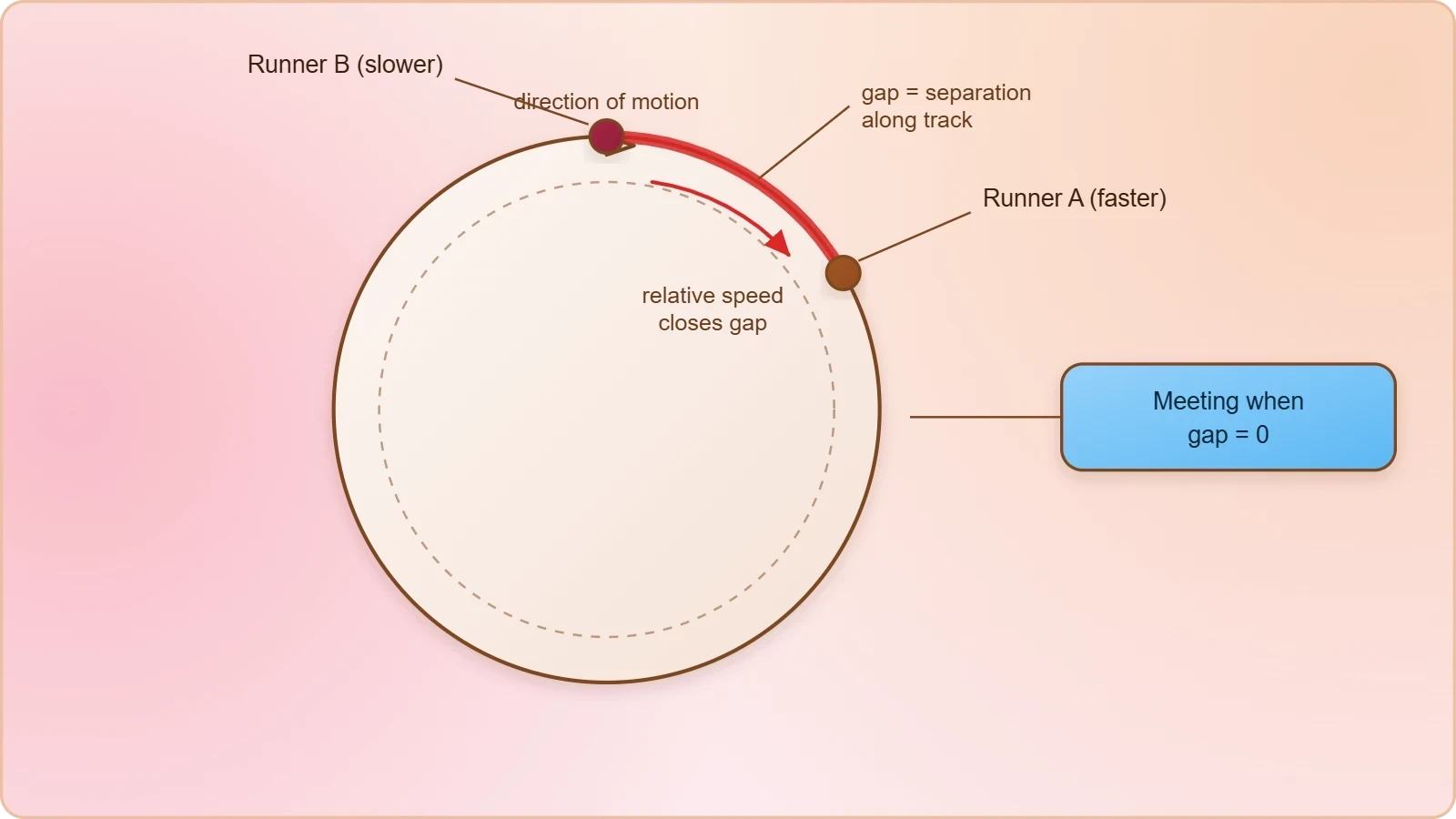
The essential reframing is that distance no longer means the length of the path travelled, but the separation between bodies measured along the circumference. When two runners are separated by a gap, closing that gap is what produces a meeting, and the gap itself is always a fraction of the track. This perspective converts every circular problem into a relative speed problem with a carefully identified target distance.
Same Direction Versus Opposite Direction
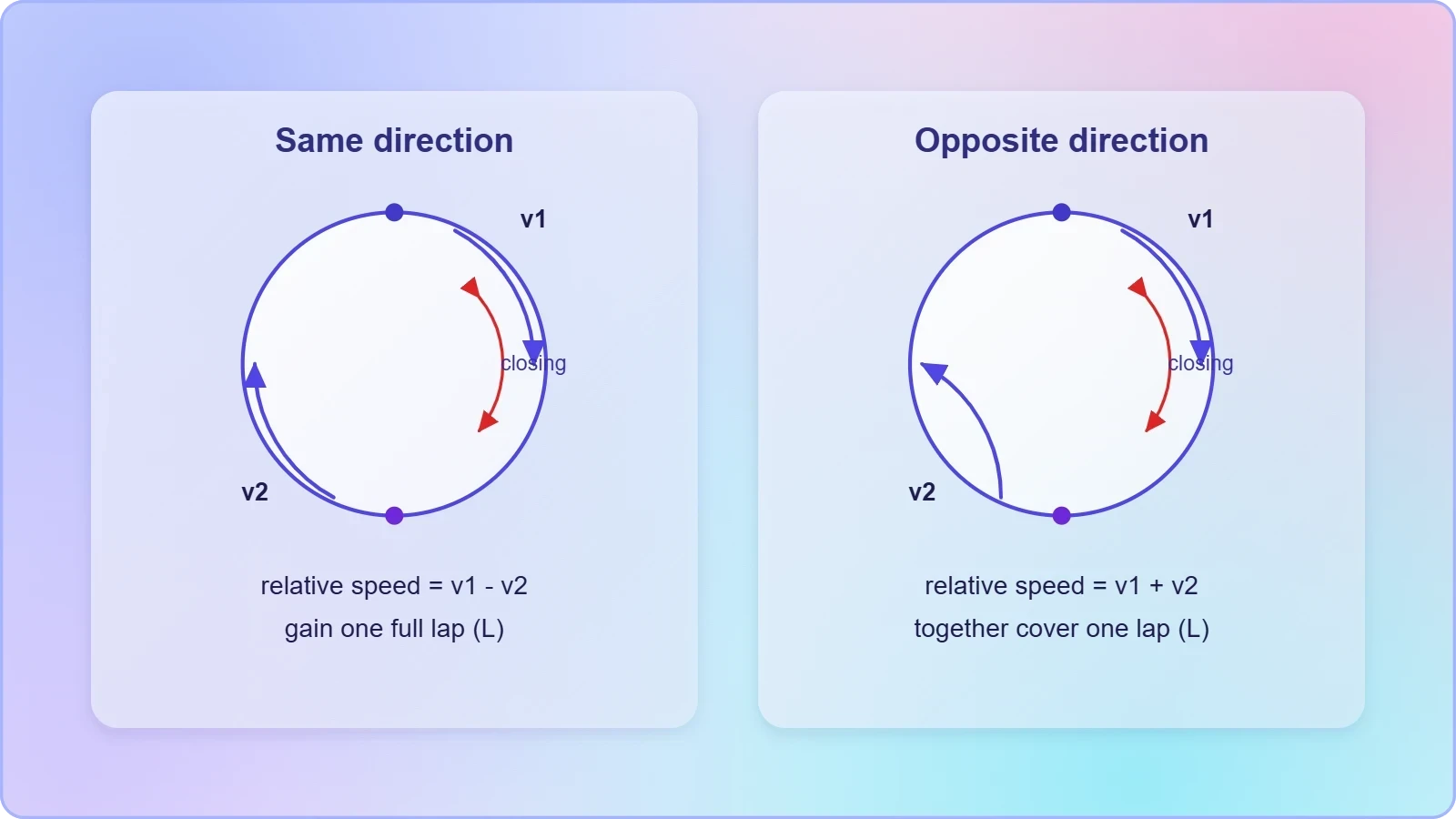
When two bodies move in the same direction around a loop, the faster one must gain a full lap on the slower one before they coincide again. The relative speed is therefore the difference of their speeds, and the distance to be covered is one complete circumference. This single insight resolves the majority of same-direction questions, including those involving three or more runners.
When the bodies move in opposite directions, they approach each other along the track and together must cover one full circumference before meeting. Here the relative speed is the sum of the individual speeds, echoing the downstream logic from the boats lesson. Recognising which of these two regimes applies is the first decision point in every circular track question.
Establishing the Governing Equations
The mathematics is compact once the geometry is clear. For same-direction motion, the time to the next meeting is the circumference divided by the speed difference; for opposite-direction motion, it is the circumference divided by the speed sum. These two expressions form the backbone of the entire lesson and should be internalised before attempting any numerical work.
Here ##L## denotes the circumference of the track, while ##v_1## and ##v_2## are the speeds of the two bodies. The formulas assume constant speeds and a single lap of separation, and they extend naturally to multiple laps by multiplying the numerator by the number of laps required.
Meeting Points and the Speed Ratio Principle
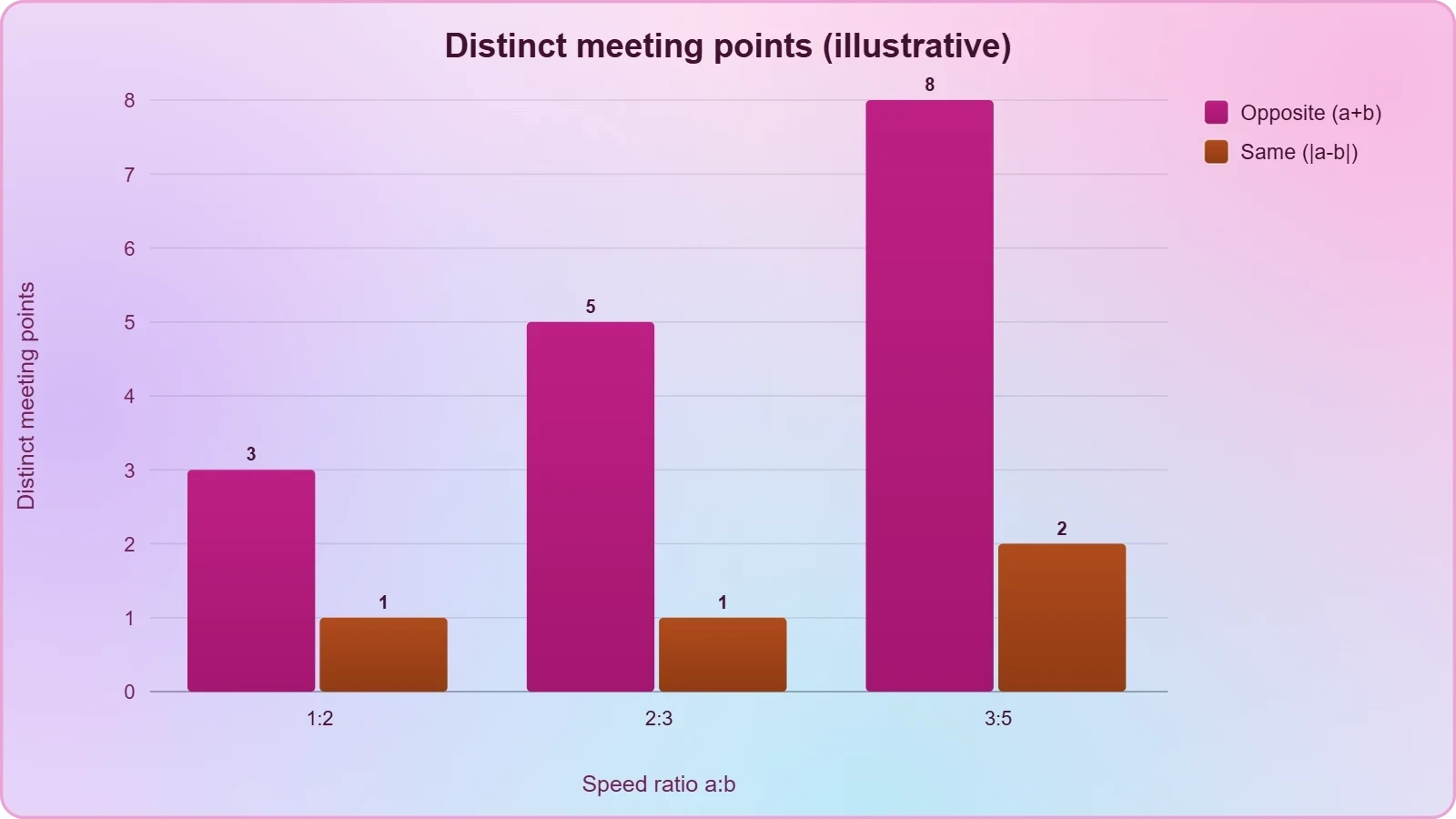
Beyond the timing of meetings, examiners frequently ask where on the track two runners will coincide. The answer depends entirely on the ratio of their speeds, and this ratio produces a remarkably elegant result: the number of distinct meeting points equals the sum of the terms of the simplified ratio. Understanding why this happens deepens intuition and eliminates guesswork.
Suppose two runners have speeds in the simplified ratio ##a : b##. During the interval between successive meetings, the faster runner covers a proportionally larger arc, and the meeting point advances around the circle by a fixed fraction each time. After a finite number of meetings, the pattern returns to its starting configuration, and the number of distinct locations visited is exactly ##a + b##.
Deriving the Number of Distinct Meeting Points
The derivation rests on a simple observation about laps. In the time the faster runner completes ##b## laps, the slower completes ##a## laps, and both return simultaneously to the starting point. During this cycle, the faster runner has gained exactly ##b - a## laps on the slower, which corresponds to ##b - a## meetings, each at a distinct position.
Counting the positions carefully, including the starting point, yields ##a + b## distinct meeting locations when the runners move in opposite directions. For same-direction motion, the count becomes ##|a - b|##, reflecting the smaller number of overtaking events within the cycle. This contrast is a favourite trap in objective examinations.
Worked Illustration with Three Runners
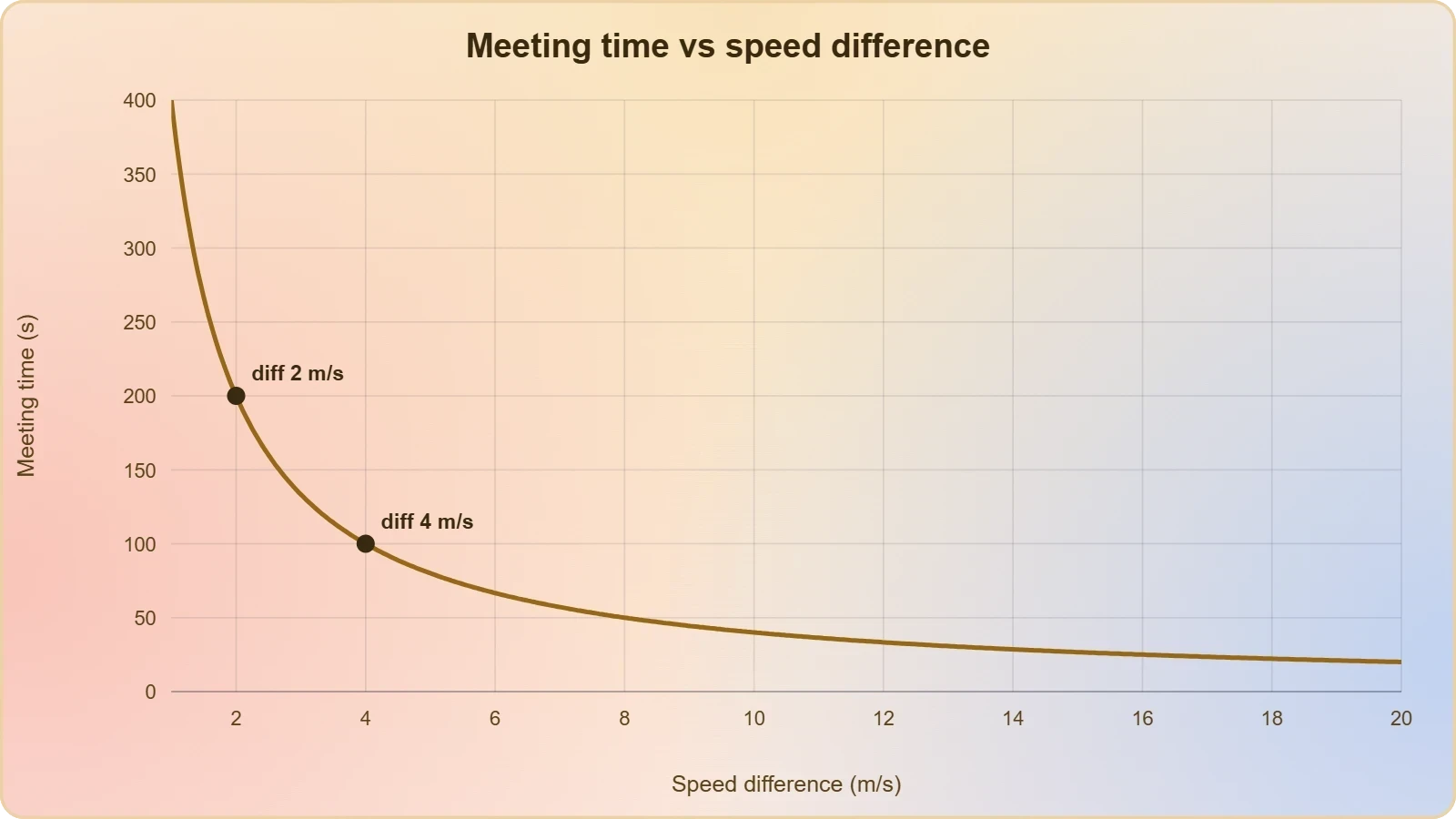
Consider three runners on a 400-metre track with speeds of 4, 6, and 8 metres per second, all starting together and moving in the same direction. The pairwise speed differences are 2, 2, and 4, so the first meeting of the fastest with the slowest occurs after 100 seconds, while the other pairs meet sooner. The earliest triple coincidence requires the least common multiple of the individual meeting intervals.
This layered reasoning demonstrates why three-body problems demand patience rather than new formulas. Each pair is handled with the two-body rule, and the overall answer emerges from combining those results through least common multiples. Examiners favour such questions because they test structural thinking rather than raw computation.
Unit Conversions and the Discipline of Consistent Measurement
Circular track questions are notorious for mixing units: track lengths in metres, speeds in kilometres per hour, and answers demanded in minutes. The arithmetic is trivial once the units align, yet a single mismatch can derail an otherwise correct solution. Building a conversion habit before substitution is therefore not pedantry but a genuine scoring strategy.
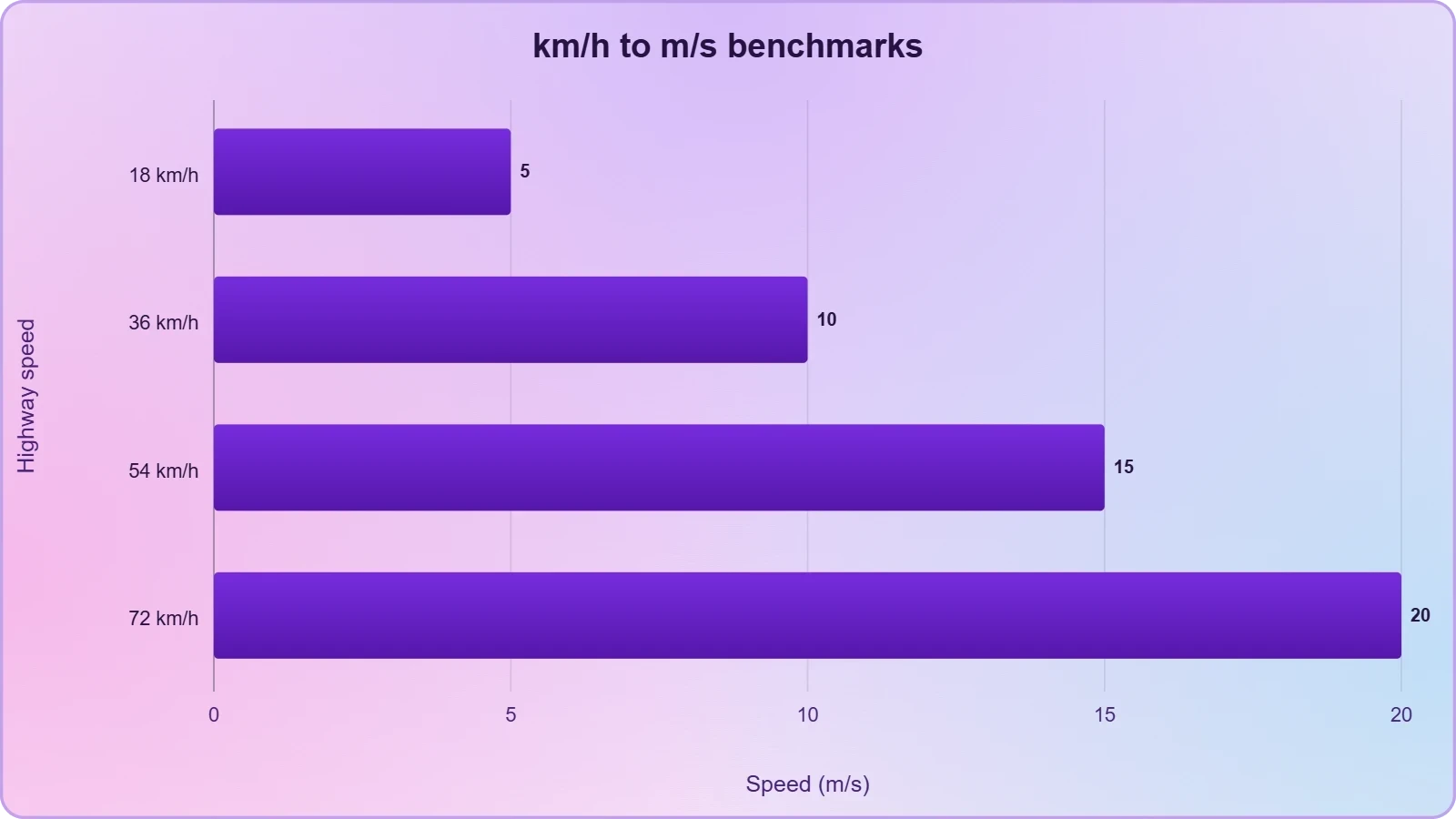
The standard conversion factor is that one kilometre per hour equals five-eighteenths of a metre per second. Multiplying by this fraction converts highway-style speeds into track-friendly units, while the reciprocal handles the reverse. Candidates should practise the conversion until it becomes automatic, because examiners deliberately exploit hesitation at this step.
Building a Reliable Conversion Habit
A disciplined approach converts every quantity to metres and seconds at the outset, then converts the final answer to whatever unit the question requests. This two-stage method prevents mid-calculation confusion and makes intermediate results easy to sanity-check. It also aligns naturally with the circumference formula, which is most comfortable in metres.
Applying this factor to a speed of 36 kilometres per hour yields 10 metres per second, a figure worth memorising alongside its common companions. Familiarity with such benchmarks accelerates mental arithmetic and reduces the temptation to reach for a calculator during timed sections.
Avoiding the Classic Unit Traps
The most frequent error involves mixing a track length in metres with a speed in kilometres per hour, producing a time in an unrecognisable unit. A second trap arises when the question supplies the circumference in kilometres but the speeds in metres per second. Both are solved by the same discipline of early conversion.
Another subtle pitfall concerns time expressed in minutes and seconds simultaneously. Converting everything to seconds before dividing eliminates ambiguity, and the final answer can then be reformatted as required. These habits compound across the entire quantitative section, not merely within circular track problems.
Clock Hands as a Circular Track Problem
The minute and hour hands of an analogue clock trace concentric circles, and their coincidences are governed by precisely the same relative speed logic developed above. The minute hand completes a full revolution in sixty minutes, while the hour hand takes twelve hours, giving a speed ratio of twelve to one. This ratio is the key to every clock-based aptitude question.
Treating the clock face as a circular track of 360 degrees, the minute hand moves at six degrees per minute and the hour hand at half a degree per minute. Their relative speed in the same direction is therefore five and a half degrees per minute, and the time between successive coincidences follows immediately from the circumference divided by this relative speed.
Computing the Interval Between Coincidences
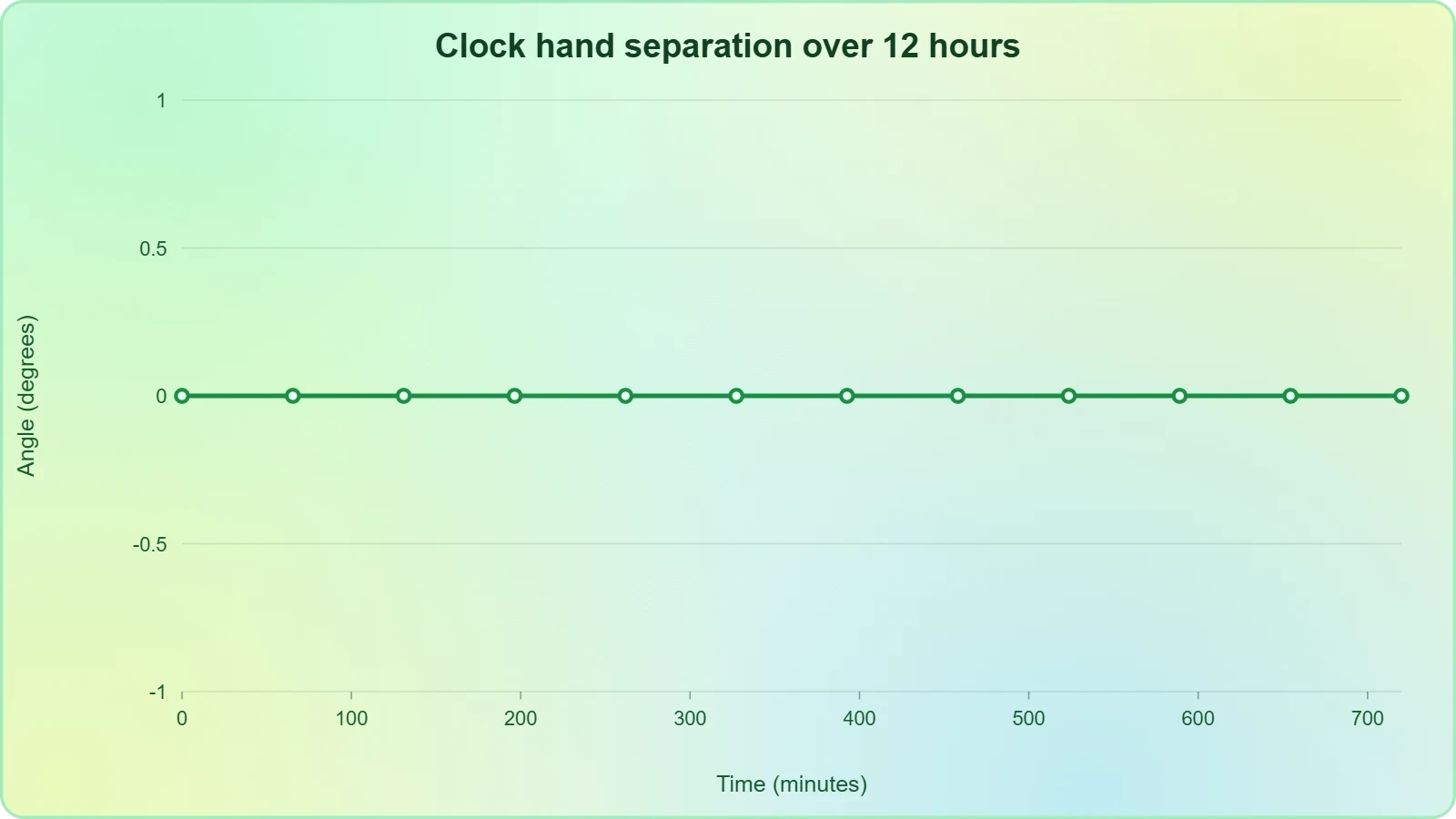
Dividing 360 degrees by five and a half degrees per minute produces the familiar result of sixty-five and five-elevenths minutes, or roughly sixty-five minutes and twenty-seven seconds. This interval explains why clock hands do not meet at neat hourly marks and why the eleven o'clock position is famously skipped.
Over a twelve-hour cycle, the hands coincide exactly eleven times, a fact derivable by dividing 720 minutes by the interval above. Recognising this count allows rapid answers to questions about how often the hands align within a given period, without any step-by-step simulation.
Applying the Framework to Angle Questions
Many clock questions ask for the angle between the hands at a specified time, which is simply the relative angular displacement after accounting for the starting offset. The same relative speed of five and a half degrees per minute drives the calculation, with the hour hand's initial position subtracted as a correction term.
This unified treatment removes the need for separate memorised formulas for coincidence, opposition, and right angles. Each is a special case of the general relative displacement equation, and candidates who grasp the underlying structure can reconstruct any variant on demand during the examination.
Exam-Focused Problem Solving and Common Traps
Circular track questions in competitive examinations rarely appear in their textbook form. They are dressed in the language of races, athletic meets, or rotating machinery, and the underlying structure must be extracted before any calculation begins. The skill being tested is translation, not arithmetic, and practice should reflect that emphasis.
A reliable routine begins with identifying the track length, the number of bodies, their directions, and whether they start together. From these four facts, the appropriate relative speed rule follows mechanically. Candidates who internalise this checklist reduce errors dramatically and free mental capacity for the actual computation.
Structuring the Solution Under Time Pressure
Under examination conditions, the temptation is to begin calculating immediately, which often leads to wasted effort on the wrong quantity. A brief pause to classify the problem as same-direction or opposite-direction pays for itself many times over. Writing the governing formula before substituting numbers further reduces the risk of arithmetic slips.
Approximation is a legitimate and powerful tool in objective papers. When the answer options are widely spaced, rounding the relative speed or the circumference to convenient values often identifies the correct choice without exact division. This technique should be practised deliberately rather than discovered accidentally in the exam hall.
Diagnosing Frequent Errors
The most common mistake is applying the sum of speeds to a same-direction problem, which produces a plausible but incorrect answer. A second frequent error involves forgetting that the first meeting requires a full lap of separation, not merely the initial gap. Both errors stem from skipping the classification step described above.
Another trap concerns questions that ask for the number of meetings within a specified time rather than the time to the first meeting. Here the total time must be divided by the meeting interval, and the integer part taken. Careless candidates report the fractional quotient and lose the mark despite correct underlying reasoning.
Practice Set and Bridge to Races and Games
Consolidation requires active retrieval rather than passive review. The practice set below targets the four core competencies of this lesson: first meeting time, distinct meeting points, clock-hand coincidence, and unit discipline. Attempt each question before consulting the reasoning, and record the type of error made so that revision becomes targeted rather than general.
A useful exercise involves constructing your own problems by choosing a track length and a pair of speeds, then predicting the meeting interval before calculating it. This generative practice exposes gaps in understanding far more effectively than solving ready-made questions, because it forces you to commit to a structure before seeing the answer.
Targeted Quiz for This Lesson
Two runners move around a 500-metre track in opposite directions at 6 and 4 metres per second. Their relative speed is 10 metres per second, so they meet every 50 seconds, and the number of distinct meeting points is ten, corresponding to the sum of the simplified ratio terms.
A second question asks how many times the hands of a clock coincide between 3:00 and 9:00. The interval is 720/11 minutes, and the elapsed period of 360 minutes accommodates five complete intervals, giving five coincidences. Both questions reward the structural approach developed throughout this lesson.
Preparing for Races and Games
The next lesson shifts from closed loops to linear contests, where the concepts of head start, dead heat, and beats-by-distance enter the vocabulary. The relative speed reasoning mastered here transfers directly, since a race is simply a straight-line version of the pursuit problems already solved. The circular track thus serves as an ideal rehearsal for the more nuanced race scenarios ahead.
Before proceeding, ensure that you can state the two governing formulas from memory, explain why the meeting point count equals the sum of ratio terms, and convert speeds fluently between units. These competencies form the foundation on which the races lesson builds, and any weakness here will compound later.
Also Read
- No links available.
From our network :
- The Diverse Types of Convergence in Mathematics
- How to design postgres partitions with native and hash methods
- JD Vance Charlie Kirk: Tribute and Political Strategy
- How to migrate to postgres using logical replication and cutover
- Bitcoin Hits $100K: Crypto News Digest
- How to secure postgres connections across VPC, VPN, and cloud
- Bitcoin price analysis: Market signals after a muted weekend
- Limits: The Squeeze Theorem Explained
- Limit Superior and Inferior
RESOURCES
- No results found.