Average speed is the single most misunderstood quantity in the entire time, speed, and distance syllabus, and it is precisely where competitive examiners set their most elegant traps. Most candidates instinctively add two speeds and divide by two, a habit that feels natural but collapses the moment the two segments cover unequal distances or consume unequal time. This lesson dismantles that reflex and replaces it with a rigorous, formula-driven understanding that survives any variation the paper throws at you.
Building directly on the unit conversions you mastered in Lesson 2, we now move from single-segment motion to journeys composed of multiple legs, each with its own speed and duration. You will learn to distinguish the arithmetic mean of speeds from the true harmonic relationship that governs equal-distance travel, and you will see why the distinction matters in problems involving trains, buses, and walking commutes. Every formula here is derived rather than memorised, so recall under pressure becomes automatic.
By the end of this lesson you will handle three canonical patterns with confidence: equal distances at different speeds, equal times at different speeds, and mixed segments requiring weighted reasoning. Each concept is reinforced with worked examples and a targeted quiz, and the groundwork laid here flows directly into Lesson 4, where relative speed between two moving bodies takes centre stage.
On This Page
Defining Average Speed Against Instantaneous Speed
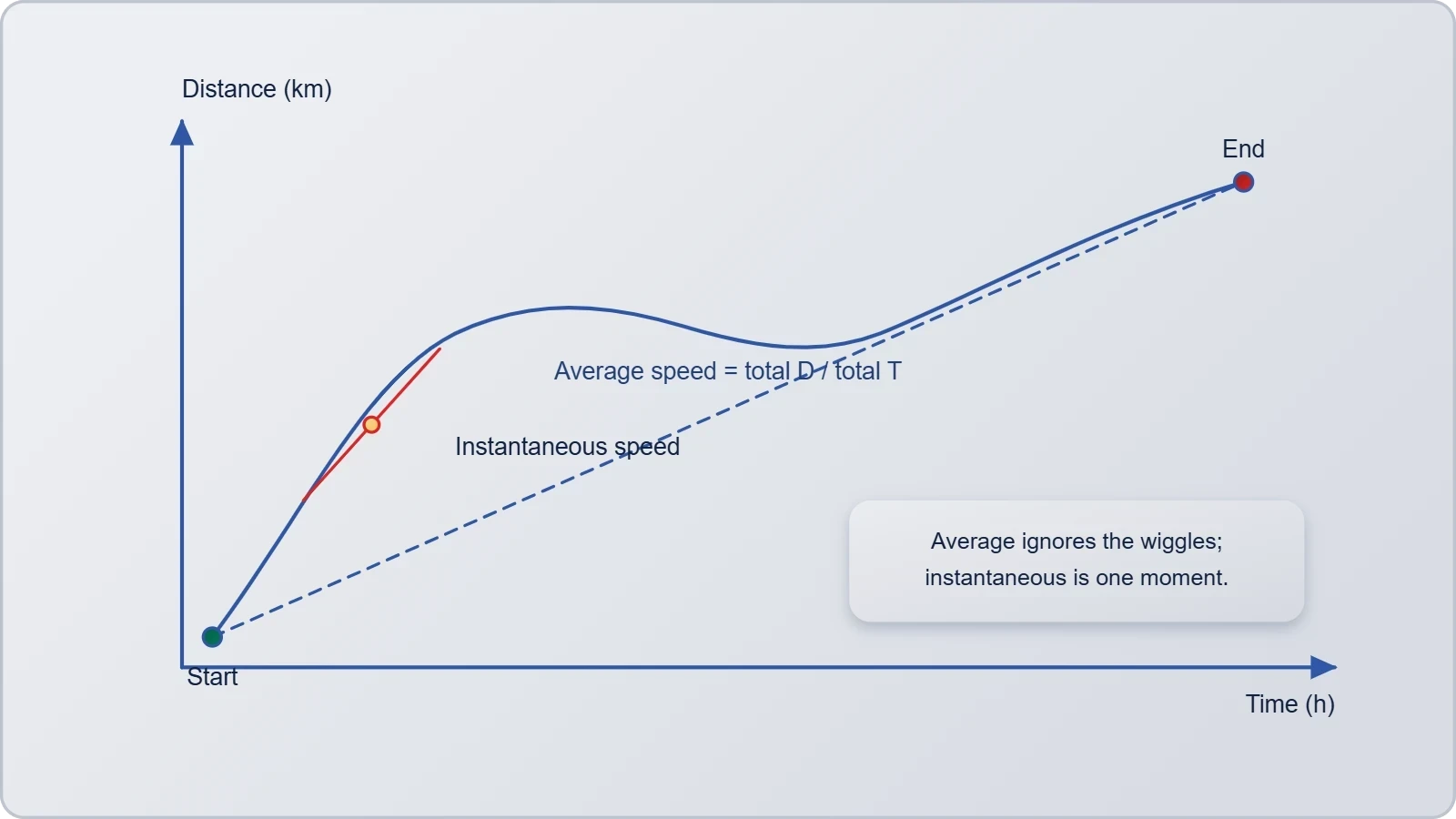
Average speed describes an entire journey as though it were a single uniform motion, compressing every acceleration, pause, and speed change into one representative number. Instantaneous speed, by contrast, is the speed at a precise moment, the reading on a speedometer at one tick of the clock. Examiners exploit this distinction constantly, because a journey's average rarely equals any of its component speeds.
The Formal Definition and Its Units
Average speed is defined as total distance travelled divided by total time taken, with no regard for direction or intermediate variation. This definition is deliberately blunt: it does not care whether you sprinted for ten seconds and crawled for an hour, only that the two totals are correctly summed. Units must match before division, which is exactly why Lesson 2's conversion drills matter here.
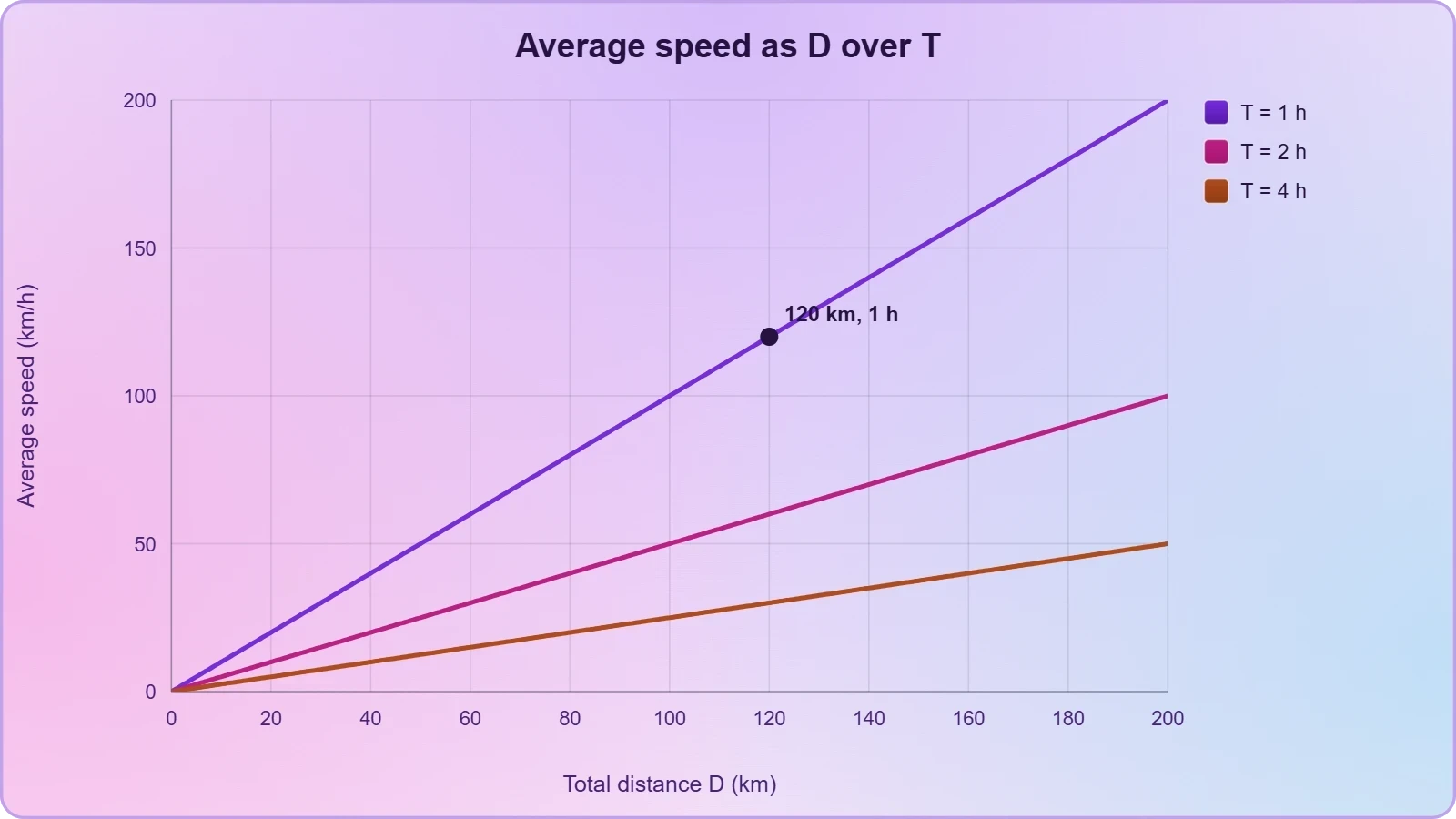
Formally, for a journey covering total distance ##D## in total time ##T##, the average speed is given by the relation below. Note that the numerator is the sum of all segment distances and the denominator the sum of all segment times, never a simple average of the individual speeds.
Why the Arithmetic Mean Fails
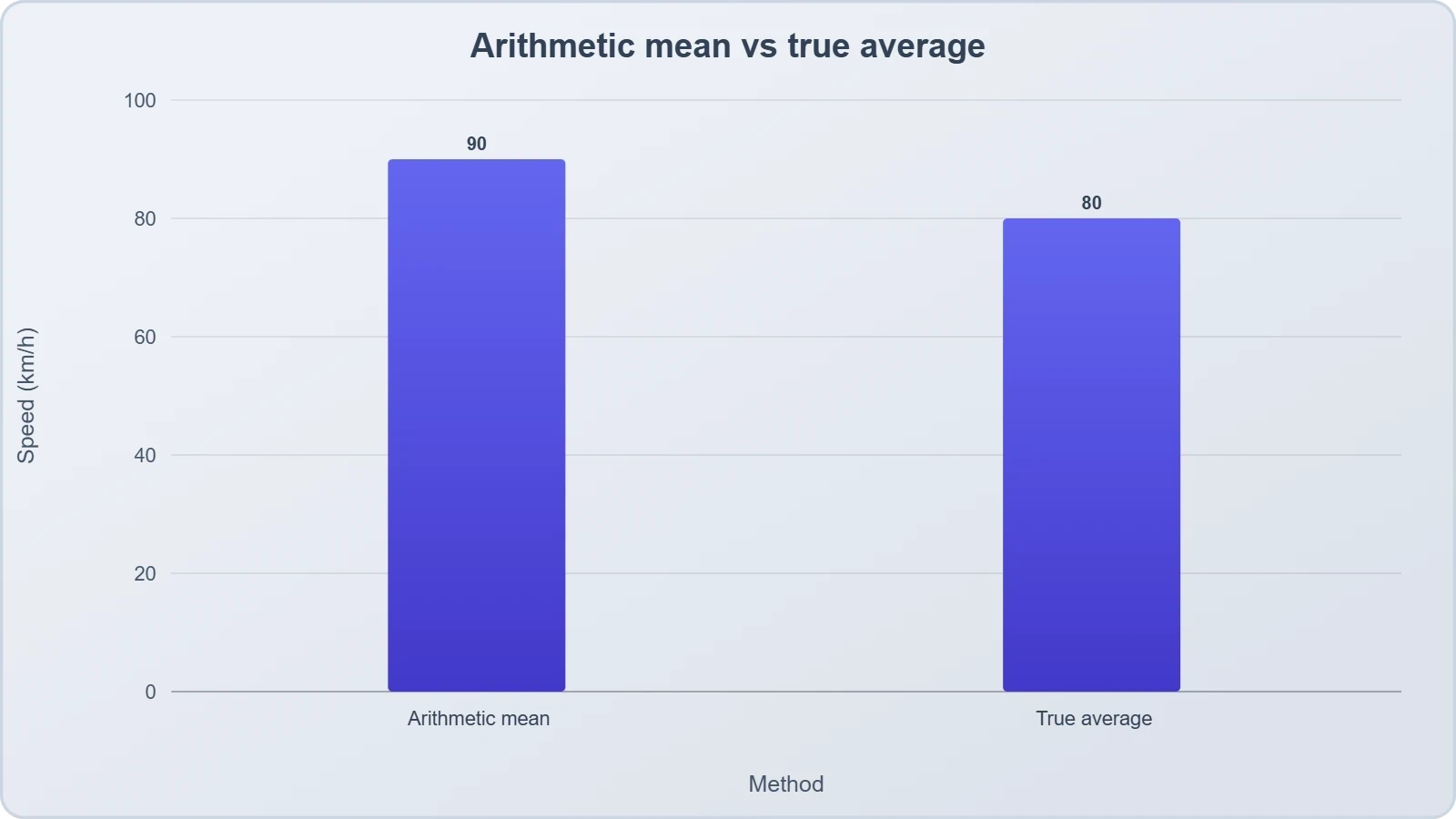
Suppose a car covers 60 km at 60 km/h and another 60 km at 120 km/h. The arithmetic mean suggests 90 km/h, yet the true average is 80 km/h, because the slower leg consumes twice the time. Time, not distance, is the currency in which average speed is paid, and ignoring that weighting is the classic error this lesson eliminates.
This asymmetry explains why average speed always leans toward the slower speed when distances are equal. The vehicle spends more clock time in the sluggish segment, dragging the overall figure downward. Recognising this bias lets you sanity-check answers instantly: if your computed average sits above the arithmetic mean of two equal-distance speeds, something has gone wrong.
The Equal-Distance Formula and Its Derivation
The most frequently tested scenario involves a body covering the same distance twice at two different speeds, and the resulting formula deserves derivation rather than blind memorisation. Once you can rebuild it from first principles in fifteen seconds, no examiner can unsettle you with unfamiliar numbers or disguised wording. The derivation also reveals exactly when the shortcut applies and when it quietly fails.
Deriving the Harmonic Mean Result
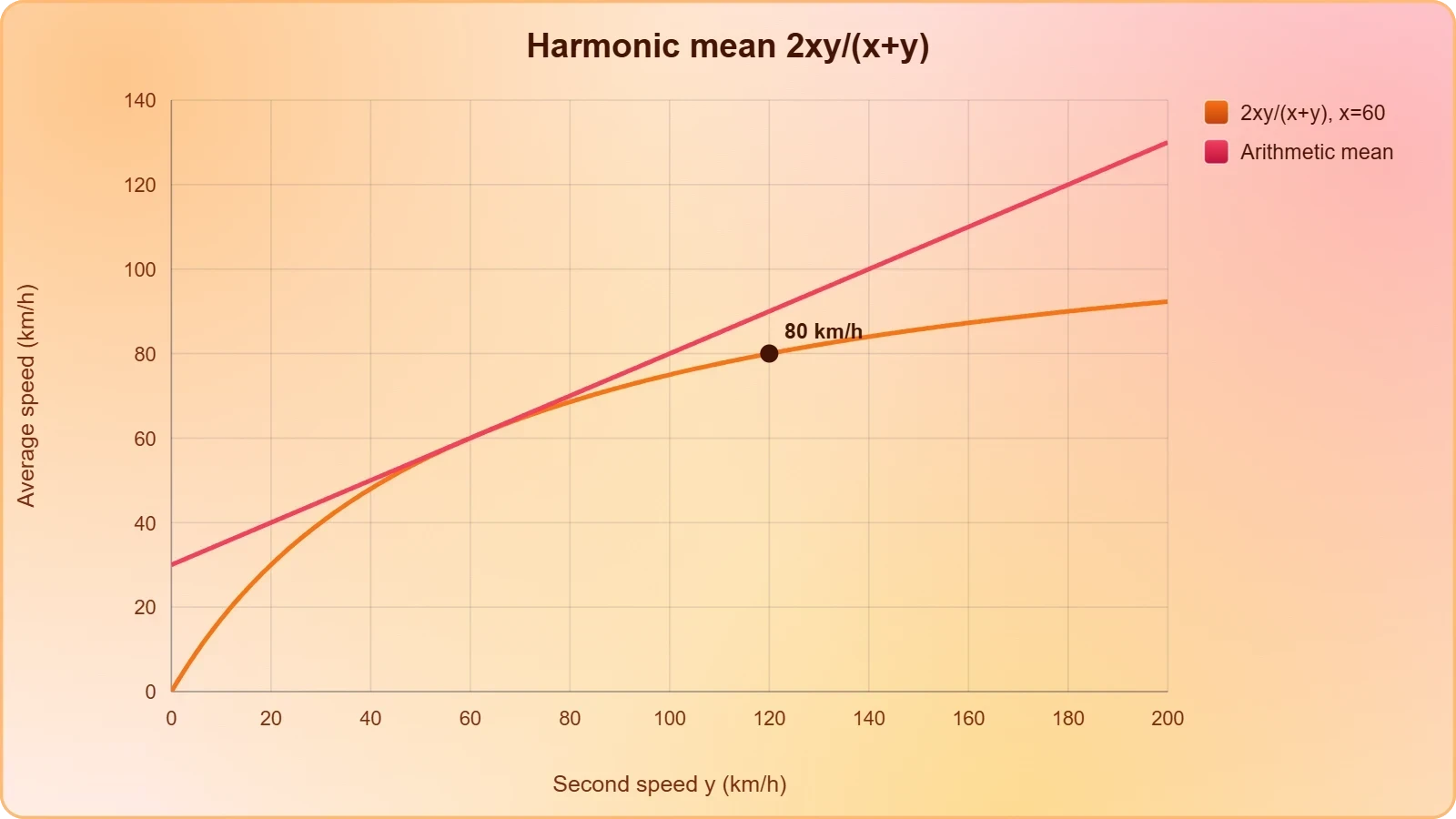
Let the equal distance be ##d##, with speeds ##x## and ##y## on the two legs. The time for each leg is ##d/x## and ##d/y## respectively, so the total time is their sum. Dividing total distance ##2d## by this total time and simplifying yields the compact result shown below, which is the harmonic mean of the two speeds.
Notice that the distance ##d## cancels completely, which is the formula's quiet power: the answer depends only on the two speeds, never on how far the journey actually extends. This is why problems can omit the distance entirely and still be solvable. Whenever a question gives two speeds and equal distances, apply the formula directly.
Worked Example and Sanity Checks
A cyclist rides 30 km at 15 km/h and returns along the same road at 10 km/h. Applying the formula gives ##2 \times 15 \times 10 / 25 = 12## km/h, comfortably below the arithmetic mean of 12.5. The outbound leg takes two hours, the return three, so five hours for 60 km confirms the result independently.
Always run this time-based verification when the numbers are friendly, because it catches sign errors and inverted fractions instantly. If your formula answer exceeds the arithmetic mean of the two speeds, you have almost certainly swapped numerator and denominator. Cultivating this habit converts a fragile memory into a dependable checking mechanism under exam pressure.
Equal-Time Segments and the Weighted Average
When a journey is split into segments of equal duration rather than equal distance, the mathematics flips entirely and the simple arithmetic mean becomes correct. This symmetry is one of the most elegant features of the topic, and examiners love testing whether candidates can identify which regime applies. The key diagnostic is always the same: ask what quantity is held constant across the segments.
When Time Is the Constant
If a vehicle travels at ##x## km/h for one hour and ##y## km/h for another hour, the total distance is ##x + y## and the total time is two hours. The average speed is therefore ##(x+y)/2##, the plain arithmetic mean. Equal time makes distance proportional to speed, so the weighting becomes uniform and the harmonic correction vanishes.
This result generalises cleanly: for ##n## segments of equal duration with speeds ##v_1, v_2, \ldots, v_n##, the average speed is simply their arithmetic mean. Recognising the phrase "for equal times" or "each for one hour" in a question stem should immediately trigger this shortcut, saving precious minutes in a timed paper.
Mixed Segments Requiring Weighted Reasoning
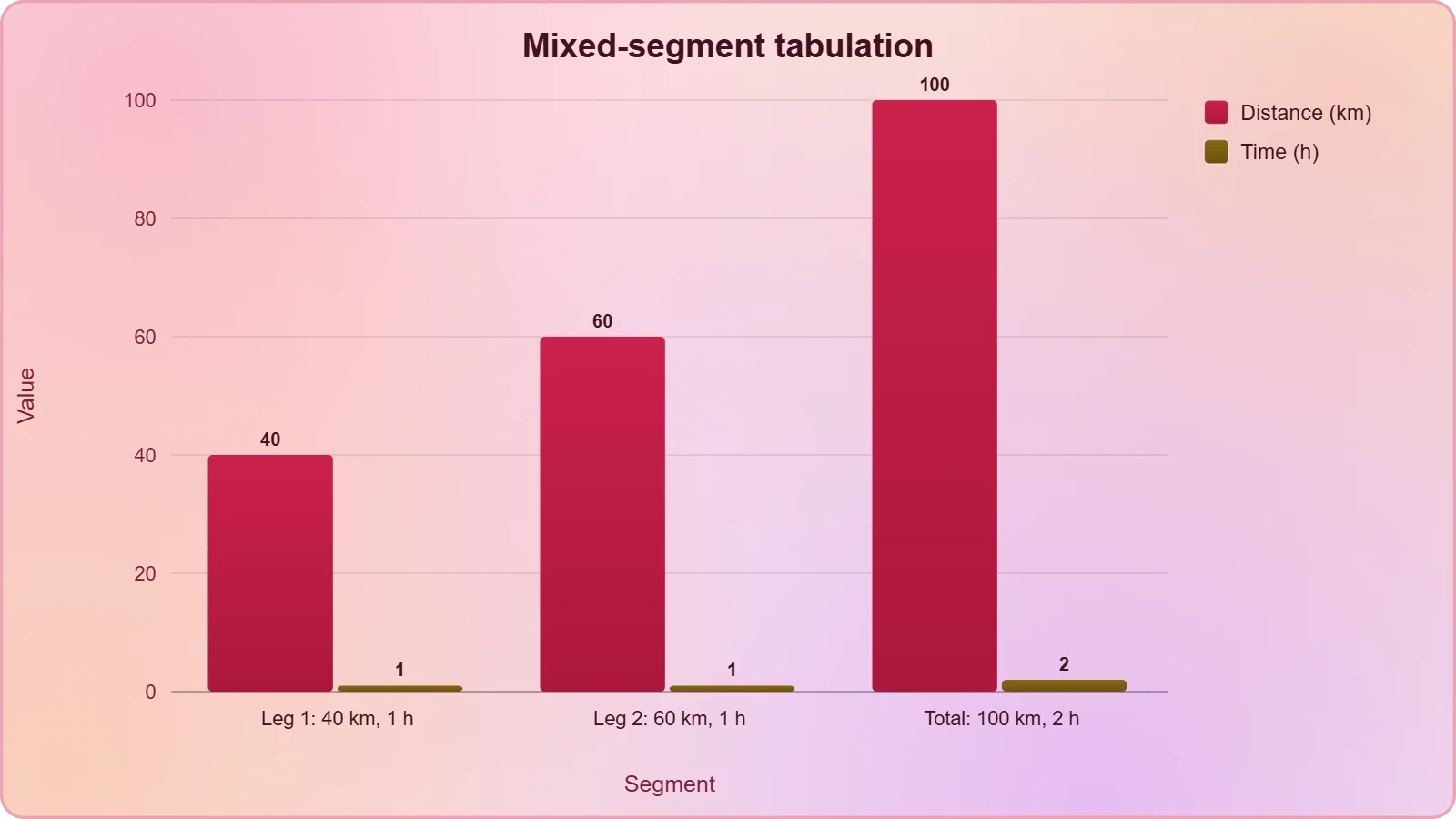
Real problems often mix regimes, giving distances for some legs and times for others. Here no single formula suffices, and the disciplined approach is to tabulate distance and time for every segment, sum each column, and divide. This universal method never fails, though it costs more time than a recognised shortcut.
Consider a traveller covering 40 km at 40 km/h, then travelling for one hour at 60 km/h. The first leg takes one hour and 40 km; the second covers 60 km in one hour. Totals of 100 km and two hours give 50 km/h, a figure neither formula alone would produce.
Extending to Three or More Equal Segments
Examiners frequently escalate from two segments to three, testing whether candidates understand the underlying structure or merely memorised a single formula. The three-speed equal-distance case produces a beautifully symmetric expression that is worth deriving once and then recognising on sight. Beyond three segments, the general harmonic mean takes over and the tabulation method becomes the pragmatic choice.
The Three-Speed Equal-Distance Formula
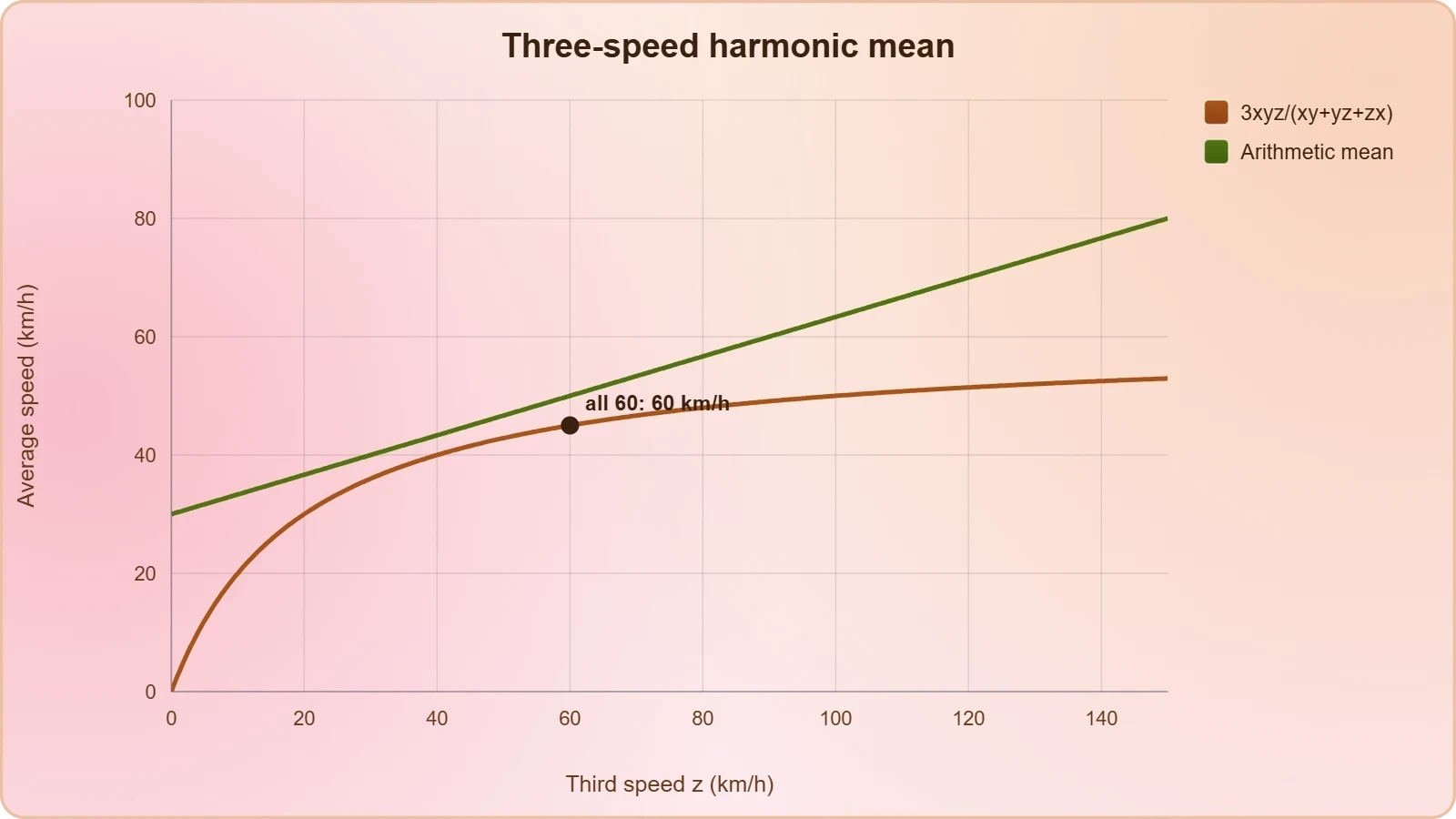
For three equal distances covered at speeds ##x##, ##y##, and ##z##, the total distance is ##3d## and the total time is ##d/x + d/y + d/z##. Simplifying the resulting quotient yields the expression below, which reduces correctly to the two-speed formula when ##z## equals ##y##.
A useful verification: if all three speeds equal ##v##, the formula returns ##3v^3 / 3v^2 = v##, exactly as intuition demands. Such limiting-case checks are a professional habit worth cultivating, because they expose algebraic slips before the answer reaches the answer sheet. Apply them routinely to every derived formula you use.
General Harmonic Mean and Practical Shortcuts
For ##n## equal-distance segments, the average speed is the harmonic mean of the individual speeds, written below. In practice, exam questions rarely exceed three segments, and when they do, the numbers are usually chosen so that tabulation is faster than formula substitution.
One elegant shortcut deserves mention: if the speeds form an arithmetic progression, the average speed for equal distances is the harmonic mean, which for three terms equals ##3 \times## (product) divided by (sum of pairwise products). Recognising progression patterns in question data often collapses a lengthy calculation into a single line of arithmetic.
Exam-Focused Problem Solving and Common Traps
Competitive papers rarely ask for average speed in plain language; they bury it inside stories about buses, trains, and commuters, and they sprinkle distractors designed to trigger the arithmetic-mean reflex. The disciplined candidate reads the stem twice, identifies what is constant, and only then selects a method. This section consolidates that workflow into a repeatable procedure you can execute under strict time limits.
A Systematic Solution Workflow
Begin by extracting every speed, distance, and time figure into a small table, converting all units to a single system immediately. Next, identify whether distances or times are equal across segments, since that single observation determines the formula. Finally, compute and verify against the arithmetic mean as a directional sanity check.
This workflow can be encoded as a simple script for practice sets, letting you generate and verify dozens of problems quickly. The routine below computes average speed from segment lists and flags any result that violates the harmonic-mean bound, making it a useful self-testing tool during revision.
def average_speed(segments):
    total_distance = sum(d for d, s in segments)
    total_time = sum(d / s for d, s in segments)
    return total_distance / total_time

def harmonic_mean(speeds):
    return len(speeds) / sum(1 / s for s in speeds)

journey = [(30, 15), (30, 10)]
print(average_speed(journey))          # 12.0
print(harmonic_mean([15, 10]))         # 12.0
Traps Involving Stops, Rest Breaks, and Round Trips
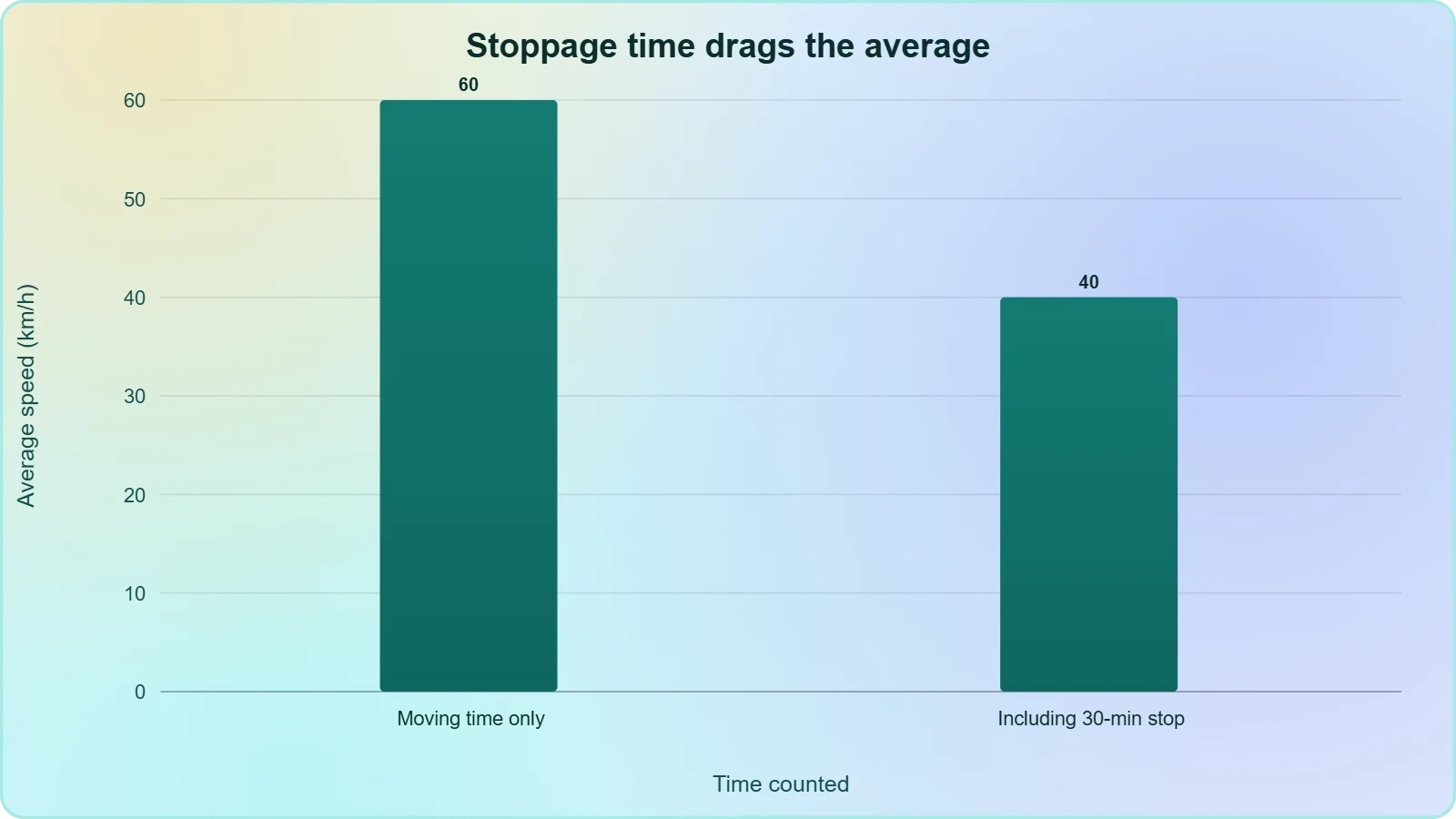
Stoppage time is the most common hidden trap: a bus that pauses for thirty minutes still accumulates that time in the denominator, dragging the average down. Candidates who compute only moving time produce an inflated answer that looks plausible but fails the options. Always scan the stem for words like halted, waited, or rested before finalising.
Round trips deserve separate attention because the return distance equals the outbound distance, automatically invoking the harmonic formula. If the return speed is unknown but the overall average is given, the problem becomes an algebraic inversion of the same relationship. Practise this inversion until it feels as natural as the forward calculation.
Consolidation and the Bridge to Relative Speed
Average speed rewards candidates who think in totals rather than averages, and that single mental shift resolves the majority of exam questions on this topic. The harmonic formula for equal distances, the arithmetic mean for equal times, and the tabulation method for everything else form a complete toolkit. Master these three and no variation will surprise you.
Key Takeaways for Rapid Revision
Remember that average speed equals total distance over total time, always, without exception. The two-speed equal-distance formula ##2xy/(x+y)## is the harmonic mean and always falls below the arithmetic mean. Equal-time segments use the plain arithmetic mean, and mixed problems demand tabulation of both columns before division.
Stoppage time belongs in the denominator, round trips invoke the harmonic formula automatically, and unit consistency must be established before any calculation begins. These five principles, applied consistently, cover the entire question bank for this lesson. Rehearse them until they surface automatically when you read a problem stem.
Preparing for Relative Speed
Lesson 4 shifts the frame of reference from a single moving body to two bodies in motion, where the same distance-time logic applies but with combined or opposed speeds. The averaging skills developed here remain essential, because multi-leg chases often require computing each traveller's average before comparing them. A firm grasp of harmonic weighting will make those problems considerably more tractable.
Before moving on, complete the quiz accompanying this lesson and revisit any question where your first instinct was to average the speeds directly. That instinct is the single strongest predictor of errors in this topic, and consciously overriding it now will pay dividends throughout the quantitative aptitude section. The next lesson builds directly on this corrected foundation.
Also Read
- No links available.
From our network :
- How to design postgres partitions with native and hash methods
- Bitcoin Hits $100K: Crypto News Digest
- The Diverse Types of Convergence in Mathematics
- Bitcoin price analysis: Market signals after a muted weekend
- How to migrate to postgres using logical replication and cutover
- JD Vance Charlie Kirk: Tribute and Political Strategy
- How to secure postgres connections across VPC, VPN, and cloud
- Limits: The Squeeze Theorem Explained
- Limit Superior and Inferior
RESOURCES
- No results found.