Every competitive examination that tests quantitative aptitude eventually asks the same quiet question: can you reason about motion? Time, speed, and distance form the bedrock of that reasoning, appearing in railway recruitment papers, banking examinations, SSC tests, and management entrance assessments alike. Before averages, relative motion, or train-crossing puzzles can make sense, a candidate must first understand what these three quantities actually mean and how they lock together.
This opening lesson establishes that foundation with deliberate care. It defines speed, distance, and time in plain language, derives the governing formula, and shows how the same relationship rearranges itself into three useful variations. Worked examples drawn from realistic exam scenarios illustrate each rearrangement, while a short quiz at the end confirms retention before the course advances to unit conversions.
Because this is the first lesson of ten, nothing here assumes prior exposure. The treatment stays conceptual and precise, avoiding shortcuts that belong to later sessions. Students who internalise the proportional logic presented below will find every subsequent topic, from average speed to relative velocity, considerably easier to absorb and apply under examination pressure.
On This Page
The Three Pillars of Motion Defined
Motion analysis rests on three measurable quantities, and each carries a precise meaning that examiners expect candidates to articulate without hesitation. Distance records how much ground an object covers, time records how long the covering takes, and speed records the rate at which the covering occurs. Confusing these roles produces errors that compound through an entire problem.
Distance as the Space Covered
Distance measures the total length of the path travelled by a moving body, expressed in units such as metres, kilometres, or miles. It is a scalar quantity, meaning direction plays no part in its value. A runner who completes a full lap of a circular track has covered a distance equal to the circumference, regardless of returning to the starting point.
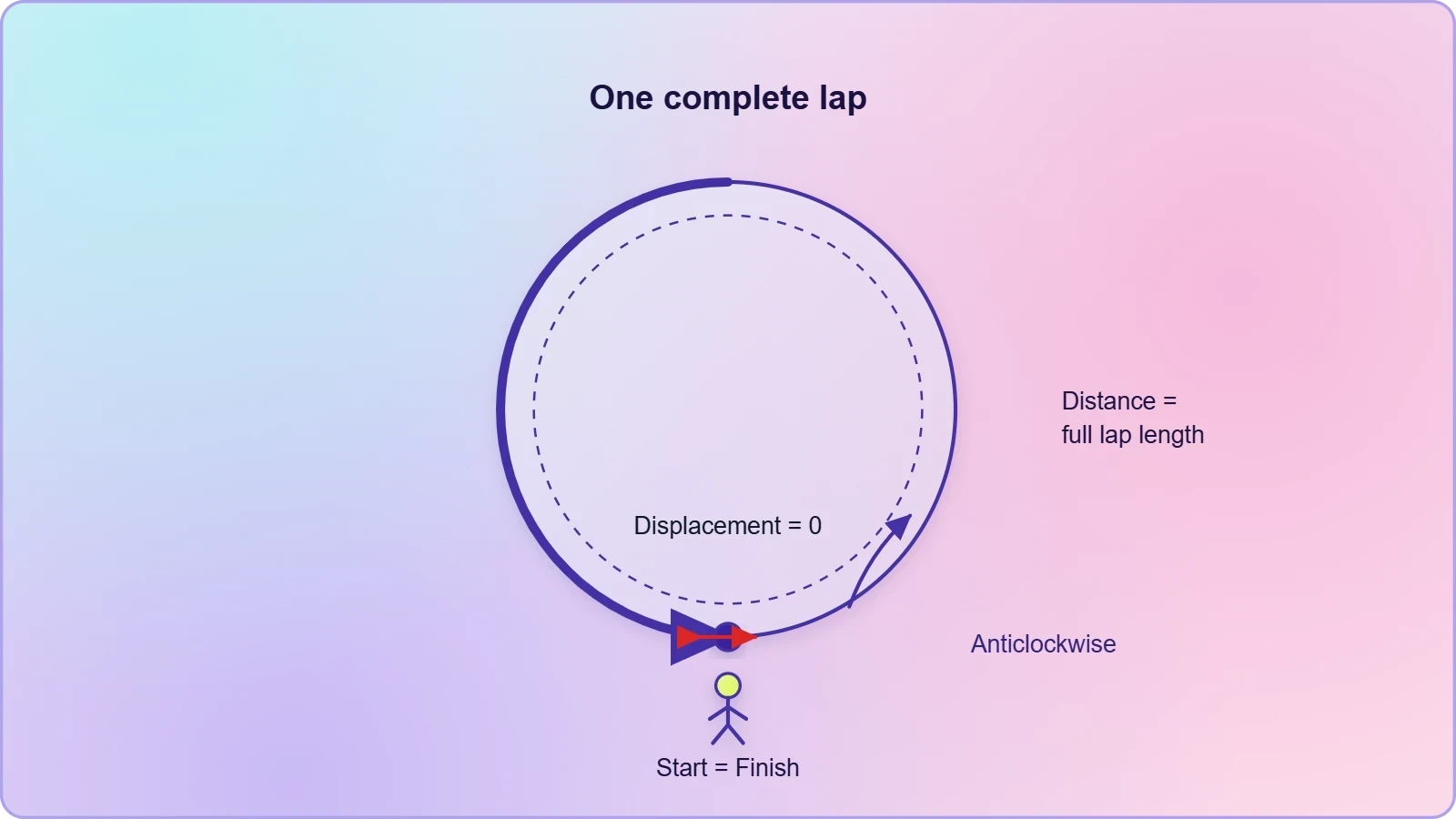
Examiners frequently exploit the distinction between distance and displacement, so candidates should note it early. Displacement concerns net change in position and can be zero after a round trip, whereas distance never shrinks. For the problems in this course, distance alone governs the arithmetic, keeping the treatment clean and exam-focused.
Time as the Duration of Travel
Time quantifies the interval during which motion occurs, measured in seconds, minutes, or hours. In examination settings, time is usually the quantity to be found rather than the quantity given, which makes its manipulation through the formula especially important. Careless unit handling here is the single most common source of lost marks.
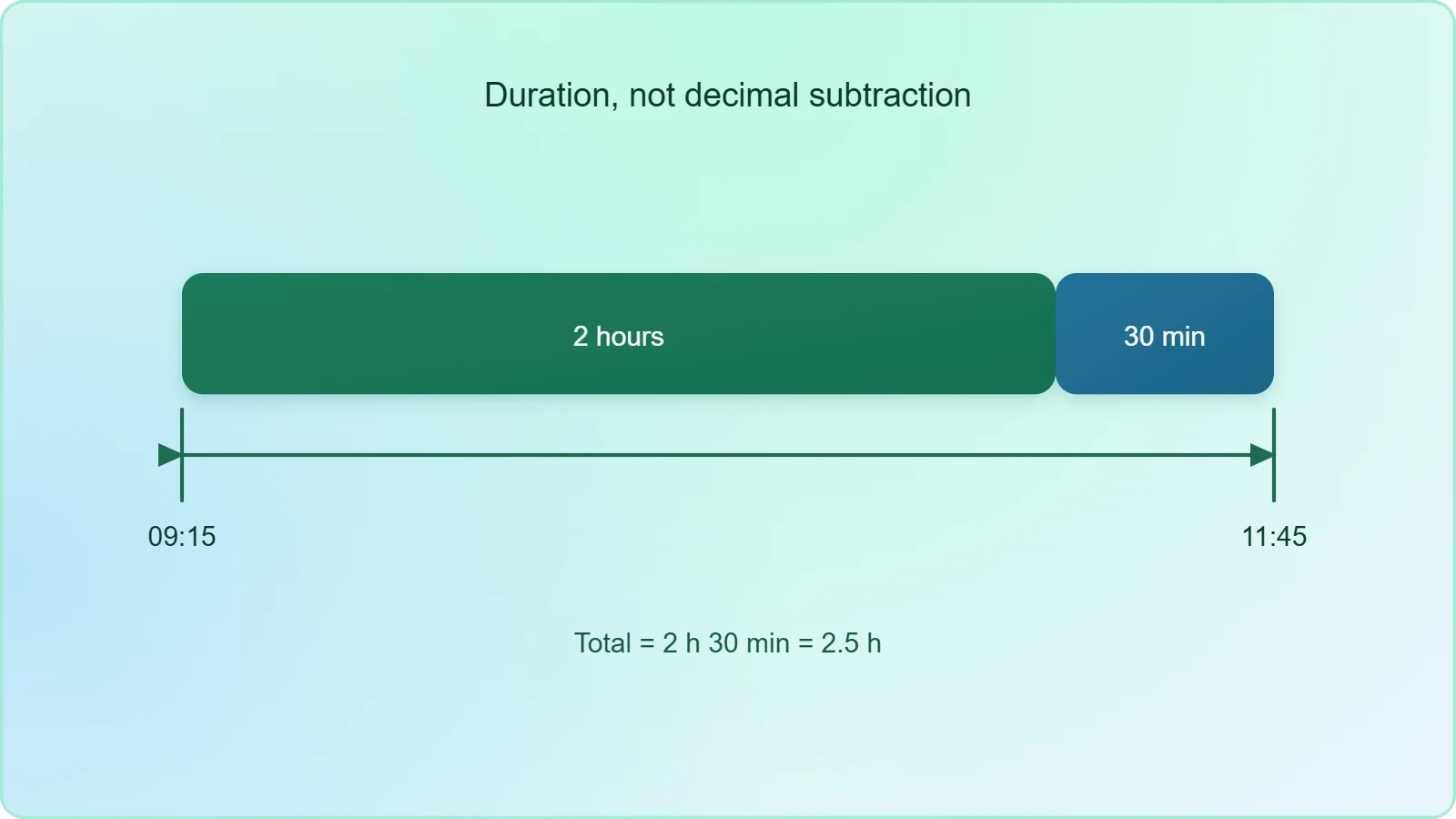
Consider a traveller who departs at 09:15 and arrives at 11:45. The duration is not 11:45 minus 09:15 treated as decimal subtraction; it is two hours and thirty minutes, or 2.5 hours. Converting durations into a single consistent unit before substituting into any formula prevents the silent arithmetic slips that plague timed papers.
The Fundamental Speed Formula and Its Logic
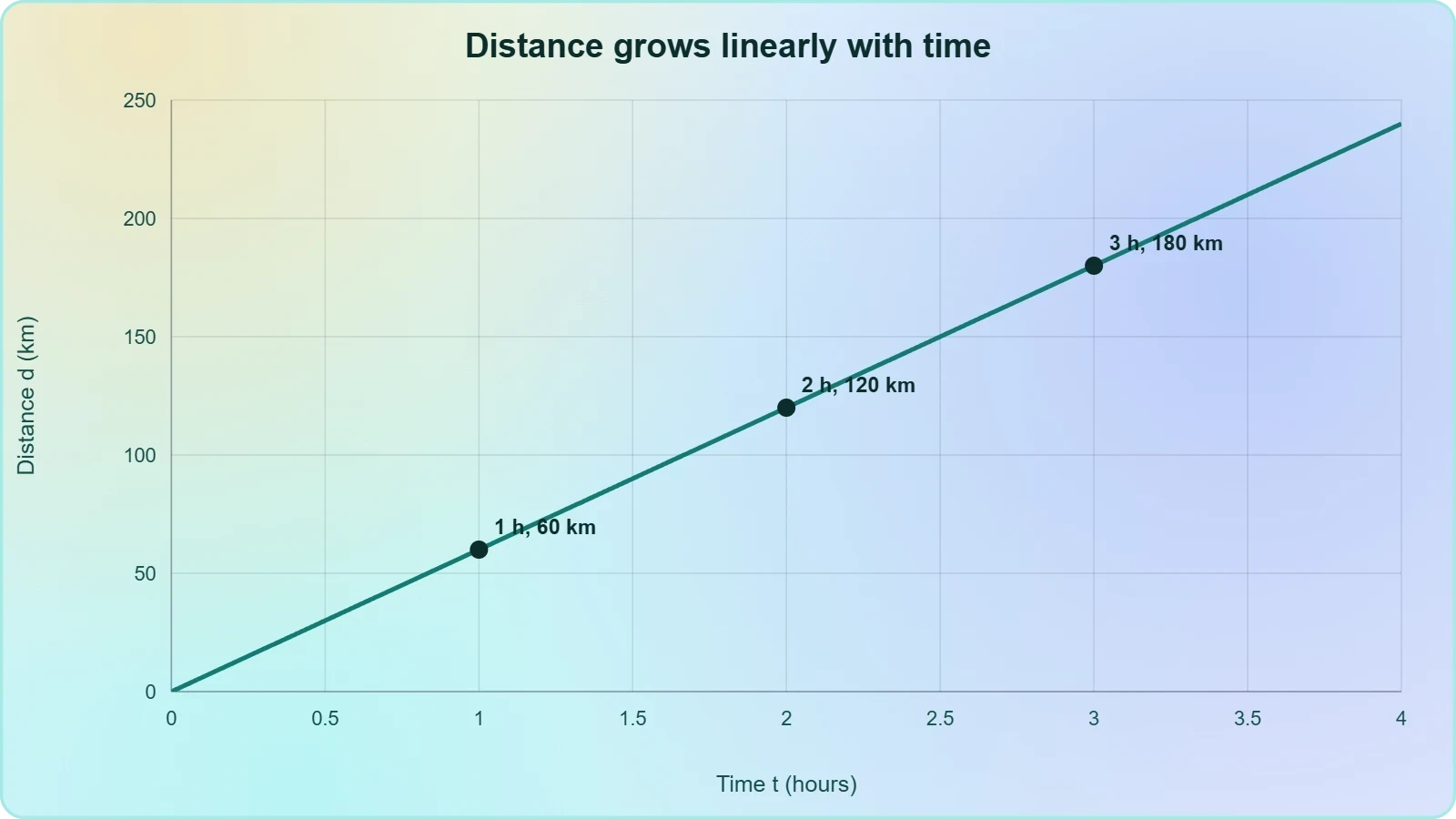
Speed expresses how quickly distance accumulates with respect to time, and the relationship is best understood as a rate rather than a memorised string of letters. When a car covers 180 kilometres in three hours, it accumulates sixty kilometres of distance for every hour that passes. That per-hour accumulation is precisely what the word speed denotes.
Deriving the Core Relationship
The governing equation follows directly from the rate interpretation. Speed equals distance divided by time, written compactly as a formula every candidate must command instantly:
This single equation generates the entire lesson. If any two of the three quantities are known, the third follows by algebraic rearrangement. The derivation is trivial, yet its implications are profound: speed, distance, and time are locked in a fixed proportional dance that later lessons will exploit repeatedly.
Reading the Formula as a Proportion
At constant speed, distance and time are directly proportional, so doubling the journey time doubles the distance covered. Conversely, for a fixed distance, speed and time are inversely proportional, meaning a faster vehicle needs proportionally less time. Recognising these two proportional patterns allows many exam questions to be solved without full computation.
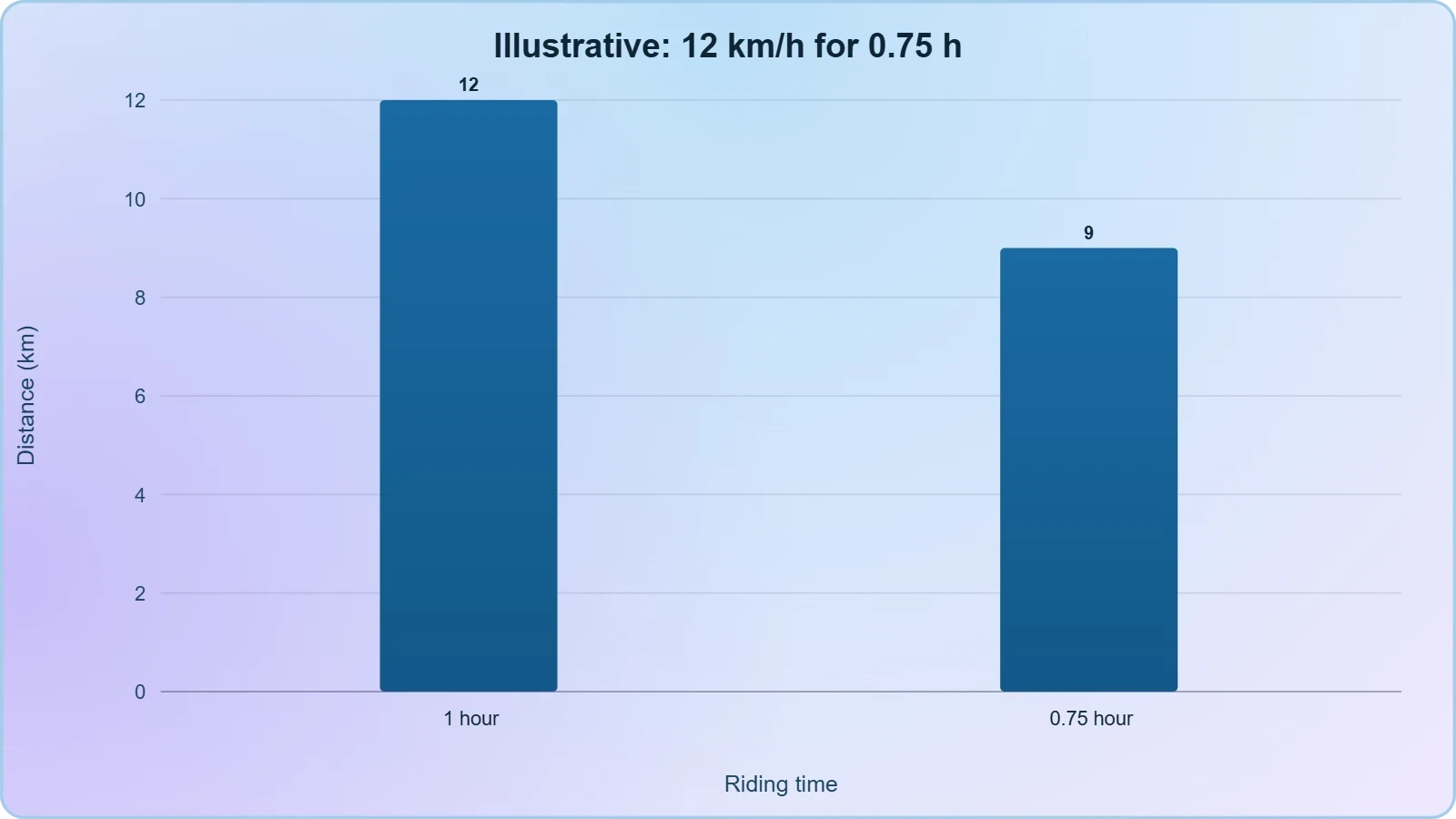
Suppose a cyclist maintains ##12\ \text{km/h}## and rides for ##45## minutes. Converting to hours gives ##0.75## hours, and multiplying yields ##9## kilometres. The proportional view confirms the answer instantly: three-quarters of an hour at twelve kilometres per hour must cover three-quarters of twelve.
Rearranging the Formula for Distance and Time
Examination questions rarely present the unknown as speed. More often the paper supplies speed and time and demands distance, or supplies distance and speed and demands time. Fluency in rearrangement is therefore not optional polish but a core competency that separates confident candidates from hesitant ones under strict timing.
Finding Distance from Speed and Time
Multiplying speed by time yields distance, a manipulation so natural that it barely feels like algebra. A train moving at ##80\ \text{km/h}## for ##2.5## hours covers ##200## kilometres. The multiplication mirrors the definition: eighty kilometres accumulate for each of the two and a half hours travelled.
Word problems often disguise the time component, presenting departure and arrival clocks instead. The candidate must first extract the duration, then multiply. Practising this two-step sequence builds the reflex needed when papers compress many such questions into a few minutes of available working time.
Finding Time from Distance and Speed
Dividing distance by speed yields time, and the result arrives in the same unit family as the speed denominator. A journey of ##150## kilometres at ##50\ \text{km/h}## takes three hours. When the quotient is fractional, converting to minutes or seconds may be required to match the answer options offered.
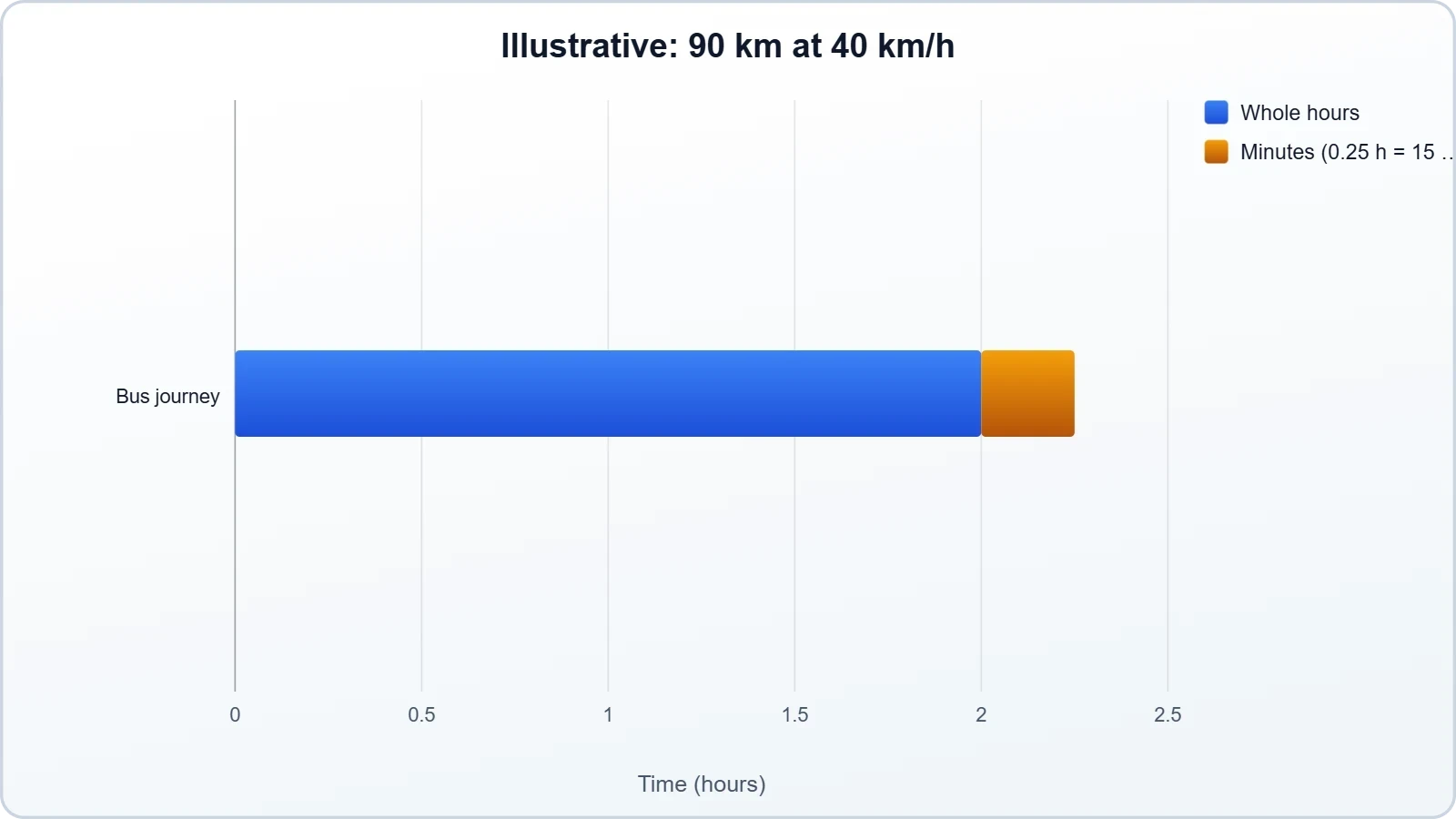
Consider a bus covering ##90## kilometres at ##40\ \text{km/h}##. The division gives ##2.25## hours, which equals two hours fifteen minutes. Presenting the answer in the format the question demands is itself a skill, and examiners routinely set options that punish unit-format carelessness.
Proportional Reasoning Without Full Calculation
Many examination questions reward candidates who see ratios before they see numbers. Because speed, distance, and time obey strict proportionality, a question that changes one quantity while holding another fixed can often be answered by inspection. This section trains that proportional instinct, which later lessons on average and relative speed will assume.
Direct Proportion Between Distance and Time
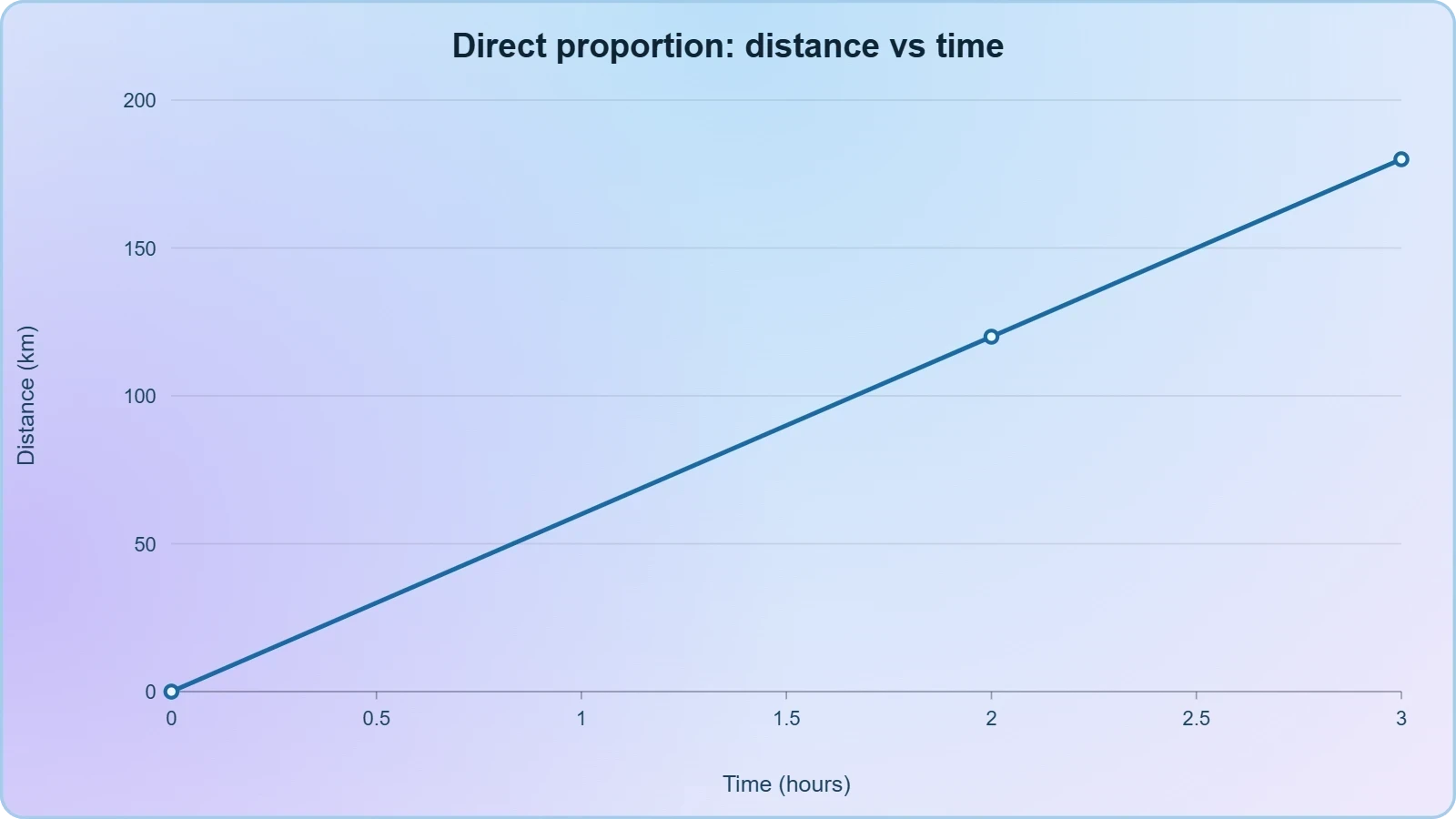
When speed remains constant, distance grows in lockstep with time. A vehicle covering ##120## kilometres in two hours will cover ##180## kilometres in three hours, because the ratio ##120:2## equals ##180:3##. Setting up such ratios converts many word problems into simple cross-multiplications.
Examiners exploit this pattern by supplying one complete journey and asking about a scaled version. The candidate need not compute the speed at all; the ratio of times directly gives the ratio of distances. Recognising this shortcut saves precious seconds in tightly timed sections.
Inverse Proportion Between Speed and Time
For a fixed distance, speed and time move in opposite directions. Doubling the speed halves the journey time, and tripling it reduces the time to one-third. This inverse relationship underpins countless exam questions about vehicles completing the same route at different speeds.
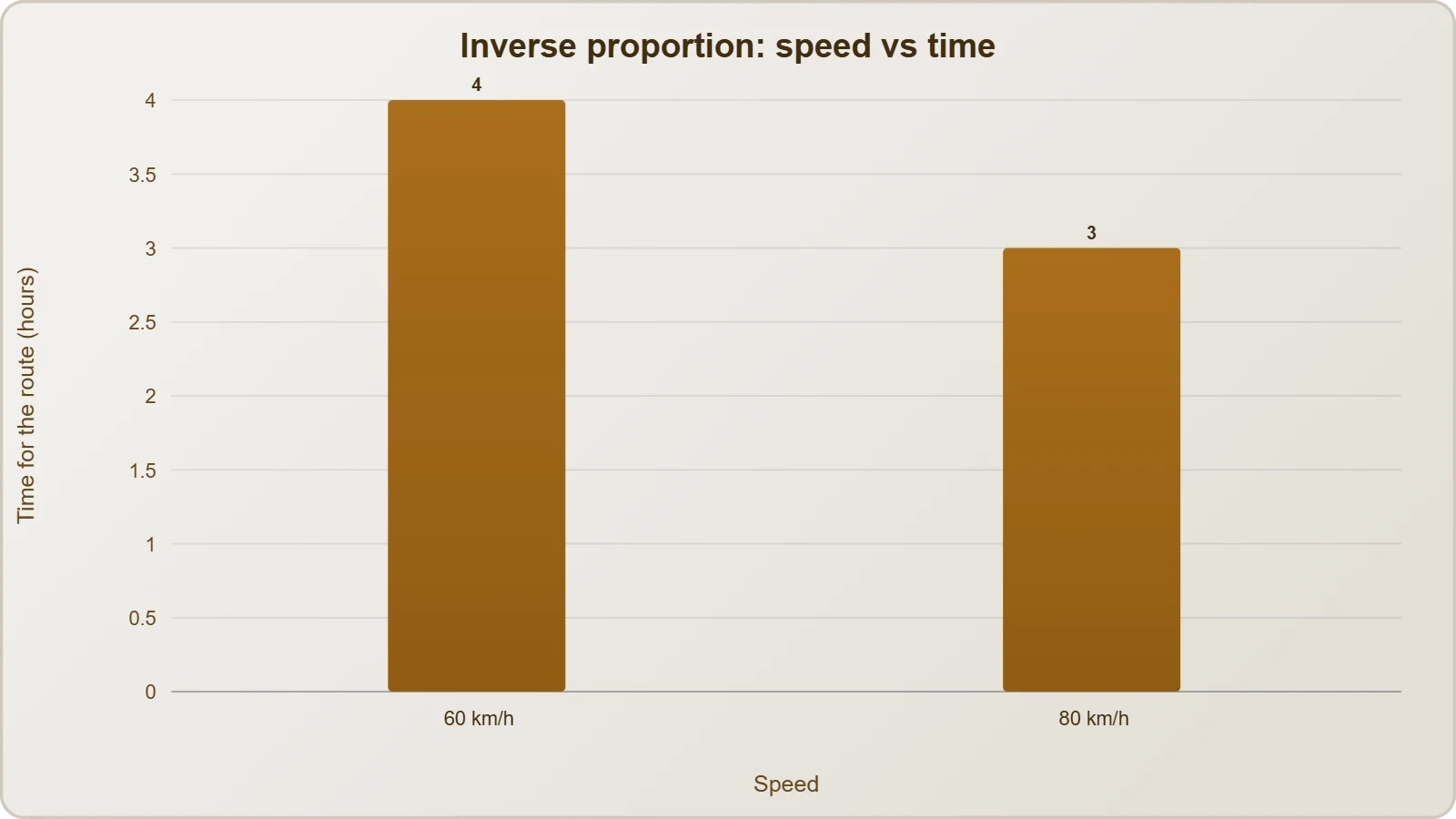
A car at ##60\ \text{km/h}## takes four hours for a route; at ##80\ \text{km/h}## the same route takes three hours. The speeds stand in the ratio ##3:4##, so the times stand in the ratio ##4:3##. Stating the inverse relationship explicitly prevents the direction errors that careless candidates commit.
Common Pitfalls and Examination Traps
Even candidates who understand the formula lose marks through predictable errors, and knowing these traps in advance is half the defence. The most frequent offenders involve mismatched units, misread questions, and arithmetic performed on clock times as though they were decimals. Each deserves explicit attention before the lesson closes.
Unit Mismatches and Silent Errors
Substituting minutes into a formula expecting hours produces answers wrong by a factor of sixty, and such errors often survive unchecked because the arithmetic itself looks clean. The discipline of converting every quantity to a common unit before substitution eliminates this entire class of mistake.
Similarly, speeds quoted in metres per second must not be multiplied by times quoted in hours. The next lesson treats conversions systematically, but candidates should already adopt the habit of writing units beside every number. Dimensional awareness catches errors that pure arithmetic conceals.
Misreading the Question's Demand
Papers frequently ask for the time in minutes while the natural computation yields hours, or ask for speed in metres per second while the data suits kilometres per hour. Reading the final demand before beginning the calculation prevents the frustrating situation of correct working paired with a wrong final answer.
Another trap involves journeys described in stages. A question may state that a traveller covers the first half of a route at one speed and the second half at another, then ask for total time. Each stage must be computed separately; averaging the speeds directly is a classic error reserved for later lessons.
Building Exam-Ready Fluency
Conceptual understanding becomes examination performance only through deliberate practice, and this lesson's closing section outlines how to convert knowledge into speed. The goal is not merely to solve problems correctly but to solve them within the unforgiving time limits that competitive papers impose on every candidate.
Structured Practice Routines
Begin with single-step problems that isolate one rearrangement, then progress to two-step problems combining duration extraction with multiplication. Only after these feel automatic should candidates attempt mixed sets where the required rearrangement is not signalled. This graduated approach builds genuine fluency rather than fragile familiarity.
Timed drills deserve a place in every study session. Solving ten straightforward problems in ten minutes trains the mental arithmetic and pattern recognition that examination conditions demand. Reviewing errors immediately after each drill converts mistakes into durable learning rather than repeated habits.
Preparing for the Next Lesson
This lesson has deliberately confined itself to consistent units, leaving conversions for the session that follows. Candidates should therefore arrive at Lesson Two comfortable with the formula in all three forms and ready to extend it across kilometres, metres, hours, minutes, and seconds without confusion.
A brief self-check confirms readiness: can you state the formula from memory, rearrange it instantly for any unknown, and explain why distance and time are directly proportional at constant speed? Affirmative answers mean the foundation is solid, and the course can proceed confidently to unit conversions and their importance.
Lesson Quiz and Key Takeaways
The quiz accompanying this lesson tests the three rearrangements and the proportional relationships in a compact format. Attempt it without reference material first, then review any missed items against the relevant section above. Accuracy matters more than speed at this stage, though both will be trained together in later sessions.
Sample Quiz Questions
A cyclist rides at ##15\ \text{km/h}## for ##40## minutes. What distance is covered? Converting to hours gives two-thirds of an hour, and multiplying by fifteen yields ten kilometres. Candidates who answered twelve have multiplied by the minutes directly, the exact error this lesson warns against.
A truck covers ##210## kilometres in ##3.5## hours. What is its speed? Dividing distance by time gives ##60\ \text{km/h}##. A second question asks how long the same truck needs for ##150## kilometres; dividing by sixty yields ##2.5## hours, or two hours thirty minutes.
Consolidating the Core Message
The lesson's central message is elegantly simple: speed, distance, and time are three views of one relationship, and every examination problem is a request to move between those views. Mastery means performing that movement accurately, quickly, and with units under control at all times.
Students who internalise this relationship now will find the remaining nine lessons of the course considerably lighter. Unit conversions, average speed, relative speed, and train problems all extend the same proportional logic introduced here. The foundation laid in this session supports every structure built upon it.
Also Read
- No links available.
From our network :
- Limits: The Squeeze Theorem Explained
- How to secure postgres connections across VPC, VPN, and cloud
- How to migrate to postgres using logical replication and cutover
- Bitcoin price analysis: Market signals after a muted weekend
- How to design postgres partitions with native and hash methods
- The Diverse Types of Convergence in Mathematics
- JD Vance Charlie Kirk: Tribute and Political Strategy
- Limit Superior and Inferior
- Bitcoin Hits $100K: Crypto News Digest
RESOURCES
- No results found.