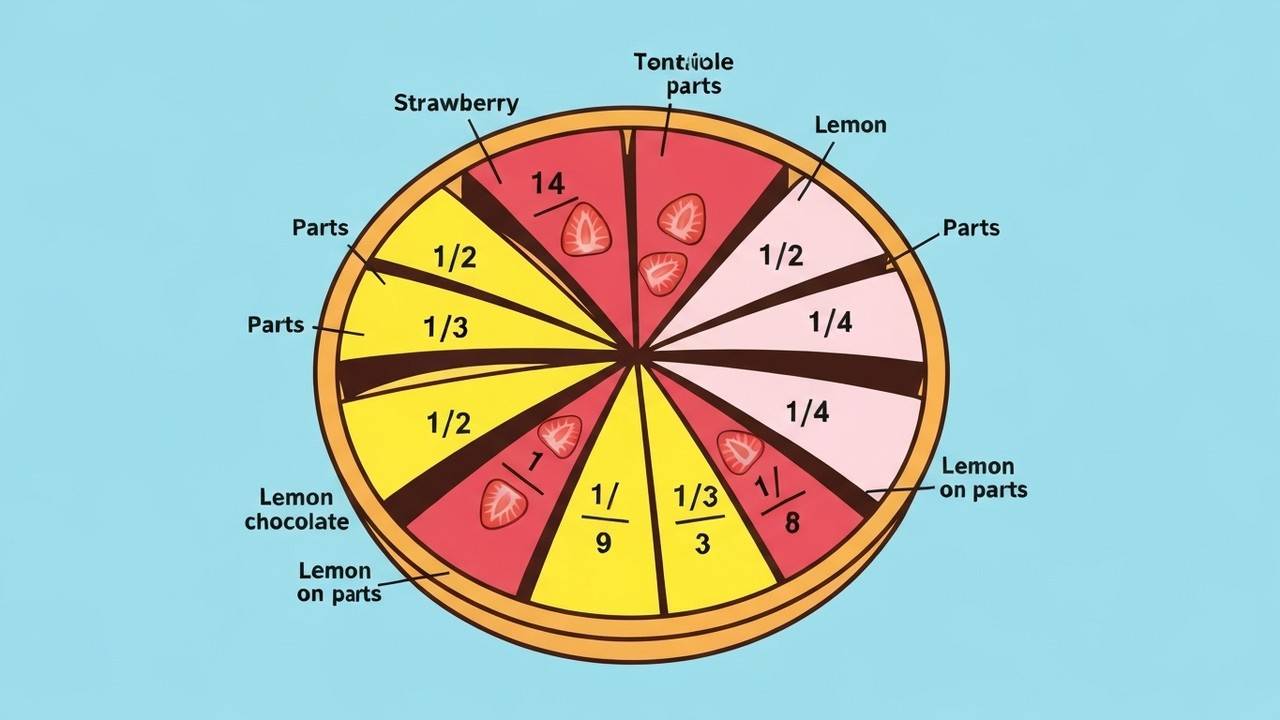
Fractions, representing parts of a whole, are essential in mathematics and everyday life. You will learn to understand and use fractions, which allows you to solve a wide range of problems, from dividing a pizza to calculating proportions. This guide helps you to master fractions and their applications.
On This Page
We Also Published
Understanding Fractions: A Comprehensive Guide
Fractions are a fundamental concept in mathematics, representing parts of a whole or ratios. This guide will help you understand fractions by exploring their definitions, types, operations, and historical context. You will learn to work with fractions effectively.
What is a Fraction?
What exactly *is* a fraction? Let's break it down.
What is a fraction?
A fraction represents a portion of a whole. The whole is divided into equal parts, and the fraction indicates how many of those parts we're considering. Fractions are used in everyday life, from cooking to measuring.
A fraction is written as ##a/b##, where *a* is the numerator (the number of parts we have) and *b* is the denominator (the total number of equal parts in the whole). For example, in the fraction ##3/4##, the numerator is 3 and the denominator is 4. This means we have 3 parts out of a total of 4 equal parts.
Fractions can represent different things. They can represent a portion of a pizza, the amount of ingredients in a recipe, or the probability of an event. They can also represent division and ratios, as we'll see later.
What do the numerator and denominator represent?
How do we interpret the two parts of a fraction?
The numerator represents the number of parts we are considering. The denominator represents the total number of equal parts that make up the whole. Think of it like a pie cut into equal slices. The numerator tells you how many slices you have, and the denominator tells you how many slices the pie was cut into.
For example, in the fraction ##5/8##, the numerator 5 means we have 5 parts. The denominator 8 means the whole is divided into 8 equal parts. So, ##5/8## represents 5 out of 8 equal parts of the whole.
Understanding the numerator and denominator is crucial for performing operations with fractions, comparing fractions, and understanding their real-world applications.
Give examples of fractions.
Can you show me some different kinds of fractions?
Examples of fractions include ##1/2## (one-half), ##1/4## (one-quarter), ##3/4## (three-quarters), and ##2/3## (two-thirds). These are all common fractions. There are also improper fractions (where the numerator is greater than the denominator), such as ##5/3##, and mixed numbers (a whole number and a fraction), such as ##1 1/2##.
Fractions can be positive or negative. For example, ##-1/2## represents negative one-half. Fractions can also be expressed as decimals (e.g., ##0.5## is equivalent to ##1/2##) or percentages (e.g., ##50%## is equivalent to ##1/2##).
Fractions are used in many different contexts. In a recipe, ##1/2## cup of flour means half a cup. In measuring, ##3/4## inch represents three-quarters of an inch. In probability, a fraction can represent the likelihood of an event.
Types of Fractions
What are the different classifications of fractions?
Fractions can be classified into different types based on their properties. Understanding these types is essential for performing operations and solving problems.
What is a proper fraction?
How do we know if a fraction is “proper” or not?
A proper fraction is a fraction where the numerator is less than the denominator. This means the fraction represents a value less than 1. Examples of proper fractions include ##1/2##, ##2/3##, ##3/4##, and ##5/8##. These fractions represent a part of a whole, not a whole or more than a whole.
Proper fractions always have a value between 0 and 1. They are always less than 1. You can visualize a proper fraction as a part of a pie that is smaller than the whole pie.
In a proper fraction, the denominator represents the total number of parts the whole is divided into, while the numerator represents how many of those parts you have. Proper fractions are the most common type encountered.
What is an improper fraction?
What if the numerator is larger than the denominator?
An improper fraction is a fraction where the numerator is greater than or equal to the denominator. This means the fraction represents a value of 1 or more. Examples of improper fractions include ##3/2##, ##4/4##, ##5/3##, and ##7/4##.
Improper fractions can be written as mixed numbers, which include a whole number and a proper fraction (e.g., ##3/2 = 1 1/2##). Improper fractions represent one whole or more than one whole.
Improper fractions are useful when dealing with quantities greater than one. For instance, ##5/4## represents a quantity larger than one. Improper fractions can be converted into mixed numbers to provide a clearer understanding of the quantity.
What is a mixed number?
What are mixed numbers, and how do they relate to fractions?
A mixed number is a number consisting of a whole number and a proper fraction. For example, ##1 1/2##, ##2 1/4##, and ##3 2/5## are mixed numbers. They represent a quantity that is more than one whole.
Mixed numbers are often used to express quantities that are not whole numbers but are greater than one. For example, if you have 2 whole pizzas and half of another pizza, you have ##2 1/2## pizzas.
Mixed numbers can be converted to improper fractions, and vice versa. For example, ##2 1/2## can be converted to ##5/2##. This conversion is crucial when performing operations like addition and subtraction.
What is a unit fraction?
What's special about a unit fraction?
A unit fraction is a fraction where the numerator is 1. Examples of unit fractions include ##1/2##, ##1/3##, ##1/4##, and ##1/5##. Unit fractions are fundamental in understanding fractions because they represent a single part of a whole.
Unit fractions are the building blocks of all other fractions. Any fraction can be expressed as a sum of unit fractions. For example, ##2/3## can be written as ##1/3 + 1/3##.
Unit fractions are important in historical contexts, such as the ancient Egyptian method of expressing fractions as sums of unit fractions. They simplify many calculations and provide a clear way to visualize fractional parts.
What is a complex fraction?
What does it mean for a fraction to be complex?
A complex fraction is a fraction where either the numerator, the denominator, or both contain a fraction. Examples include ##(1/2) / 3##, ##2 / (3/4)##, and ##(1/2) / (3/4)##. Complex fractions often arise in more advanced mathematical contexts.
Complex fractions are simplified by performing the division indicated. For example, ##(1/2) / 3## can be simplified to ##1/6## by dividing ##1/2## by 3 (which is the same as multiplying ##1/2## by ##1/3##).
Simplifying complex fractions involves understanding the rules of fraction division and multiplication. They are a valuable tool in algebra and calculus.
Operations with Fractions
How do we perform calculations with fractions?
Performing operations with fractions is a crucial skill. This section covers the basic operations: addition, subtraction, multiplication, and division. Let's learn to add, subtract, multiply, and divide fractions.
How to add fractions
How do you add fractions together?
To add fractions, they must have a common denominator. If the fractions already have a common denominator, you can simply add the numerators and keep the same denominator. For example, ##1/4 + 1/4 = 2/4##, which simplifies to ##1/2##.
If the fractions do not have a common denominator, you must find a common denominator (the least common multiple, or LCM, of the denominators) and convert each fraction to an equivalent fraction with that denominator. For example, to add ##1/2 + 1/3##, find the LCM of 2 and 3, which is 6. Convert ##1/2## to ##3/6## and ##1/3## to ##2/6##, and then add the numerators: ##3/6 + 2/6 = 5/6##.
Adding fractions is essential in various real-world scenarios, such as measuring ingredients in a recipe or calculating distances. Mastery of this skill is a cornerstone of mathematical proficiency.
How to subtract fractions
How does subtracting fractions work?
Subtracting fractions follows a similar process to addition. The fractions must have a common denominator. If they do, subtract the numerators and keep the same denominator. For example, ##3/4 - 1/4 = 2/4##, which simplifies to ##1/2##.
If the fractions do not have a common denominator, find a common denominator and convert each fraction to an equivalent fraction. For example, to subtract ##1/2 - 1/3##, find the LCM of 2 and 3, which is 6. Convert ##1/2## to ##3/6## and ##1/3## to ##2/6##, and then subtract the numerators: ##3/6 - 2/6 = 1/6##.
Subtracting fractions is used in various real-world contexts, such as determining the remaining amount of something after a portion has been used. The process is a key part of solving mathematical problems.
How to multiply fractions
How do we multiply fractions?
To multiply fractions, multiply the numerators together and multiply the denominators together. For example, ##1/2 * 1/3 = (1*1) / (2*3) = 1/6##. This process is straightforward and does not require a common denominator.
When multiplying fractions, you can often simplify the result by canceling common factors before multiplying. This simplifies the numbers and makes the calculation easier. For example, to multiply ##2/3 * 3/4##, cancel the 3s to get ##2/4##, which simplifies to ##1/2##.
Multiplication of fractions is fundamental in many calculations, such as finding a fraction of a quantity or scaling a recipe. This operation is essential in both theoretical and practical applications.
How to divide fractions
How do you divide with fractions?
To divide fractions, you invert the second fraction (the divisor) and multiply. This means you swap the numerator and denominator of the second fraction and then multiply the two fractions. For example, ##1/2 / 1/3 = 1/2 * 3/1 = 3/2##.
Dividing fractions is essentially the same as multiplying by the reciprocal. The reciprocal of a fraction is found by swapping the numerator and denominator. For example, the reciprocal of ##2/3## is ##3/2##. Dividing fractions is crucial in solving proportions and understanding ratios.
Division of fractions is a key concept in mathematics and is used in many different contexts. It's important to understand how to apply this rule to a range of problems.
Historical Context of Fractions
What's the history behind fractions?
The concept of fractions has a rich history, dating back to ancient civilizations. Understanding the historical development of fractions provides insight into their importance and evolution.
Ancient Egyptian fractions
What did the ancient Egyptians do with fractions?
The ancient Egyptians used fractions extensively, primarily unit fractions (fractions with a numerator of 1). They expressed all fractions except ##2/3## using sums of distinct unit fractions. For example, they might express ##2/5## as ##1/3 + 1/15##.
Egyptian fractions were written using hieroglyphs. The Egyptians had a special symbol for the fraction ##2/3##. This method of representing fractions reflects their practical needs in measuring and dividing.
The study of Egyptian fractions provides valuable insights into the mathematical practices of ancient civilizations. It reveals the ingenuity of early mathematicians in solving practical problems.
Greek contributions to fractions
How did the Greeks approach fractions?
The ancient Greeks built upon the foundation laid by the Egyptians. They used unit fractions and also explored continued fractions. They made significant advancements in understanding the properties and applications of fractions.
The Greeks were interested in the theoretical aspects of fractions and their relation to number theory. They recognized the irrationality of certain numbers, such as the square root of 2, which challenged the idea that all numbers could be expressed as fractions.
The Greeks' contributions laid the groundwork for further developments in mathematics. Their focus on both practical and theoretical aspects of fractions shaped the course of mathematical history.
Development of modern fraction notation
How did we get the fraction notation we use today?
The modern notation for fractions, with the numerator above the denominator separated by a horizontal line, emerged over time. This notation made fractions easier to write and work with, which enabled further mathematical progress. You'll learn how to approach fraction problems.
The use of the horizontal fraction bar became widespread during the Middle Ages. This notation, along with the development of decimal fractions, revolutionized the way fractions were used in calculations.
The evolution of fraction notation reflects the ongoing refinement of mathematical tools. The development of efficient notation systems has been crucial for the advancement of mathematical thought.
Key Takeaways
What are the most important things to remember about fractions?
Fractions are fundamental mathematical concepts representing parts of a whole, essential for understanding proportions, ratios, and division. You will learn to work with fractions effectively.
Understanding the different types of fractions, how to perform operations with them, and their historical context is key to success in mathematics. These concepts underpin many real-world applications.
Similar Problems (Quick Solutions)
What is ##1/2 + 1/3##?
The answer is ##5/6##.
What is ##2/5 - 1/10##?
The answer is ##3/10##.
What is ##1/4 * 2/3##?
The answer is ##1/6##.
What is ##3/4 / 1/2##?
The answer is ##3/2## or ##1 1/2##.
Convert ##3 1/4## to an improper fraction.
The answer is ##13/4##.
References
To further deepen your understanding, explore resources on fraction concepts, operations, and historical development. Study the key concepts, practice solving problems, and explore where to find more information on the topic.
| Type of Fraction | Description | Example |
|---|---|---|
| Proper Fraction | Numerator is less than the denominator. | ##2/3## |
| Improper Fraction | Numerator is greater than or equal to the denominator. | ##5/3## |
| Mixed Number | A whole number and a proper fraction. | ##1 1/2## |
| Unit Fraction | Numerator is 1. | ##1/4## |
| Complex Fraction | Numerator, denominator, or both contain a fraction. | ##(1/2) / (3/4)## |
RESOURCES
- Learn Fractions In 7 min ( Fast Review on How To Deal With ...
- What should I learn to make learning fractions easier? : r/learnmath
- Fractions Made EASY! - YouTube
- A Way to Make Fractions Easier to Understand for Upper Elementary ...
- The Easier Way to Teach Fractions - YouTube
- I'm crying. I'm university level but can't even do simple fractions. I can ...
- Learn Fractions in 9 Minutes! - YouTube
- I cannot for the life of me do fractions. : r/learnmath
- How to Understand Fractions: 13 Steps (with Pictures) - wikiHow
- Can someone explain dividing fractions? Really struggling to ...
- 4 Easy Strategies for Teaching Fractions | Frax
- Why are fractions so hard for some people to understand? - Quora
- Is it possible to understand decimals without understanding fractions ...
- Why do people find percentages easier to compare than fractions ...
- Understand fractions | Arithmetic | Math | Khan Academy
From our network :
- Limit Superior and Inferior
- Bitcoin price analysis: Market signals after a muted weekend
- How to secure postgres connections across VPC, VPN, and cloud
- How to migrate to postgres using logical replication and cutover
- JD Vance Charlie Kirk: Tribute and Political Strategy
- Limits: The Squeeze Theorem Explained
- Bitcoin Hits $100K: Crypto News Digest
- How to design postgres partitions with native and hash methods
- The Diverse Types of Convergence in Mathematics