On This Page
- Understanding the Core of Dynamics
- Inertia and the First Law of Motion
- Force, Mass, and Acceleration: The Second Law
- The Symmetry of Action-Reaction
- Common Forces in NEET Physics
- Mastering the Normal Reaction Force
- Tension and String Dynamics
- The Art of Free Body Diagrams (FBD)
- Solving Complex Pulley Systems
- Friction and Real Surface Motion
- Strategic Approaches for NEET MCQs
Understanding the Core of Dynamics
Newton’s Laws of Motion are not just theoretical postulates but the very language through which we understand the physical world. For a NEET aspirant, these laws provide the necessary tools to dissect complex mechanical systems into manageable components. Understanding how forces interact allows students to predict the motion of objects with high precision. This section introduces the fundamental mindset required to master dynamics effectively during your preparation.
Historical Significance of Newton's Work
The transition from Aristotelian views to Newtonian mechanics marked a massive shift in scientific thought during the 17th century. Isaac Newton’s ability to quantify the relationship between motion and force changed everything from engineering to astronomy. By establishing these three laws, he provided a universal framework that applies to both terrestrial and celestial bodies. This historical context helps students appreciate the elegance and durability of the laws they study today.
Significance in the NEET Syllabus
In the context of the NEET exam, Newton’s Laws are a high-weightage topic that influences several other units. Concepts from this chapter are frequently integrated with work-power-energy, rotational motion, and even electrostatics. A solid grasp here ensures that you can handle multi-concept questions that often appear in the physics section. Mastering these laws is essentially a prerequisite for scoring above 150 in the NEET physics paper.
Dynamics questions in NEET often test your ability to visualize physical scenarios and apply mathematical models to them. Whether it is a block sliding down an incline or a satellite orbiting a planet, the principles remain the same. Developing a strong conceptual foundation allows you to avoid rote memorization and rely on logical deduction. This approach is much more effective for tackling the unpredictable nature of competitive entrance exams.
The study of dynamics also fosters critical thinking skills that are useful throughout a medical career. Analyzing how forces act on the human body, such as in orthopedic mechanics, relies on these very same principles. By approaching Newton’s Laws with curiosity, you build a bridge between basic science and practical application. Let us now delve deeper into the specific laws and their practical implications for your exam.
Inertia and the First Law of Motion
The First Law of Motion, often called the Law of Inertia, defines the behavior of objects in the absence of a net force. It states that an object will remain in its state of rest or uniform motion unless acted upon by an external force. This concept is fundamental because it introduces the idea that motion does not require a force to maintain it. For NEET, understanding the nuances of inertia is crucial for conceptual MCQ questions.
Types of Inertia Explained
Inertia is categorized into three types: inertia of rest, inertia of motion, and inertia of direction. Inertia of rest is the tendency of an object to stay stationary, while inertia of motion keeps it moving at a constant velocity. Inertia of direction is the resistance an object offers to changing its path of travel. Recognizing these distinctions helps in solving descriptive problems where physical intuition is tested against theoretical definitions.
Equilibrium Concepts for NEET
An object is in equilibrium when the vector sum of all external forces acting upon it is zero. In NEET problems, you will often encounter static equilibrium where the object is at rest. Translatory equilibrium means the acceleration is zero, even if the object is moving at a constant speed. Mastering the conditions for equilibrium is the first step in solving complex multi-body problems involving strings and surfaces.
The First Law also serves as a definition for an inertial frame of reference, which is essential for applying Newton's equations. In a non-inertial frame, such as a turning car, pseudo-forces must be considered to maintain the validity of the laws. NEET aspirants must be careful to identify the frame of reference before setting up their force equations. This subtle distinction can often be the difference between a correct and an incorrect answer.
Mathematically, the first law implies that if ##\sum \vec{F} = 0##, then ##\vec{v}## is constant. This simple relationship is the basis for many "find the missing force" type questions in the exam. Students should practice identifying all forces, including gravity and normal reaction, to ensure the net force is correctly calculated. This systematic approach reduces errors during the high-pressure environment of the NEET examination.
Force, Mass, and Acceleration: The Second Law
The Second Law of Motion provides the quantitative link between force and the resulting change in motion. It states that the rate of change of momentum is directly proportional to the applied force and occurs in its direction. This law is most commonly expressed in the form of the equation ##F = ma## for objects with constant mass. For NEET, this is the most frequently used formula in the mechanics section.
Mathematical Formulation of the Second Law
The general form of the second law involves the derivative of momentum with respect to time. This is expressed as:
In most NEET problems, the mass ##m## is constant, simplifying the expression to the product of mass and acceleration. However, for variable mass systems like rockets, the full derivative form must be utilized to find the correct force.
Impulse-Momentum Theorem Applications
Impulse is defined as the change in momentum and is calculated as the integral of force over time. In NEET, impulse problems often involve collisions or sudden changes in velocity where the force is not constant. The theorem states that:
Understanding this relationship allows students to solve problems involving bats hitting balls or jumping from heights where impact time is a factor.
The second law is a vector equation, meaning it must be satisfied independently in the x, y, and z directions. When solving problems, it is helpful to resolve forces into perpendicular components to simplify the math. This component-wise analysis is a standard technique for dealing with motion on inclined planes or curved paths. It ensures that all influences on the object's acceleration are accounted for systematically.
Mass in the second law represents "inertial mass," which is a measure of how much an object resists acceleration. A larger mass requires a greater force to achieve the same change in velocity compared to a smaller mass. This proportionality is a key concept in NEET questions comparing the behavior of different objects under identical force conditions. Mastering the units and dimensions of force is also essential for clearing basic conceptual hurdles.
The Symmetry of Action-Reaction
Newton’s Third Law states that for every action, there is an equal and opposite reaction. This law highlights that forces always exist in pairs and never in isolation. In the NEET context, this law is vital for understanding how objects interact with each other and their environment. It simplifies the analysis of internal forces within a system of connected particles or bodies.
Misconceptions About Action-Reaction Pairs
A common mistake among students is thinking that action and reaction forces cancel each other out. However, these forces always act on two different bodies, so they cannot neutralize one another. For instance, if you push a wall, the wall pushes you back with equal force, but these forces affect different objects. Clarifying this distinction is essential for correctly applying the laws of motion in multi-body scenarios.
Internal vs External Forces
In a system of multiple objects, internal forces are the action-reaction pairs between the components of the system. When analyzing the system as a whole, these internal forces sum to zero and do not contribute to the net acceleration. Only external forces, such as gravity or an applied push, determine the motion of the system's center of mass. Distinguishing between internal and external forces is a critical skill for simplifying complex NEET problems.
The third law also explains the mechanics of walking, swimming, and propulsion. When a swimmer pushes the water backward, the water pushes the swimmer forward with an equal and opposite force. This principle is applied in NEET questions involving man-boat problems or recoil of guns. Understanding the conservation of momentum, which is a direct consequence of the third law, is also highly beneficial.
In problems involving contact between two blocks, the contact force (normal reaction) is an action-reaction pair. If block A pushes block B, then block B pushes block A with the same magnitude. Writing separate equations for each block while keeping the reaction force consistent is the key to solving for acceleration. This symmetry ensures that the total force balance of the universe remains consistently in equilibrium.
Common Forces in NEET Physics
To solve problems effectively, one must be familiar with the various types of forces encountered in the syllabus. These include gravitational force, contact forces like normal reaction and friction, and tension in strings. Each force has specific characteristics and rules for its direction and magnitude. NEET often tests the ability to identify these forces in a given physical setup accurately.
Gravitational Force and Weight
Weight is the gravitational pull exerted by the Earth on an object, calculated as ##W = mg##. In most NEET problems, the acceleration due to gravity ##g## is taken as ##9.8 \, m/s^2## or approximated to ##10 \, m/s^2##. Weight always acts vertically downward toward the center of the Earth, regardless of the orientation of the surface. Correctly placing the weight vector is the first step in constructing any Free Body Diagram.
Spring Forces and Hooke's Law
Springs exert a restorative force that is proportional to the displacement from their equilibrium position. This is governed by Hooke's Law: ##F_s = -kx##, where ##k## is the spring constant. In NEET, spring problems often involve energy conservation or oscillations in addition to basic force balance. Understanding how springs behave in series and parallel combinations is also a common topic for competitive exam questions.
We Also Published
Electromagnetic forces also play a role in mechanics, specifically in the form of tension and normal reaction at the atomic level. While NEET Physics separates these into different chapters, recognizing their origin helps in understanding why surfaces don't merge. For the purpose of mechanics, we treat these as macroscopic contact forces with defined directions. This simplification allows us to focus on the dynamics of the system without getting lost in subatomic details.
Buoyant force is another common force encountered when objects are submerged in fluids. While primarily discussed in fluid mechanics, it often appears in Newton's Law problems involving floating objects. The buoyant force acts upward and is equal to the weight of the displaced fluid. Being able to combine buoyancy with gravity and tension is a hallmark of a well-prepared NEET candidate.
Mastering the Normal Reaction Force
The normal reaction is a contact force exerted by a surface on an object in a direction perpendicular to the interface. It is a "self-adjusting" force that prevents an object from passing through a solid surface. In NEET, calculating the normal reaction is essential for determining friction and analyzing motion on inclined planes. Many students struggle with its direction, especially on curved or slanted surfaces.
Contact Surface Analysis
The magnitude of the normal force depends on the other forces acting on the object. For a block on a horizontal table, ##N = mg## if no other vertical forces are present. However, if you push down on the block, the normal force increases to balance the extra load. Conversely, if you pull upward, the normal force decreases, illustrating its reactive nature in maintaining surface integrity.
Inclined Plane Reactions
On an inclined plane of angle ##\theta##, the normal force is not equal to the full weight of the object. Instead, it balances the component of gravity perpendicular to the surface, which is ##mg \cos \theta##. The component ##mg \sin \theta## acts parallel to the plane, causing the object to slide down. NEET questions frequently use this setup to test if students can resolve weight vectors correctly.
Normal reaction can also be observed in accelerating systems, such as an elevator. When an elevator accelerates upward, the normal force (and thus the apparent weight) increases: ##N = m(g + a)##. If the elevator accelerates downward, the normal force decreases: ##N = m(g - a)##. Understanding these variations is crucial for solving "man in a lift" problems, which are a staple of the NEET physics section.
In circular motion, the normal force can contribute to the centripetal force required to keep an object on its path. For example, a car on a banked road or a pilot in a loop-the-loop experience varying normal forces. These problems require a combination of Newton's second law and circular kinematics. Mastering the normal reaction in these contexts demonstrates a high level of conceptual clarity.
Tension and String Dynamics
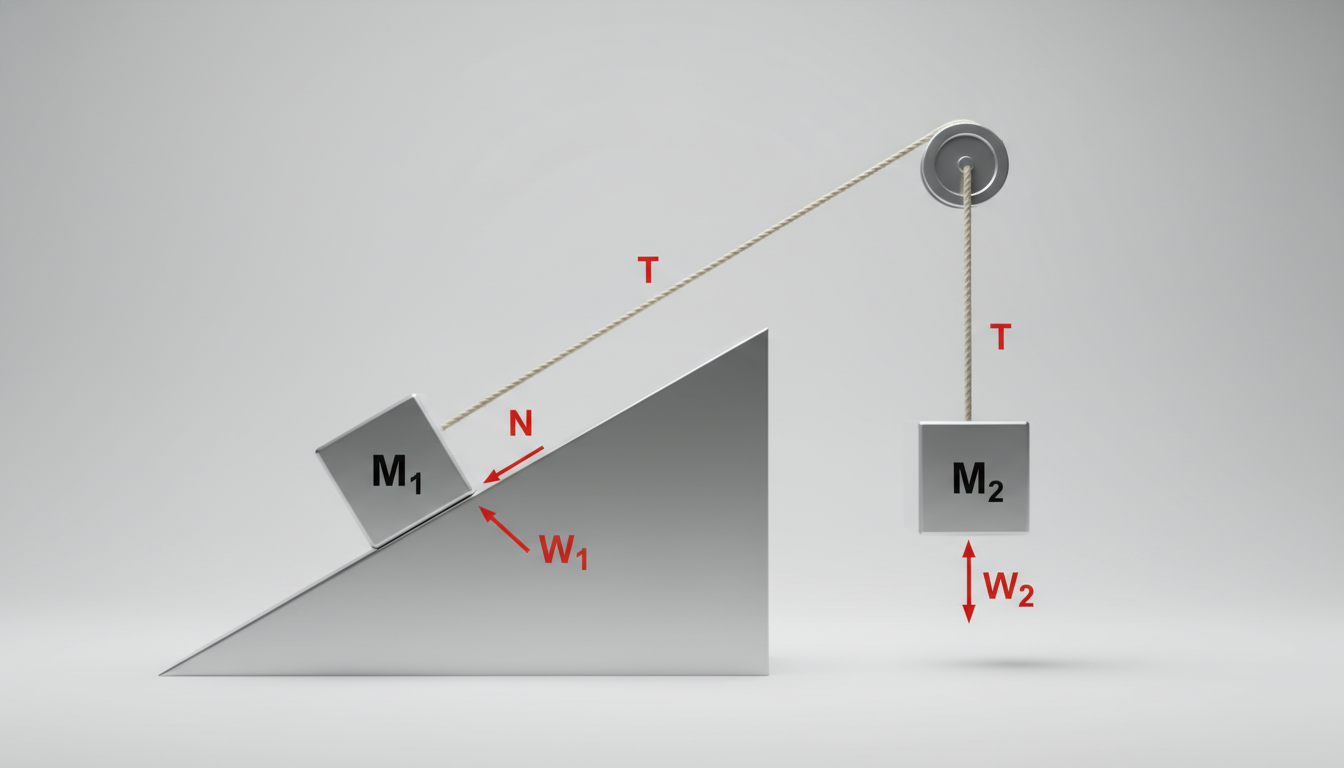
Tension is the pulling force transmitted through a string, rope, or cable when it is pulled by forces acting from opposite ends. In NEET, strings are usually considered "ideal," meaning they are massless and inextensible. This simplification allows the tension to be uniform throughout the length of the string. Understanding tension is vital for solving problems involving pulleys and connected masses.
Ideal String Assumptions
An ideal string has no mass, so it does not require any net force to accelerate itself. This implies that the tension is the same at every point along the string, even if the system is moving. Additionally, being inextensible means that all connected objects must move with the same acceleration magnitude. These assumptions significantly reduce the complexity of the equations of motion for NEET aspirants.
Massive String Considerations
Occasionally, NEET may present a problem involving a string with a non-negligible mass. In such cases, the tension varies along the length of the string because the string itself must be accelerated. The tension at a point is responsible for pulling the remaining mass of the string plus any attached load. Solving these requires a more nuanced approach, often involving integration or linear mass density calculations.
When a string passes over a frictionless and massless pulley, the magnitude of tension remains unchanged on both sides. This is a key principle for solving Atwood machines and other pulley configurations. However, if the pulley has mass and friction, the tensions on either side will differ to provide the necessary torque for rotation. While NEET primarily focuses on ideal pulleys, being aware of these factors is helpful.
Tension always acts away from the body being analyzed. If you are drawing a Free Body Diagram for a block hanging from a ceiling, the tension vector points upward. If you are analyzing the ceiling hook, the tension vector points downward. Consistently applying this "pulling" rule prevents sign errors in your force equations. This disciplined approach is essential for accurate problem-solving in physics.
The Art of Free Body Diagrams (FBD)
A Free Body Diagram (FBD) is a visual representation used to analyze the forces acting on a single object. It involves isolating the object from its surroundings and replacing all contacts with force vectors. For NEET, mastering the FBD is the single most important skill for solving mechanics problems. A well-drawn FBD translates a physical description into a solvable mathematical equation.
Step-by-Step Construction of FBD
To draw an FBD, first identify the object of interest and represent it as a point or a simple box. Next, draw the gravitational force acting vertically downward from the center. Then, identify all contact points and add normal reaction, friction, or tension vectors accordingly. Finally, ensure all vectors are labeled correctly with their magnitudes and directions relative to a chosen coordinate system.
Coordinate System Selection
Choosing the right coordinate system can greatly simplify the math. Usually, it is best to align one axis with the direction of expected acceleration. For a block on an incline, the x-axis should be parallel to the plane and the y-axis perpendicular to it. This choice ensures that acceleration only appears in one equation, reducing the number of simultaneous equations you need to solve.
An FBD must only include forces *acting on* the object, not forces exerted *by* the object. Forgetting this rule often leads to the inclusion of extra forces that complicate the analysis. For example, in an action-reaction pair, only one of the forces belongs on the FBD of a specific block. Accuracy in this step is what separates top scorers from average students in the NEET exam.
Once the FBD is complete, apply Newton's Second Law for each axis: ##\sum F_x = ma_x## and ##\sum F_y = ma_y##. This systematic translation from diagram to algebra minimizes the chance of overlooking a force. It also provides a clear path to the solution, even for problems that initially seem overwhelming. Consistent practice with FBDs builds the "physics intuition" needed for fast-paced exams.
Solving Complex Pulley Systems
Pulley systems are a favorite topic in NEET because they test multiple concepts simultaneously. They involve tension, acceleration constraints, and multiple connected bodies. Solving these requires a combination of FBDs for each mass and a clear understanding of how their motions are linked. This section focuses on the strategies needed to navigate these problems without getting confused.
Single Fixed Pulleys
A single fixed pulley changes the direction of the applied force but does not provide a mechanical advantage. In an Atwood machine (two masses hanging over a pulley), the acceleration is given by:
This formula is derived by writing FBD equations for both masses and eliminating the tension variable. Understanding this derivation is more important than memorizing the result for NEET.
Movable Pulley Constraints
Movable pulleys provide a mechanical advantage but introduce constraint relations between the accelerations of different blocks. If a pulley moves, the length of the string on either side changes, leading to a specific ratio of velocities and accelerations. For example, if one end of a string is fixed and the other is pulled, a movable pulley might move at half the speed of the free end. Mastering these "string constraints" is vital for advanced NEET problems.
The "Virtual Work Method" is a powerful shortcut for finding constraint relations in complex pulley systems. It states that the total work done by internal tensions in an inextensible string system is zero. By setting ##\sum \vec{T} \cdot \vec{x} = 0## and differentiating, you can quickly find the relationship between the accelerations of all connected bodies. This technique saves valuable time during the MCQ-based NEET exam.
When multiple pulleys are involved, always start by labeling the tension in one segment and determining others based on pulley equilibrium. For a massless pulley, the sum of tensions on one side must equal the tension on the other. This step-by-step labeling ensures that your equations are consistent across the entire system. Pulley problems may look intimidating, but they are very logical once you break them down.
Friction and Real Surface Motion
In the real world, surfaces are not perfectly smooth, and friction plays a significant role in dynamics. Friction is the force that opposes the relative motion (or the tendency of motion) between two surfaces in contact. NEET questions often incorporate friction to add a layer of realism and complexity to standard Newton’s Law problems. Understanding the different types of friction is key to solving these accurately.
Static vs Kinetic Friction
Static friction acts when there is no relative motion between surfaces, and it is a self-adjusting force up to a maximum limit. Kinetic friction acts when there is actual sliding occurring between the surfaces. The maximum static friction is given by ##f_{s,max} = \mu_s N##, while kinetic friction is ##f_k = \mu_k N##. Usually, ##\mu_s > \mu_k##, meaning it is harder to start motion than to keep it going.
Angle of Repose and Friction
The angle of repose is the maximum angle of an inclined plane at which an object remains at rest without sliding. At this angle, the component of gravity down the slope equals the maximum static friction. Mathematically, this is expressed as ##\tan \theta = \mu_s##. Understanding this concept helps in quickly determining if a block will slide or stay put in NEET problems involving inclines.
Friction always acts in a direction that opposes the relative slipping of surfaces. This can sometimes be counter-intuitive, such as the friction on a walking person’s foot acting forward. In NEET, always look at the direction the object *wants* to move relative to the surface it is touching. This "relative motion" perspective is the most reliable way to assign the correct direction to the friction vector.
Friction can also act as a centripetal force, such as when a car turns on a flat circular road. In these cases, static friction provides the necessary force to prevent the car from skidding outward. The maximum safe speed for such a turn is ##v = \sqrt{\mu rg}##. Combining friction with circular motion is a common way NEET tests your ability to synthesize different physics topics.
Strategic Approaches for NEET MCQs
The NEET exam is not just about knowing the concepts but also about how quickly and accurately you can apply them. Physics is often considered the most challenging section due to the time-consuming nature of numerical problems. Developing a specific strategy for Newton’s Laws can help you gain a significant advantage. This final section provides actionable tips to improve your MCQ performance.
Time Management Tips
In NEET, you have less than a minute per question on average. To save time, avoid lengthy calculations by looking for patterns and using standard results for common setups like Atwood machines. Practice mental math and rounding where appropriate, especially when the options are far apart. Focus on setting up the correct equation first; often, the algebra becomes simple once the physics is right.
Elimination Techniques
If you are unsure of the exact answer, use dimensional analysis to eliminate incorrect options. Check the units of the given choices—if a question asks for force, the answer must have units of Newtons (##MLT^{-2}##). Also, consider extreme cases: what happens if the mass becomes zero or the angle becomes 90 degrees? These "boundary condition" checks can often reveal the correct answer without full derivation.
Read the questions carefully to identify keywords like "smooth," "massless," or "constant velocity." These words are clues that simplify the problem by allowing you to ignore friction, string mass, or acceleration. Missing a single word can lead to choosing a "distractor" option designed to catch students who make common assumptions. Paying attention to detail is just as important as knowing the formulas.
Practice with previous years' NEET papers to familiarize yourself with the recurring themes in dynamics. You will notice that certain types of problems, like blocks in contact or pulleys on inclines, appear almost every year. By mastering these "prototype" problems, you can solve them almost reflexively during the actual exam. Consistency in practice builds the confidence needed to tackle the physics section effectively.
From our network :
- How to design postgres partitions with native and hash methods
- How to migrate to postgres using logical replication and cutover
- JD Vance Charlie Kirk: Tribute and Political Strategy
- Limits: The Squeeze Theorem Explained
- Limit Superior and Inferior
- How to secure postgres connections across VPC, VPN, and cloud
- The Diverse Types of Convergence in Mathematics
- Bitcoin price analysis: Market signals after a muted weekend
- Bitcoin Hits $100K: Crypto News Digest
RESOURCES
- No results found.