India stands at a pivotal demographic juncture where its burgeoning youth cohort represents immense potential alongside severe economic vulnerabilities. Recent civil unrest centered on competitive examination procedures highlights profound structural fissures across entry-level employment markets nationwide.
Addressing these tensions requires scrutinizing the divergence between statistical workforce indicators and the lived realities of educated job seekers. Beneath aggregate macroeconomic expansion lies a stubborn deficit of durable, high-productivity formal employment opportunities for young citizens.
A sustainable path forward demands systemic industrial modernization, institutional overhaul within tertiary education, and supportive civil infrastructure. Without coordinated policy intervention across demand and supply dimensions, demographic advantages risk translating into persistent socioeconomic friction.
TL;DR While headline youth unemployment figures in India show moderate reductions, university graduate unemployment hovers near thirty percent alongside falling real entry wages. Resolving this crisis requires expanding labor-intensive manufacturing, green economy positions, female labor support, and educational quality controls.
On This Page
- Macroeconomic Divergence and Youth Labor Realities
- Supply-Side Distortions and the Higher Education Landscape
- Structural Bottlenecks in Industrial Labor Absorption
- Regional Disparities and Underemployment Dynamics
- The Exam Industrial Complex and Institutional Integrity
- Strategic Policy Pathways for Structural Transformation
Macroeconomic Divergence and Youth Labor Realities
Aggregate macroeconomic metrics often mask deep generational challenges within Indian labor markets, creating significant disconnects between headline gross domestic product expansion and real employment stability for emerging young workers across urban and semi-urban regions.
Evaluating Aggregate Unemployment Statistics
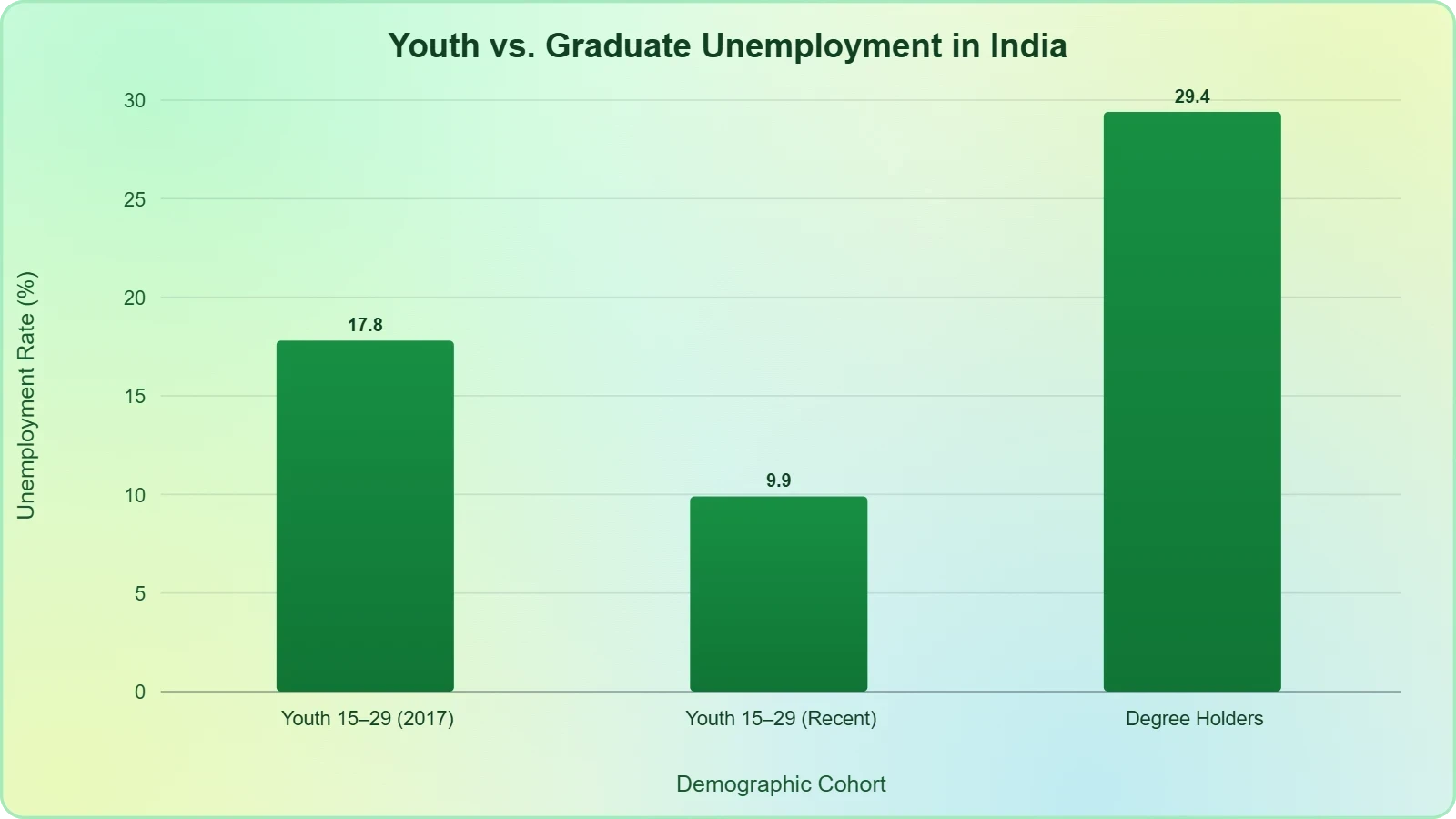
Government statistical agencies report that youth unemployment among individuals aged 15 to 29 declined substantially from 17.8 percent in 2017 to roughly 9.9 percent recently. This reduction appears encouraging on paper yet obscures deeper qualitative trends.
A critical consideration involves labor force participation rates, which frequently fall when discouraged candidates abandon active searches. Consequently, lower statistical unemployment rates do not automatically indicate the creation of sustainable, high-quality career pathways for modern Indian graduates.
International observers note that definitions of employment encompass precarious agricultural subsistence alongside unpaid familial assistance. When individuals settle for marginal self-employment out of acute financial distress, headline surveys record them as successfully employed economic agents.
This statistical illusion blinds observers to the widening gap between aspirations and outcomes. Emerging generations invest heavily in credentials only to encounter an economic machinery unable to absorb their capabilities into value-added productive institutional frameworks.
The Graduate Paradox and Precarious Participation
Unemployment among educated degree-holders tells an entirely different story, holding persistently near 29.4 percent across metropolitan and suburban zones. Tertiary credentials no longer guarantee economic mobility, leaving millions stranded in protracted transitional uncertainty.
International Labour Organization statistics for youth aged 15 to 24 highlight an employment-to-population ratio of only 26 percent. Concurrently, nearly 26 percent remain outside education, employment, or technical training, representing severe systemic human capital underutilization.
The resulting economic strain forces credentialed youth into underemployment across gig platforms and petty trade. Degrees in engineering, humanities, and commerce often fail to secure compensation commensurate with the private expenditure incurred during collegiate enrollment.
This dynamic fuels chronic disillusionment among educated cohorts whose social expectations were shaped by promises of modern knowledge-economy growth. Their predicament underscores that nominal qualification expansion without structural industrial absorption produces widespread generational disaffection.
Supply-Side Distortions and the Higher Education Landscape
The aggressive expansion of collegiate access across the nation over recent decades has introduced profound quality discrepancies, transforming higher education into an uneven marketplace prioritizing institutional throughput over rigorous skill development.
Commercial Expansion of Tertiary Institutions
India currently hosts more than 72,500 registered higher education institutions, representing an immense numerical increase compared to earlier decades. Approximately 80 percent of these establishments operate under private management models designed primarily for enrollment scale.
This rapid commodification replaced the public-private balance characteristic of late twentieth-century higher education. While physical access expanded dramatically, academic standards, infrastructure development, and faculty mentorship failed to scale concurrently across suburban and rural campuses.
Many private colleges function without adequate technical laboratories, up-to-date curricula, or qualified academic faculty. Consequently, students incur substantial financial debts while earning degrees that lack academic rigor and substantive recognition among competitive private-sector employers.
The outcome is an institutional architecture that sells academic credentials detached from real technical competency. This structural deficit degrades degree integrity across disciplines, leaving graduates poorly equipped for evolving market requirements.
The Chronic Skills Disconnect
Surveys conducted across major corporate enterprises routinely reveal that only a fraction of technical graduates possess baseline professional readiness. Curricula remain outdated, emphasizing rote theoretical memorization over pragmatic problem-solving and modern digital workflows.
Graduates frequently find themselves overqualified on paper yet underprepared for the analytical requirements of modern industry. This profound mismatch leads to widespread underemployment, where degree holders must accept roles requiring minimal technical training.
Technical disciplines often teach software languages and mechanical principles long discarded by commercial developers. Without mandatory apprenticeships or ongoing industry collaboration, educational programs produce talent profiles fundamentally misaligned with emerging market demands.
Employers must consequently allocate substantial capital toward basic remedial orientation or abandon broad graduate recruitment altogether. This friction increases recruitment costs and deepens graduate vulnerability across competitive labor markets.
We Also Published
Structural Bottlenecks in Industrial Labor Absorption
The inability of the domestic economy to absorb millions of job entrants stems from an uneven development trajectory that bypassed classical labor-intensive industrialization in favor of capital-intensive services.
Manufacturing Stagnation and Premature Deindustrialization
Historically, emerging nations expanded formal employment by transitioning low-productivity agricultural workers into labor-intensive industrial factories. India experienced premature deindustrialization, with manufacturing employment stagnating near 12 percent of total labor for decades.
Factory growth centered largely on capital-intensive sectors like chemicals, automobiles, and advanced pharmaceuticals. These high-productivity operations utilize automated assembly systems that generate limited direct floor employment for non-technical workers.
Regulatory hurdles, uneven infrastructure, and logistical frictions have hindered mass assembly operations seen elsewhere in East Asia. As a result, millions exiting agricultural work miss out on formal industrial apprenticeships and steady manufacturing employment.
Without a dynamic manufacturing base to anchor mass recruitment, labor must turn to marginal construction or gig commerce. These unstable alternatives leave workers exposed to market volatility without formal protections or benefits.
The Limits of Service-Led Growth
India’s celebrated service boom created significant wealth through software development, finance, and telecommunications. However, these sectors absorb only a narrow tier of elite graduates, leaving the broader youth cohort largely disconnected from modern growth drivers.
Between 2004 and 2011, rapid enterprise digitization sparked widespread white-collar wage growth across major tech hubs. Yet between 2017 and 2023, entry-level salaries for technical recruits declined in real terms due to supply saturation.
Advanced services require sophisticated domain proficiencies that average regional colleges fail to provide. Consequently, software vendors struggle with skill shortages even as thousands of computer science graduates submit resumes unsuccessfully.
This dynamic illustrates that knowledge services cannot single-handedly solve mass youth unemployment. An economy cannot rely solely on high-skill service exports while neglecting the broad industrial infrastructure needed for inclusive hiring.
Regional Disparities and Underemployment Dynamics
National employment aggregates conceal wide differences across state economies, reflecting divergent localized policies, demographic trajectories, and distinct regional industrial compositions.
The Subnational Divergence
Regional variations underscore the complexity of India’s employment landscape. In states like Kerala, youth unemployment reaches 29.9 percent, whereas agrarian-dominated Madhya Pradesh reports rates as low as 2.6 percent in official labor surveys.
This stark divergence stems from differing structural realities. In affluent, highly literate southern states, educated youth can afford to defer work while searching for formal roles that match their aspirations and qualifications.
Conversely, in agrarian economies, economic precarity leaves little room for extended job searches. Young workers must take on any available task, resulting in pervasive informal underemployment that registers statistically as stable work.
These geographic disparities prevent uniform national remedies. Policymakers must develop tailored regional strategies that account for local literacy levels, industrial capacities, and the specific employment expectations of their workforces.
Informality as the Default Economy
Informality remains the defining feature of India's labor ecosystem, absorbing over 90 percent of young workers. These roles lack formal employment contracts, paid leave, medical benefits, and legal protection against sudden termination.
The gig economy has expanded as a transitional outlet for young workers seeking financial independence. However, long shifts, lack of career advancement, and piece-rate compensation leave these workers vulnerable to economic fluctuations.
The ubiquity of informal arrangements suppresses household savings and delays wealth building for young adults. Without institutional protections, unexpected medical emergencies or economic downturns can push families into severe debt.
The informal economy serves as a crucial social buffer preventing widespread poverty, but it cannot deliver long-term security. Sustainable growth requires systematically converting informal activities into regulated, protected employment frameworks.
The Exam Industrial Complex and Institutional Integrity
The scarcity of stable formal employment has driven intense competition for secure public-sector positions, creating an extensive commercial coaching industry across major urban centers.
The Public Sector Fixation
Job security, social status, and retirement protections make government roles intensely desirable. Millions of hopefuls compete for modest clerical, railway, or administrative positions, generating applicant ratios that often exceed five hundred candidates per post.
Candidates dedicate their peak productive years—often from ages 20 to 30—to cyclical testing regimens. This practice represents a profound misallocation of talent, diverting energetic minds from entrepreneurial ventures into repetitive rote learning.
The coaching industry thrives on these aspirations, extracting significant fees from middle-class families. Hubs like Prayagraj, Kota, and Mukherjee Nagar house hundreds of thousands of aspirants pursuing elusive public-sector appointments.
This prolonged dedication carries high personal costs. When aspirants age out of eligibility lists after years of preparation, they re-enter the private market with outdated resumes, little practical experience, and reduced career prospects.
Paper Leaks and Procedural Vulnerabilities
The high stakes of competitive testing have fostered an illicit network of compromised administrators, intermediaries, and testing centers. Systematic paper leaks, digital compromises, and irregular grading trigger recurring cancellations of national examinations.
These procedural failures triggered widespread youth-led demonstrations in 2026 across major northern transit hubs and capital centers. Aspirants protested against corrupt examination networks that devalue years of rigorous study and financial sacrifice.
When testing authorities abruptly cancel sessions due to compromised security, millions lose travel expenses and months of focused preparation. This volatility erodes institutional credibility, leaving candidates deeply cynical about merit-based recruitment systems.
Rebuilding faith in public evaluations requires end-to-end digital security, clear transparency, and strict accountability for bad actors. Without institutional integrity, competitive examinations will continue to heighten social and economic instability.
Strategic Policy Pathways for Structural Transformation
Resolving India’s youth employment challenge requires looking beyond piecemeal skills initiatives toward an integrated economic strategy that stimulates private labor demand while supporting emerging workers.
Labor-Intensive Industrial Policy and Frontier Sectors
National fiscal policy must evolve beyond capital-intensive production-linked incentives toward schemes tied directly to verified payroll expansion. Fiscal rewards should support sectors that absorb substantial labor, including textiles, footwear, food processing, and consumer electronics.
Concurrently, proactive policy should prepare candidates for opportunities in artificial intelligence engineering, green energy, and environmental retrofitting. Public investments in smart electricity networks and solar infrastructure can generate high-quality technical jobs nationwide.
Strengthening the domestic care economy—encompassing early childhood education and healthcare services—offers an underutilized opportunity. Formalizing these occupations establishes meaningful service professions while addressing unmet public needs across rural and urban centers.
Transitioning from uncoordinated skill programs to intentional demand generation ensures that emerging graduates meet active corporate and municipal recruitment pipelines. Industrial strategy must directly align capital deployment with labor absorption priorities.
Dismantling Barriers to Female Labor Force Participation
India’s economic potential remains constrained by low female labor force participation. Entrenched social expectations, unsafe public transportation, and limited affordable urban housing deter millions of educated women from entering and remaining in the workforce.
Overcoming these obstacles requires modern municipal infrastructure. State governments should invest in secure, well-lit public transit systems, subsidized child-care centers, and regulated hostel accommodations across expanding industrial corridors.
Legislative frameworks must enforce non-discriminatory hiring and transparent equal-pay standards across private firms. Supporting remote work arrangements can also help women balance career commitments with cultural constraints.
Enabling women to participate fully in the formal economy would significantly raise domestic household incomes and strengthen growth. An economy that leaves its female talent underutilized cannot achieve its broader demographic ambitions.
From our network :
- How to migrate to postgres using logical replication and cutover
- How to secure postgres connections across VPC, VPN, and cloud
- Bitcoin price analysis: Market signals after a muted weekend
- How to design postgres partitions with native and hash methods
- Limit Superior and Inferior
- Bitcoin Hits $100K: Crypto News Digest
- Limits: The Squeeze Theorem Explained
- JD Vance Charlie Kirk: Tribute and Political Strategy
- The Diverse Types of Convergence in Mathematics
RESOURCES
- No results found.