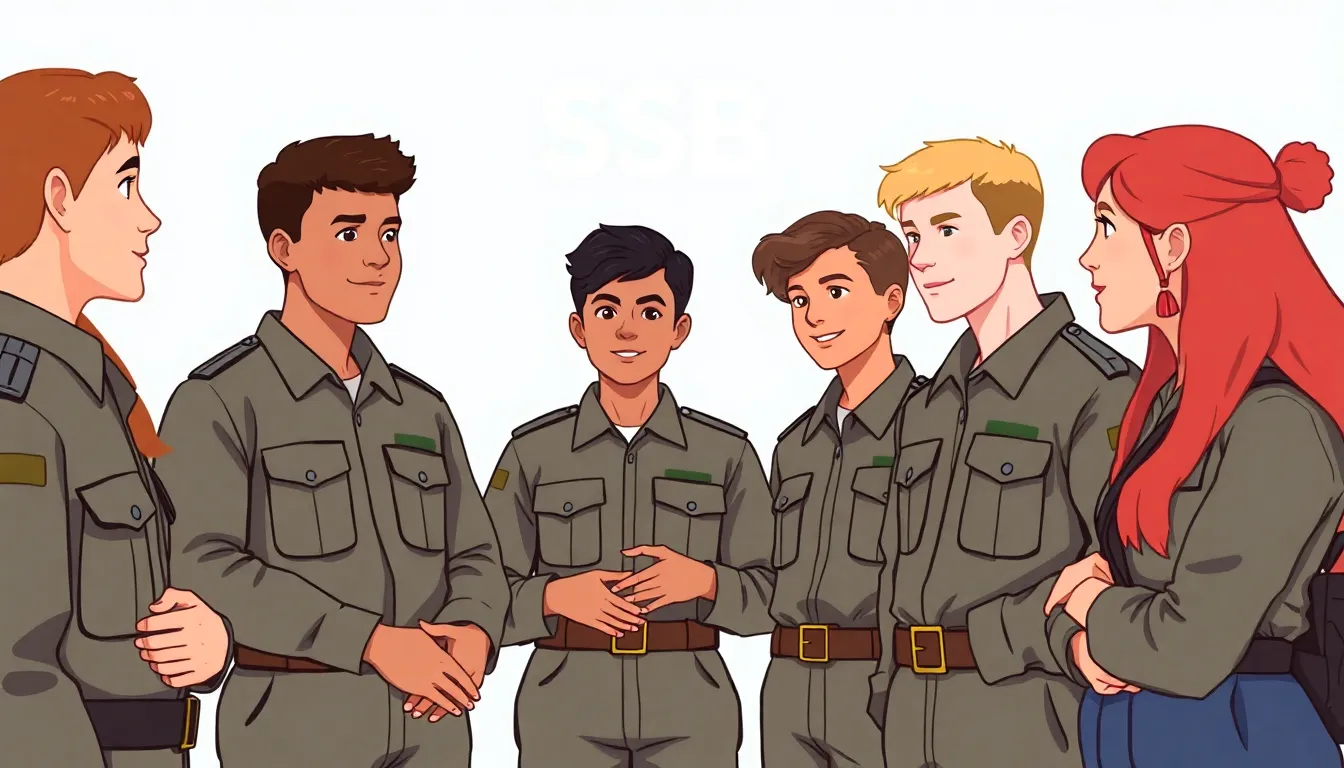
To embark on a career in the Indian Armed Forces, you must first navigate the demanding Service Selection Board (SSB) interview. This rigorous assessment, spanning five days, is designed to evaluate candidates' suitability for officer positions in the Army, Navy, and Air Force. The SSB interview is a critical hurdle, testing not only knowledge but also the qualities essential for leadership. You'll learn to prepare for this multi-stage evaluation. This guide provides insight into the process.
On This Page
We Also Published
The SSB Interview: A Gateway to Leadership
The SSB interview is a multi-stage process, meticulously designed to evaluate a candidate's cognitive abilities, psychological attributes, and physical capabilities. The assessment extends over five days, each stage contributing to the overall evaluation. This comprehensive approach ensures that only the most deserving candidates, those who embody the qualities of a future officer, are selected. The selection process is a crucial step for aspirants aiming to serve the nation.
Day 1: Screening Test
The first day involves a screening test, which acts as an initial filter. Candidates are assigned chest numbers and undergo two tests: a verbal test and a non-verbal test. Each test is worth 50 marks. This stage also includes a group discussion, assessing the candidates' ability to communicate and collaborate. The aim is to gauge the candidates' initial abilities and suitability for further assessment.
The screening test is a crucial element of the SSB interview, as it helps to narrow down the pool of candidates. The verbal test evaluates language proficiency and comprehension, while the non-verbal test assesses reasoning skills. The group discussion provides an opportunity to observe how candidates interact and express their ideas in a team setting. The screening test results determine who progresses to the next stages.
Day 2: Psychological Testing
The second day centers on psychological tests designed to reveal the candidates' personality traits, emotional intelligence, and decision-making abilities. These tests include the Thematic Apperception Test (TAT), where candidates write stories based on 12 pictures; the Word Association Test (WAT), where they respond to 60 words; the Situation Reaction Test (SRT), where they write responses to 60 situations; and the Self-Description Test, where candidates answer five questions about themselves. These tests provide insights into the candidates' thought processes and reactions.
The psychological tests are an integral part of the SSB interview, as they offer a deeper understanding of the candidates' personalities. The TAT assesses imagination and storytelling skills, while the WAT gauges quick thinking and emotional responses. The SRT evaluates problem-solving abilities, and the Self-Description Test reveals self-awareness. The tests provide a comprehensive understanding of the candidates.
The Rigorous Assessment Continues
Day 3: Group Testing
Day three is dedicated to group activities that assess teamwork, leadership, and problem-solving skills. Candidates participate in various tasks, including group discussions, group obstacle races, group planning exercises, and progressive group tasks. These activities evaluate how candidates interact with others, contribute to team efforts, and demonstrate leadership qualities. The group activities provide a realistic assessment of candidates' potential as officers.
The group activities are designed to simulate real-world scenarios and assess how candidates perform under pressure. Group discussions evaluate communication and interpersonal skills, while group obstacle races test physical endurance and coordination. Group planning exercises assess strategic thinking, and progressive group tasks evaluate problem-solving abilities. The assessments provide insights into the candidates' ability to work in a team.
Day 4: The Personal Interview
The fourth day is the most critical for candidates. The individual interview assesses leadership potential, communication skills, problem-solving abilities, and overall suitability for a career in the armed forces. Candidates are also evaluated on their knowledge of current affairs, family background, educational qualifications, hobbies, and interests. The personal interview is a comprehensive evaluation of the candidates.
The personal interview is a significant stage of the SSB interview. It allows the interviewing officer to gain a deeper understanding of the candidate's personality, motivations, and aspirations. The questions are designed to assess the candidates' leadership potential, communication skills, and problem-solving abilities. The personal interview offers the candidates a chance to showcase their strengths and demonstrate their suitability for a career in the armed forces.
The Path to Commission: Beyond the Interview
The SSB interview is a challenging but essential process for candidates aspiring to become officers in the Indian Armed Forces. The five-day assessment evaluates a wide range of qualities, including cognitive abilities, psychological attributes, physical capabilities, and leadership potential. The SSB interview ensures that only the most deserving and suitable candidates are selected to serve the nation. The candidates are then invited for medical tests, and if they clear the medical tests, they will be selected for the final training.
| Day | Activity | Purpose |
|---|---|---|
| Day 1 | Screening Test (Verbal & Non-Verbal), Group Discussion | Initial filtering; assesses basic cognitive and communication skills. |
| Day 2 | Psychological Tests (TAT, WAT, SRT, Self-Description) | Evaluates personality, emotional intelligence, and decision-making. |
| Day 3 | Group Activities (Group Discussion, Obstacle Race, Planning, Tasks) | Assesses teamwork, leadership, and problem-solving abilities. |
| Day 4 | Personal Interview | Comprehensive assessment of leadership, communication, and suitability. |
RESOURCES
- How to prepare for the SSB from home - Quora
- Ssb tips : r/NDATards
- How to prepare for the SSB in one month by myself - Quora
- What's the best way to prepare for SSB interview? : r/NDATards
- How to Prepare for SSB Interview in 30 Days: A Step-by-Step Plan
- SSB Interview Online Coaching
- How to Prepare for SSB Interview in just 30 days
- Best 10 Preparation Tips To Crack SSB Interview in 2025
- Top 10 Tips to Crack the SSB Interview: A Comprehensive Guide
- Prepare for SSB Interview in 30 days. Get the Curated tips here.
- How to Prepare for SSB (at Home) ?
- SSB Interview Preparation Online Course - Olive Greens Institute
- Target SSB – Apps on Google Play
- How to Prepare for NDA SSB Interview | Prince NDA Academy ...
- I'm not prepared but I got a chance for SSB interview, should I go for ...
From our network :
- Bitcoin price analysis: Market signals after a muted weekend
- JD Vance Charlie Kirk: Tribute and Political Strategy
- The Diverse Types of Convergence in Mathematics
- Bitcoin Hits $100K: Crypto News Digest
- Limit Superior and Inferior
- How to migrate to postgres using logical replication and cutover
- How to secure postgres connections across VPC, VPN, and cloud
- Limits: The Squeeze Theorem Explained
- How to design postgres partitions with native and hash methods