The Graduate Management Admission Test verbal section rewards neither uniform effort nor indiscriminate practice volume; it rewards diagnostic precision. Candidates who distribute study hours evenly across Critical Reasoning, Reading Comprehension, and Sentence Correction frequently plateau, because aggregate accuracy conceals the specific question archetype responsible for the largest score deficit.
A defensible GMAT verbal study plan therefore begins not with content review but with forensic diagnosis of error patterns, converting raw practice data into a ranked inventory of weaknesses that subsequent study time can address systematically.
Contemporary admissions research and test-preparation literature converge on a single methodological principle: remediation should be allocated proportionally to marginal score impact rather than to perceived difficulty or personal discomfort.
On This Page
This principle, borrowed conceptually from constrained optimization, implies that a candidate facing a fixed preparation window must identify which verbal question type yields the greatest score improvement per hour invested.
The analytical apparatus required is modest—a structured error log, item-level accuracy tracking, and disciplined review cycles—yet its application is frequently neglected in favour of passive content consumption.
The exposition that follows constructs a complete, evidence-led framework for building such a plan. It examines diagnostic instrumentation, the architecture of a weakness-centred schedule, the mechanics of error-log analysis, the calibration of practice difficulty, and the governance of progress through periodic reassessment.
Quantitative reasoning is introduced where it clarifies decision rules, and each section supplies operational guidance rather than abstract exhortation, so that the resulting plan can be executed and audited by the candidate independently.
TL;DR An effective GMAT verbal study plan is built backwards from diagnostic evidence rather than forwards from generic syllabi. Candidates should first quantify item-level accuracy across Critical Reasoning, Reading Comprehension, and Sentence Correction, then rank question subtypes by the score deficit they generate, and finally allocate practice and review hours proportionally to that ranking. Structured error logs, timed section drills, and periodic recalibration convert preparation from an undifferentiated grind into a targeted intervention, and the same instrumentation supplies the evidence required to adjust the plan as accuracy improves.
Diagnostic Foundations: Quantifying the Verbal Deficit
Diagnosis precedes prescription in clinical practice, and the same ordering applies to standardised test preparation. A candidate cannot rationally allocate study hours without first establishing which verbal question type consumes the largest share of lost points.
This requires item-level rather than section-level data, because section scores aggregate three distinct competencies whose remediation pathways differ substantially in cost and duration.
The Limits of Aggregate Score Reporting
Official practice reports typically present verbal performance as a single scaled score accompanied by percentile rank, information sufficient for benchmarking but inadequate for planning. Two candidates sharing an identical verbal score may exhibit entirely divergent error profiles, one failing predominantly on inference questions within Reading Comprehension and the other on modifier placement within Sentence Correction. Treating the aggregate score as the diagnostic endpoint therefore obscures precisely the information a study plan requires.
The statistical phenomenon of compensatory aggregation explains this limitation. A candidate who answers all easy Critical Reasoning items correctly while failing every hard assumption question can achieve respectable aggregate accuracy, since the easy items numerically offset the hard failures.
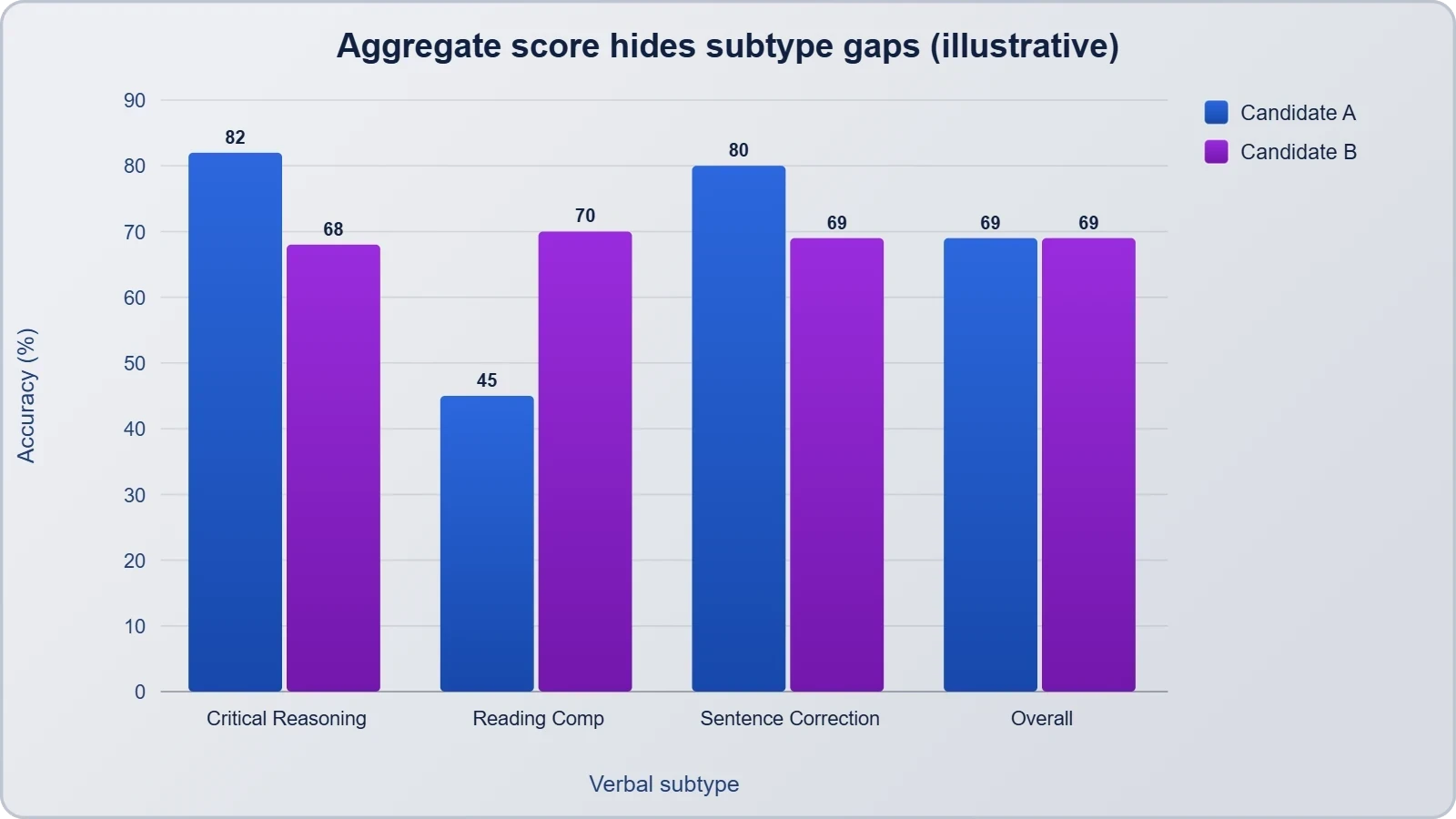
The aggregate conceals a structural weakness that will surface under adaptive testing conditions, where item difficulty escalates in response to success and the compensatory buffer disappears.
Item-level disaggregation resolves the problem by preserving the conditional structure of performance. When accuracy is computed separately for each question subtype and difficulty band, the compensatory illusion dissolves and the true deficit becomes visible.
Candidates should therefore treat any practice platform that reports only aggregate verbal accuracy as diagnostically insufficient and should reconstruct item-level records manually where necessary.
Constructing an Item-Level Error Inventory
The foundational instrument of diagnosis is a structured error inventory recording, for every incorrect response, the question subtype, the difficulty band, the time consumed, the selected answer, the correct answer, and a categorised cause of failure. This inventory transforms scattered practice into a longitudinal dataset amenable to quantitative analysis. Without such a record, candidates rely on retrospective impressions that are demonstrably unreliable.
Cause categorisation deserves particular attention because it determines the remediation strategy. Errors attributable to content gaps require conceptual review; errors attributable to process failures, such as premature answer selection or incomplete passage reading, require behavioural correction; and errors attributable to time pressure require pacing interventions. Conflating these categories produces remediation that addresses the wrong mechanism entirely.
A minimal viable inventory can be maintained in a spreadsheet with six columns and one row per missed item. Candidates practising twenty items daily accumulate roughly six hundred observations across a month, a sample sufficient to support subtype-level inference.
The inventory should also record items answered correctly but with low confidence, since these near-misses frequently predict future errors more accurately than outright failures.
Ranking Weaknesses by Marginal Score Impact
Once the inventory contains sufficient observations, each question subtype can be assigned an estimated score impact derived from its error frequency and its representation within the test blueprint. Subtypes that are both frequently missed and heavily represented warrant priority; subtypes that are rarely missed or sparsely represented warrant deferral. This ranking converts a heterogeneous list of weaknesses into an ordered remediation queue.
The ranking should be recomputed at regular intervals, since remediation alters the underlying distribution. A subtype initially ranked first may fall to fourth after two weeks of targeted practice, at which point the marginal return on further investment diminishes and attention should shift to the next item in the queue. Static study plans ignore this dynamic and consequently over-invest in already-remediated weaknesses.
Establishing a Baseline Under Timed Conditions
Diagnostic data collected under untimed conditions systematically overstates competence, because untimed practice removes the pacing constraint that generates a substantial proportion of real errors. A defensible baseline therefore requires at least one full-length, strictly timed verbal section administered under conditions approximating the actual test environment. The resulting accuracy profile becomes the reference against which all subsequent progress is measured.
Baseline administration should be repeated at intervals of roughly three to four weeks, with each repetition using previously unseen material to prevent contamination from item familiarity. Candidates who reuse practice material for baseline measurement inadvertently inflate their apparent progress and misallocate subsequent study time. The discipline of reserving fresh material for measurement is therefore essential to the plan's integrity.
Architecting a Weakness-Centred Study Schedule
With a ranked inventory in hand, the candidate can construct a schedule that allocates time proportionally to marginal impact rather than equally across content domains. The architecture should specify weekly hour allocations by subtype, the sequencing of practice and review activities, and the criteria that trigger reallocation.
A schedule lacking explicit reallocation criteria tends to ossify into the uniform distribution it was designed to replace.
Proportional Allocation of Weekly Study Hours
A defensible allocation rule assigns each subtype a share of weekly verbal hours proportional to its estimated score impact, subject to a floor that prevents complete neglect of secondary weaknesses.
If the top-ranked subtype accounts for forty percent of estimated lost points, it should receive approximately forty percent of available hours, with the remainder distributed across lower-ranked subtypes and periodic maintenance practice.
This proportional rule can be expressed formally as a normalised weighting, where the allocation to subtype ##i## equals its impact share divided by the sum of all impact shares.
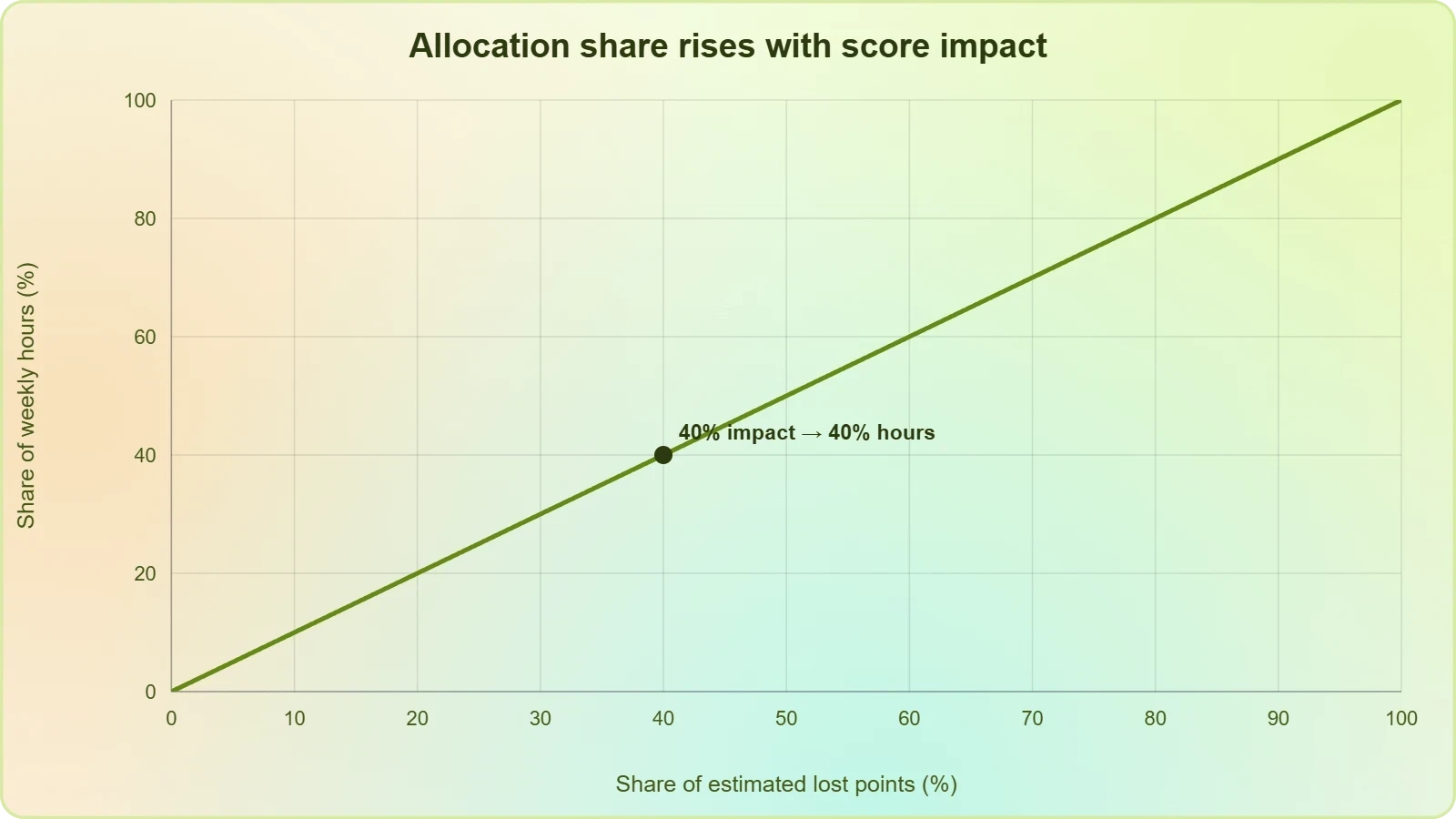
The formula renders explicit what intuition leaves vague and permits the candidate to verify that the schedule actually reflects the diagnostic ranking rather than unexamined habit.
In this expression, ##w_i## denotes weekly hours allocated to subtype ##i##, ##I_i## denotes its estimated score impact, and ##H_{\text{total}}## denotes total weekly verbal hours available. The formula is descriptive rather than prescriptive; candidates may adjust weights to reflect imminent test dates or personal constraints, provided the adjustment is documented and revisited.
Sequencing Practice and Review Within the Week
Temporal sequencing matters as much as aggregate allocation. Distributed practice, in which short sessions recur across multiple days, reliably outperforms massed practice concentrated in a single session, a finding robust across cognitive psychology and directly applicable to verbal preparation. A candidate should therefore schedule multiple brief subtype-specific sessions rather than one extended block.
Review should follow practice with minimal delay, ideally on the same day, while the reasoning trace remains accessible to introspection. Delayed review reconstructs errors from incomplete memory and frequently misattributes their causes.
Immediate structured review, by contrast, captures the decision process that produced the error and permits accurate cause categorisation within the inventory.
Interleaving distinct subtypes within a session introduces desirable difficulty and improves discrimination between question archetypes, a benefit particularly relevant to verbal preparation where surface similarity between question stems can mislead.
Candidates should therefore mix subtypes within practice sets rather than completing all items of one type consecutively, notwithstanding the temporary discomfort this produces.
Calibrating Difficulty to the Working Edge
Practice difficulty should be calibrated to the candidate's current accuracy band, targeting items answered correctly roughly seventy to eighty percent of the time. Items far below this band provide little learning signal, while items far above it generate frustration without consolidation. The working edge shifts upward as competence develops, requiring periodic recalibration of the practice set.
Adaptive practice platforms automate this calibration, but candidates using static question banks must perform it manually by selecting difficulty bands from the inventory data. The seventy-to-eighty-percent heuristic is approximate and should be treated as a guide rather than a threshold; the operative principle is that practice should be demanding but predominantly successful.
Building Reallocation Triggers Into the Plan
A schedule without reallocation triggers will not adapt to changing performance. The plan should therefore specify quantitative conditions under which hours shift between subtypes, such as a subtype reaching eighty-five percent accuracy across fifty consecutive items. Explicit triggers remove discretion from the moment of decision and prevent the inertia that sustains obsolete allocations.
Triggers should also operate in the reverse direction, restoring hours to a subtype whose accuracy declines after a period of neglect. Maintenance practice at reduced volume prevents regression on remediated weaknesses, and the trigger mechanism ensures that maintenance is scheduled rather than assumed. The plan thereby becomes a closed-loop control system rather than a static timetable.
Error-Log Mechanics and Review Protocols
The error log is the analytical engine of the entire plan, converting individual mistakes into transferable insight. Its value depends less on the volume of entries than on the rigour of the review protocol applied to them.
A log maintained diligently but reviewed superficially yields no more actionable intelligence than no log at all, and the review protocol therefore deserves explicit design attention.
Structuring the Error Log for Analytical Yield
Each entry should record the question stem in abbreviated form, the subtype classification, the selected and correct answers, and a written explanation of the reasoning failure. The explanation is the critical element: it forces the candidate to articulate the specific inferential step that went wrong, converting an inchoate sense of error into a diagnosable proposition.
Entries should be tagged with a small controlled vocabulary of failure modes, such as scope shift, extreme language, unstated assumption, or misread stem. Controlled tagging enables aggregation across entries, revealing whether a candidate's errors cluster around a single failure mode that transcends subtype boundaries. Such cross-cutting patterns frequently prove more remediable than subtype-specific gaps.
Conducting Structured Post-Mortem Analysis
Post-mortem analysis should proceed in three stages: reconstruction of the original reasoning, identification of the divergence point, and formulation of a corrective rule. Reconstruction requires the candidate to explain why the selected answer seemed attractive; identification locates the precise moment at which reasoning departed from validity; and the corrective rule states what should be done differently on future items of the same type.
Corrective rules should be phrased as actionable procedures rather than vague resolutions. "Read more carefully" is not a corrective rule; "verify that the conclusion's scope matches the evidence's scope before selecting" is.
The specificity of the rule determines its transferability to novel items, and candidates should therefore draft rules with the same precision they would apply to a formal proof.
Periodic consolidation of corrective rules into a personal checklist provides a compact reference for pre-exam review. The checklist should remain short, ideally under fifteen items, since longer lists exceed working memory capacity and are consequently ignored under time pressure.
Each item on the checklist should correspond to a failure mode that has recurred at least three times in the log.
Distinguishing Content Gaps From Process Failures
The distinction between content gaps and process failures determines whether remediation should target knowledge or behaviour. Content gaps, such as unfamiliarity with a grammatical rule, respond to focused review of explanatory material.
Process failures, such as selecting an answer before reading all options, respond to behavioural protocols and timed drills rather than additional content study.
Misclassification is costly because it directs effort to the wrong mechanism. A candidate who treats a process failure as a content gap will consume hours reviewing grammar rules without improving accuracy, since the underlying cause was never grammatical ignorance.
The error log's cause categorisation exists precisely to prevent this misallocation, and its accuracy should be verified during review.
Converting Review Into Retrieval Practice
Review sessions should incorporate retrieval practice rather than passive re-reading. Re-solving previously missed items after a delay, without consulting the original explanation, tests whether the corrective rule has been internalised. Items solved correctly on this second attempt can be retired from the active log; items failed again require renewed attention.
Spaced repetition schedules can be applied to the error log, with items revisited at increasing intervals contingent on successful retrieval. The scheduling logic mirrors that used in vocabulary acquisition, and its application to reasoning errors is conceptually sound, since corrective rules function as declarative knowledge subject to the same forgetting curves as any other learned material.
We Also Published
Practice Material Selection and Timed Simulation
Material selection determines the quality of the diagnostic signal and the fidelity of practice to the actual test. Official questions, authored by the test-maker, provide the most accurate representation of item style and difficulty, while third-party material varies considerably in fidelity.
A defensible plan reserves official material for measurement and high-stakes practice, using supplementary material for volume and skill isolation.
Evaluating Question Bank Fidelity
Fidelity encompasses item style, difficulty distribution, and the logical structure of correct and incorrect answers. Official material exhibits consistent fidelity by construction; third-party banks may deviate in any of these dimensions, and candidates should therefore evaluate supplementary material against official benchmarks before relying on it for diagnostic purposes.
Low-fidelity material can actively harm preparation by training reasoning patterns that do not transfer to the actual test. A candidate who practises extensively on items with implausible distractors may develop heuristics calibrated to those distractors rather than to the test's actual logic. Material selection is therefore a substantive decision rather than a matter of convenience.
Designing Full-Length Timed Simulations
Timed simulations should replicate the actual test's section length, item mix, and interface constraints as closely as practicable. The purpose is not merely to measure accuracy but to habituate the candidate to the cognitive load of sustained verbal reasoning under time pressure. Simulations conducted without strict timing forfeit this habituation benefit entirely.
Simulation frequency should increase as the test date approaches, moving from fortnightly to weekly during the final month. Each simulation should be followed by a full post-mortem applying the same error-log protocol used for daily practice, since simulation errors are particularly informative about pacing and endurance failures that daily practice cannot reveal.
Isolating Skills Before Integrating Them
Skill isolation, in which a single subtype is practised in concentrated form, is valuable during the early remediation phase when the candidate is acquiring a new corrective rule. Isolation reduces cognitive load and permits focused attention on the target skill. Once the rule is established, practice should shift toward integration, since the actual test presents subtypes interleaved.
The transition from isolation to integration should be gradual, with mixed sets introduced once isolated accuracy reaches approximately eighty percent. Premature integration prevents consolidation of the corrective rule, while prolonged isolation fails to develop the discrimination skills required to identify which rule applies to a given item. The sequencing therefore follows a deliberate progression.
Managing Pacing Without Sacrificing Accuracy
Pacing interventions should be introduced only after accuracy on untimed items stabilises, since premature pacing pressure encourages rushed reasoning and entrenches process failures. Once accuracy is stable, pacing drills can be layered on, beginning with generous time limits and progressively tightening toward the test's actual per-item allowance.
The relationship between speed and accuracy is not linear, and candidates should identify their personal accuracy-maximising pace rather than simply maximising speed. For most candidates, a modest reduction in pace yields a disproportionate accuracy gain on difficult items, and the optimal strategy involves strategic abandonment of the most time-consuming items rather than uniform acceleration.
Progress Governance and Periodic Recalibration
A study plan is a hypothesis about how score improvement is produced, and like any hypothesis it requires periodic testing against evidence. Progress governance supplies the testing mechanism, comparing observed accuracy trajectories against the plan's predictions and adjusting allocations when the predictions fail.
Without governance, the plan drifts into ritual compliance with a schedule that no longer reflects the candidate's actual weaknesses.
Defining Leading and Lagging Indicators
Lagging indicators, such as full-length simulation scores, measure outcomes but respond slowly and noisily. Leading indicators, such as subtype-level accuracy on practice sets and error-log recurrence rates, respond quickly and provide earlier warning of stagnation.
A well-governed plan tracks both, using leading indicators for weekly adjustment and lagging indicators for monthly strategic review.
The distinction matters because exclusive reliance on simulation scores produces delayed and erratic feedback. A candidate may practise productively for three weeks before a simulation registers improvement, and without leading indicators this latency invites premature abandonment of an effective plan. Leading indicators supply the intermediate confirmation that sustains adherence during the lag.
Establishing Review Cadence and Decision Rules
Weekly reviews should examine leading indicators and adjust the following week's allocation according to the predefined triggers. Monthly reviews should examine lagging indicators and consider structural changes to the plan, such as altering material sources or revising the ranked weakness inventory. The cadence separates tactical adjustment from strategic revision, preventing both overreaction and inertia.
Decision rules should be specified in advance to prevent motivated reasoning during review. A candidate who decides at the moment of review whether a subtype has improved sufficiently is vulnerable to interpreting ambiguous data favourably.
Pre-specified thresholds, such as eighty-five percent accuracy across fifty items, remove this discretion and lend the review process a quasi-experimental rigour.
Detecting Plateaus and Diagnosing Their Causes
Plateaus are periods during which leading indicators remain flat despite continued practice, and they admit several distinct explanations. The practice may have drifted below or above the working edge; the corrective rules may be insufficiently specific; or the candidate may be accumulating practice volume without adequate review. Diagnosing the cause determines the appropriate response.
A plateau caused by difficulty miscalibration responds to recalibration of the practice set; a plateau caused by vague corrective rules responds to sharper rule formulation; and a plateau caused by review neglect responds to reallocating hours from practice to post-mortem analysis. Treating all plateaus as motivation problems, the most common error, addresses none of these mechanisms.
Final-Phase Consolidation and Tapering
During the final two weeks, practice volume should decline while review and simulation frequency are maintained, a tapering pattern borrowed from athletic preparation. The purpose is to consolidate corrective rules and preserve cognitive freshness rather than to acquire new skills. Introducing novel content during this phase typically produces anxiety without measurable benefit.
Consolidation should centre on the personal checklist of corrective rules, the error log's most recurrent failure modes, and a small number of full-length simulations conducted under strict conditions. The candidate should enter the test having rehearsed the specific procedures that address their documented weaknesses, rather than having attempted comprehensive coverage of the verbal syllabus.
Integrating the Framework Into a Coherent Preparation Cycle
The preceding components constitute a closed-loop system: diagnosis generates a ranked inventory, the inventory drives proportional allocation, practice generates error data, review converts error data into corrective rules, and periodic reassessment updates the inventory.
Each component depends on the others, and the system's effectiveness derives from their integration rather than from the sophistication of any single element.
Synthesising Diagnostic, Instructional, and Evaluative Phases
The preparation cycle alternates between diagnostic, instructional, and evaluative phases, each with distinct objectives and instruments. Diagnostic phases establish the current weakness profile; instructional phases build corrective rules through isolated practice; and evaluative phases test whether those rules transfer to integrated, timed conditions. Conflating the phases produces the familiar pattern of practice without improvement.
Phase duration should be calibrated to the candidate's rate of observable progress rather than fixed in advance. A candidate whose subtype accuracy responds quickly can shorten instructional phases and extend evaluative ones, while a candidate encountering plateaus should extend instructional phases and intensify review. The cycle is therefore adaptive rather than rigidly periodic.
Adapting the Plan to Individual Constraints
Individual constraints, including available hours, baseline competence, and target score, determine the plan's scale but not its structure. A candidate with ten weekly hours and a candidate with twenty follow the same diagnostic logic, differing only in the volume of practice and the granularity of subtype analysis that their data can support. The framework scales without altering its essential architecture.
Target score requirements should inform the allocation's aggressiveness. A candidate seeking a modest improvement may concentrate almost exclusively on the top-ranked weakness, while a candidate seeking a substantial gain must distribute effort more broadly to avoid ceiling effects on any single subtype. The ranking remains the organising principle in both cases.
Common Failure Modes in Plan Execution
Execution failures recur with sufficient regularity to warrant explicit anticipation. The most frequent is the reversion to uniform practice under time pressure, in which the candidate abandons proportional allocation and returns to undifferentiated drilling.
The second is review neglect, in which practice volume expands at the expense of post-mortem analysis, degrading the error log's analytical yield.
A third failure mode is measurement contamination, in which the candidate reuses practice material for baseline assessment and thereby inflates apparent progress. A fourth is premature pacing pressure, in which timed drills are introduced before accuracy stabilises and entrench rushed reasoning. Each failure mode has a corresponding safeguard within the framework, provided the safeguards are actively maintained.
Projected Outcomes and Evidentiary Caveats
The framework's expected outcome is a more efficient conversion of study hours into score improvement, achieved by directing effort toward the weaknesses with the greatest marginal impact. This expectation rests on the well-established principle of targeted remediation and on the diagnostic value of item-level data, rather than on any proprietary claim about verbal instruction.
Evidentiary caution is nonetheless warranted. Individual response to targeted remediation varies, and the framework's benefits depend on the fidelity of the diagnostic data and the rigour of review. Candidates should treat projected improvements as hypotheses to be tested through their own measurement rather than as guaranteed outcomes, and should adjust the plan accordingly when the evidence diverges.
From our network :
- Bitcoin Hits $100K: Crypto News Digest
- Bitcoin price analysis: Market signals after a muted weekend
- JD Vance Charlie Kirk: Tribute and Political Strategy
- Limits: The Squeeze Theorem Explained
- Limit Superior and Inferior
- How to design postgres partitions with native and hash methods
- How to migrate to postgres using logical replication and cutover
- The Diverse Types of Convergence in Mathematics
- How to secure postgres connections across VPC, VPN, and cloud
RESOURCES
- No results found.