On This Page
- Introduction to Kinematics for NEET
- Motion in One Dimension: The Basics
- Acceleration and Retardation
- Equations of Motion for Uniformly Accelerated Bodies
- Graphical Representation of Motion
- Relative Motion in One Dimension
- Motion in Two Dimensions: Projectile Motion
- Trajectory of a Projectile
- Uniform Circular Motion
- Common Numerical Patterns in NEET Kinematics
- Effective Study Strategy for NEET Kinematics
Introduction to Kinematics for NEET
Kinematics serves as the foundational pillar of mechanics in the NEET Physics syllabus, focusing purely on the description of motion. Unlike dynamics, which examines the forces causing motion, kinematics deals with parameters like position, time, velocity, and acceleration. For a medical aspirant, understanding these variables is crucial because they reappear in almost every subsequent chapter, from work-energy to fluid mechanics.
Defining Scalar and Vector Quantities
In kinematics, distinguishing between scalars and vectors is the first step toward accuracy. Scalars, such as distance and speed, only possess magnitude, while vectors, like displacement and velocity, include direction. NEET questions often test this distinction through conceptual problems where direction changes but magnitude remains constant, requiring a firm grasp of vector algebra.
Properly identifying these quantities allows students to apply the correct mathematical operations. For instance, when calculating average velocity, one must use the vector sum of displacements rather than the total distance covered. This nuance is frequently the difference between a correct answer and a common trap in competitive exams.
The Importance of Kinematics in NEET Physics
Kinematics contributes significantly to the total weightage of the Physics section in NEET. Beyond direct questions, the concepts of rates of change and graphical analysis are applied in electromagnetism and modern physics. Mastering this chapter ensures that students are comfortable with the mathematical rigor required for the entire competitive exam.
Furthermore, kinematics problems often integrate calculus, which is a vital tool for solving non-uniform motion scenarios. By practicing these problems early, students develop the analytical mindset needed to interpret physical phenomena. This section sets the stage for higher-level problem-solving and logical reasoning in the medical entrance journey.
Motion in One Dimension: The Basics
Motion in one dimension, or rectilinear motion, involves objects moving along a single straight line. This simplification allows students to focus on the relationships between fundamental variables without the complexity of multiple coordinates. It is the starting point for all motion-related studies, providing the basic definitions used in more advanced two-dimensional scenarios.
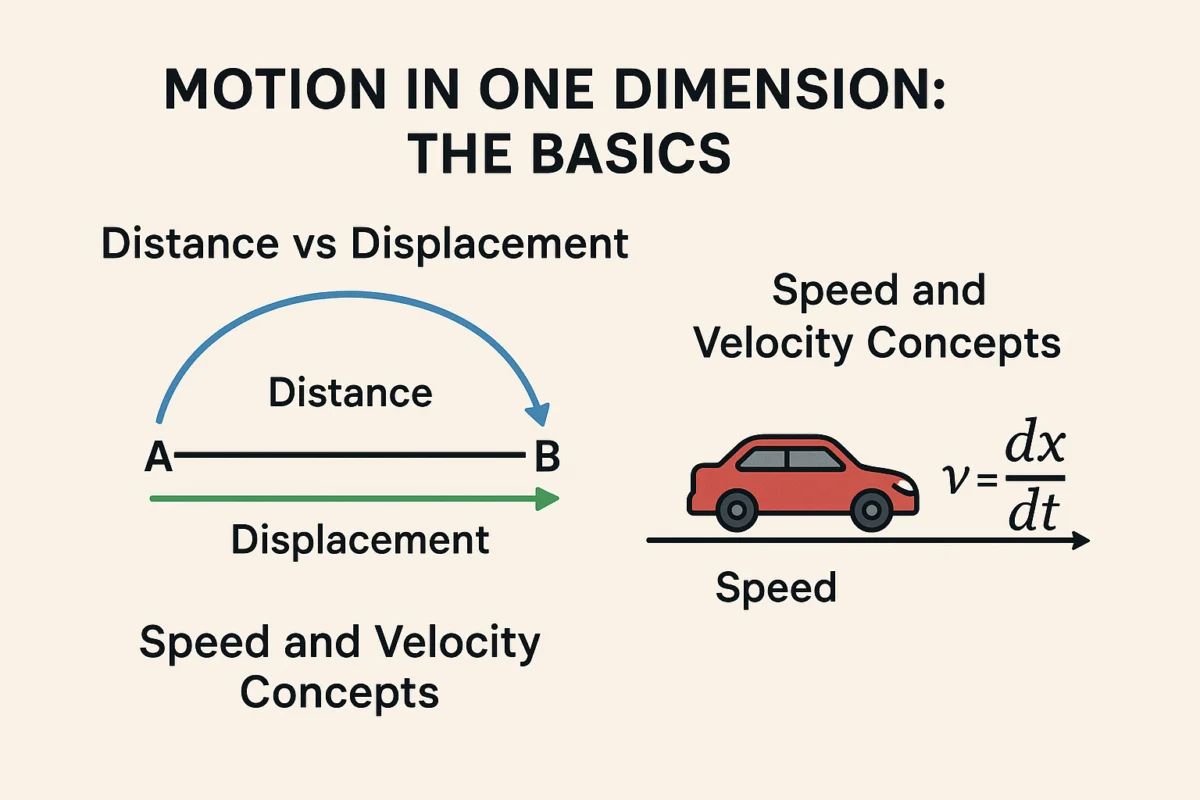
Distance vs Displacement
Distance is the total path length traveled by an object, making it a scalar quantity that is always positive. In contrast, displacement is the shortest straight-line distance between the initial and final positions, including direction. In NEET, understanding that displacement can be zero even if distance is not is a fundamental concept for solving circular path problems.
When an object reverses its direction, the magnitude of displacement becomes less than the total distance covered. Students must be careful to use displacement when calculating velocity and distance when calculating speed. This distinction is critical in problems involving multi-stage journeys or oscillating particles where directionality plays a major role.
Speed and Velocity Concepts
Speed is defined as the rate of change of distance, whereas velocity is the rate of change of displacement. Average speed is the total distance divided by total time, while average velocity is the total displacement divided by total time. NEET aspirants must be adept at calculating both to avoid confusion during high-pressure exam situations.
Instantaneous velocity is the velocity of an object at a specific moment in time, mathematically represented as ##v = \frac{dx}{dt}##. This requires a basic understanding of differentiation, as many NEET problems provide position as a function of time. Recognizing how these rates change allows for a deeper understanding of the particle's physical behavior.
Acceleration and Retardation
Acceleration represents the rate at which an object's velocity changes over time. It is a vector quantity, meaning it can result from a change in speed, a change in direction, or both. In one-dimensional motion, acceleration is often constant, but NEET also explores cases where acceleration varies with time or position.
Uniform and Non-Uniform Acceleration
Uniform acceleration occurs when the velocity of an object changes by equal amounts in equal intervals of time. This type of motion is governed by the standard equations of kinematics, which are easy to apply. Most introductory NEET problems focus on uniform acceleration, such as a car speeding up at a constant rate.
Non-uniform acceleration, however, involves a changing rate of change of velocity. In such cases, students must use calculus to find the velocity or position of the object at any given time. Understanding the transition from uniform to non-uniform motion is key to tackling the more challenging "Level 2" questions in the exam.
Instantaneous vs Average Acceleration
Average acceleration is calculated over a finite time interval by dividing the total change in velocity by the total time taken. It provides a general overview of the motion but does not describe what happens at each specific second. It is expressed by the formula
.
Instantaneous acceleration, on the other hand, is the acceleration at a precise moment, defined as
. For NEET, being able to derive acceleration from a velocity-time function is a mandatory skill. This concept is also vital when analyzing the peaks and troughs of motion graphs.
Equations of Motion for Uniformly Accelerated Bodies
The equations of motion are the primary tools for solving kinematics problems involving constant acceleration. These formulas relate displacement, initial velocity, final velocity, acceleration, and time. Memorizing these and knowing when to apply each one is a core requirement for any student aiming for a top score in NEET.
Deriving the Three Fundamental Equations
The three standard equations of motion are derived from the definitions of velocity and acceleration. The first equation,
, relates final velocity to initial velocity and time. The second,
, calculates displacement over a period of time under constant acceleration.
The third equation,
, is particularly useful because it does not require the time variable. NEET problems often omit time, making this equation the most efficient choice for finding velocity or displacement. Students should also be familiar with the displacement in the ##n^{th}## second:
.
Applying Equations to Vertical Motion Under Gravity
Motion under gravity is a classic application of the equations of motion where acceleration is constant at ##g \approx 9.8 \, m/s^2##. In these problems, the direction of motion determines the sign of the variables. Typically, upward motion is taken as positive, while downward acceleration due to gravity is taken as negative.
When an object is dropped, its initial velocity ##u## is zero, simplifying the equations significantly. Conversely, when an object is thrown upward, it reaches a maximum height where its final velocity becomes zero. Solving these problems requires careful bookkeeping of signs to ensure the resulting displacement and time values are physically meaningful.
Graphical Representation of Motion
Graphs provide a visual summary of an object's motion and are a favorite topic for NEET examiners. Being able to interpret position-time (x-t), velocity-time (v-t), and acceleration-time (a-t) graphs is essential. Graphs can quickly reveal whether an object is at rest, moving at a constant speed, or accelerating.
Interpreting Position-Time Graphs
A position-time graph shows how the location of an object changes over a period. The slope of the line at any point on an x-t graph represents the instantaneous velocity of the object. A straight diagonal line indicates uniform velocity, while a curved line suggests that the object is accelerating.
If the slope is zero (a horizontal line), the object is stationary. A negative slope indicates that the object is moving back toward the origin. NEET questions often ask students to identify the type of motion or calculate the velocity directly from the steepness of the provided graph.
Analyzing Velocity-Time and Acceleration-Time Graphs
On a velocity-time graph, the slope represents the acceleration of the object. A positive slope indicates acceleration, while a negative slope indicates retardation or deceleration. Most importantly, the area under the curve of a v-t graph represents the displacement of the object during that time interval.
Acceleration-time graphs are less common but equally important; the area under an a-t graph gives the change in velocity. Students should practice converting between these three types of graphs. For instance, a parabolic curve in an x-t graph corresponds to a straight diagonal line in a v-t graph and a horizontal line in an a-t graph.
We Also Published
Relative Motion in One Dimension
Relative motion describes how the position or velocity of one object appears from the perspective of another moving object. This concept is vital for solving problems involving two bodies moving simultaneously, such as two trains passing each other. It simplifies the math by fixing one object as the reference point.
Understanding Relative Velocity
The relative velocity of object A with respect to object B is calculated as
. If both objects are moving in the same direction, their relative speed is the difference between their individual speeds. If they are moving toward each other, their relative speed is the sum of their individual speeds.
NEET aspirants must be comfortable with vector subtraction to handle these problems correctly. Relative motion is not just about speed; it also applies to relative displacement and relative acceleration. By shifting the frame of reference, complex two-body problems can often be reduced to simple one-body kinematics equations.
Solving Overtaking and Collision Problems
Overtaking problems usually ask for the time or distance required for one vehicle to catch up to another. By using relative velocity, the distance to be covered is simply the initial separation between the two objects. The time taken is then the relative distance divided by the relative velocity.
Collision problems are similar but involve objects moving toward each other. In these cases, the "relative acceleration" might also come into play if both vehicles are braking. Mastery of these patterns allows students to solve multi-step word problems with speed and precision during the actual NEET examination.
Motion in Two Dimensions: Projectile Motion
Motion in two dimensions occurs when an object moves in a plane, such as a ball thrown into the air at an angle. This type of motion is analyzed by decomposing it into two independent one-dimensional motions: one horizontal and one vertical. The horizontal component usually has zero acceleration, while the vertical component is subject to gravity.
Horizontal and Vertical Components of Velocity
When a projectile is launched with an initial velocity ##u## at an angle ##\theta##, its horizontal component is
. This horizontal velocity remains constant throughout the flight because there is no horizontal force (ignoring air resistance). This is a key assumption in basic NEET kinematics.
The vertical component of the velocity is
. This component changes continuously due to the constant downward acceleration of gravity. At the highest point of the trajectory, the vertical velocity becomes zero, but the horizontal velocity remains unchanged, a common point of confusion for many students.
Calculating Time of Flight, Range, and Maximum Height
The time of flight is the total duration the projectile stays in the air, given by
. The maximum height reached is
. These formulas are derived by applying the standard equations of motion to the vertical component of the projectile's path.
The horizontal range is the total distance covered along the ground, expressed as
. NEET often tests the condition for maximum range, which occurs when the launch angle is ##45^\circ##. Memorizing these derived formulas saves valuable time during the physics section of the entrance exam.
Trajectory of a Projectile
The trajectory is the actual path followed by a projectile under the influence of gravity. In the absence of air resistance, this path is always a parabola. Understanding the mathematical equation of the trajectory helps in solving problems where the coordinates of the projectile are given at a specific time.
The Parabolic Nature of Projectile Paths
The equation of the trajectory is derived by eliminating the time variable ##t## from the horizontal and vertical displacement equations. The resulting formula is
. This quadratic equation confirms that the path is a downward-opening parabola.
Students should be able to identify this equation in various forms, including the version involving the range ##R##:
. This specific form is very useful for NEET problems that provide the range and ask for height at a certain horizontal distance. It simplifies the calculation significantly.
Angular Projection vs Horizontal Projection
Angular projection involves launching an object from the ground at an angle. Horizontal projection, however, occurs when an object is thrown horizontally from a certain height, such as a stone dropped from a moving airplane. In horizontal projection, the initial vertical velocity ##u_y## is zero, which changes the flight dynamics.
For horizontal projection, the time to hit the ground depends only on the height:
. The horizontal range is then simply the product of the horizontal velocity and this time. Differentiating between these two types of projection is essential for choosing the correct starting formulas for NEET numericals.
Uniform Circular Motion
Uniform circular motion occurs when an object moves in a circle at a constant speed. While the speed is constant, the velocity is not, because the direction of motion is constantly changing. This implies the existence of acceleration, even though the object is not "speeding up" in the traditional sense.
Angular Displacement and Velocity
In circular motion, we use angular variables instead of linear ones. Angular displacement ##\theta## is the angle swept by the radius vector, measured in radians. Angular velocity ##\omega## is the rate of change of this angle, defined as
. The relationship between linear velocity and angular velocity is ##v = r\omega##.
NEET problems often require converting between frequency, period, and angular velocity. The time period ##T## is the time taken for one full revolution, while frequency ##f## is the number of revolutions per second. These are related by
, forming the basis for many circular motion questions.
Centripetal Acceleration and its Direction
Even in uniform circular motion, there is an acceleration directed toward the center of the circle, known as centripetal acceleration. Its magnitude is given by
. This acceleration is responsible for changing the direction of the velocity vector without altering its magnitude.
It is important to note that centripetal acceleration is always perpendicular to the instantaneous velocity. In non-uniform circular motion, there is also a tangential acceleration that changes the speed. For NEET, mastering the vector nature of these accelerations is key to solving problems involving banking of roads and vertical circles.
Common Numerical Patterns in NEET Kinematics
Success in NEET Physics comes from recognizing patterns in numerical problems. Kinematics questions often fall into predictable categories, such as stopping distance, motion in the nth second, or relative motion of rain and man. Identifying these patterns allows for the application of shortcuts and efficient problem-solving strategies.
Solving Stopping Distance Problems
Stopping distance is the distance a vehicle travels after brakes are applied before coming to a halt. Using the third equation of motion with ##v = 0##, the stopping distance ##s## is proportional to the square of the initial velocity:
. This relationship is a frequent topic in NEET.
If the initial speed is doubled, the stopping distance becomes four times as long, assuming constant retardation. Students should also consider "reaction time" problems, where the vehicle moves at a constant speed for a brief moment before the brakes are engaged. Adding the reaction distance to the braking distance gives the total stopping distance.
Dealing with Variable Acceleration Using Calculus
When acceleration is a function of time, velocity, or position, the standard equations of motion cannot be used. Instead, students must use integration to find displacement and velocity. For example, if
, then velocity is found by integrating acceleration with respect to time.
If acceleration is given as a function of velocity, such as
, students must use the chain rule:
. This is a common advanced pattern in NEET that separates top scorers from the rest. Practice with basic integrals and derivatives of trigonometric and exponential functions is highly recommended for these scenarios.
Effective Study Strategy for NEET Kinematics
To master kinematics for NEET, a structured approach is necessary. It is not enough to just memorize formulas; one must understand the physical intuition behind them. Starting with clear concepts and progressing to complex numericals ensures a steady improvement in both speed and accuracy.
Mastering Formula Application and Units
The first step is to create a formula sheet that includes all definitions, equations of motion, and projectile motion constants. Pay close attention to SI units and ensure all variables are converted to a consistent system before calculation. Small errors in units, like using km/h instead of m/s, are a common source of negative marking.
Practice applying these formulas to various scenarios until the choice of equation becomes instinctive. For instance, if time is not mentioned, immediately look toward the third equation of motion. Consistent drill sessions help in internalizing these relationships, making them easier to recall during the actual three-hour examination.
Practicing Previous Year Questions (PYQs)
Solving previous year NEET questions is the most effective way to understand the difficulty level and the types of traps examiners set. PYQs reveal which topics, like projectile motion or graphical analysis, are prioritized. It also helps in managing time, as students learn which problems can be solved quickly and which require more thought.
Analyze the solutions to questions you get wrong to identify conceptual gaps. Often, a mistake in kinematics is due to a sign convention error or a misunderstanding of relative motion. By iteratively refining your technique through practice, you can build the confidence needed to tackle the Physics section of NEET with ease.
From our network :
- Bitcoin price analysis: Market signals after a muted weekend
- How to design postgres partitions with native and hash methods
- The Diverse Types of Convergence in Mathematics
- Limits: The Squeeze Theorem Explained
- Limit Superior and Inferior
- Bitcoin Hits $100K: Crypto News Digest
- JD Vance Charlie Kirk: Tribute and Political Strategy
- How to migrate to postgres using logical replication and cutover
- How to secure postgres connections across VPC, VPN, and cloud
RESOURCES
- No results found.