The Graduate Management Admission Test (GMAT) verbal section constitutes a psychometrically calibrated instrument designed to assess higher-order language proficiency rather than the mere recall of prescriptive grammar rules. Its three constituent question types—Sentence Correction, Critical Reasoning, and Reading Comprehension—collectively interrogate a candidate's capacity for logical argumentation, syntactic precision, and inferential reading within time-constrained conditions.
Contemporary admissions research indicates that verbal performance functions as a robust predictor of success in discussion-based graduate management curricula, where analytical writing and persuasive discourse are routine.
Understanding the section requires distinguishing between surface-level linguistic competence and the deeper cognitive operations the examination rewards. Sentence Correction evaluates the ability to identify and repair structural faults in written English while preserving intended meaning; Critical Reasoning probes the architecture of arguments, including assumptions, inferences, and evidential sufficiency; Reading Comprehension measures the synthesis of dense academic passages into defensible conclusions.
On This Page
- The Architecture of the GMAT Verbal Section
- Sentence Correction: Syntactic Repair Under Semantic Constraint
- Critical Reasoning: Evaluating the Architecture of Arguments
- Reading Comprehension: Inferential Synthesis of Academic Prose
- Preparation Strategy and Score Interpretation
- Synthesis: What the Verbal Section Ultimately Measures
Each question type therefore samples a distinct facet of analytical literacy, and the composite verbal score reflects their integration.
The section's placement within the broader examination and its representation on the official score report carry consequential implications for test-takers and admissions committees alike. Because verbal scores are reported alongside quantitative and integrated reasoning results, they permit comparative judgments about a candidate's balanced aptitude profile.
This analysis examines the substantive meaning of each question type, the cognitive constructs they operationalise, and the strategic and interpretive frameworks that follow from a rigorous reading of the section's design.
TL;DR The GMAT verbal section comprises three question types—Sentence Correction, Critical Reasoning, and Reading Comprehension—that jointly measure analytical literacy rather than rote grammar. Sentence Correction tests structural repair under meaning constraints; Critical Reasoning tests argument evaluation; Reading Comprehension tests inferential synthesis of academic prose. Verbal scores are reported alongside quantitative and integrated reasoning results, enabling admissions committees to assess balanced aptitude. Preparation should therefore target reasoning discipline and time management, not merely vocabulary expansion or rule memorisation.
The Architecture of the GMAT Verbal Section
The verbal section occupies a defined position within the GMAT's multi-part structure, and its internal composition reflects deliberate construct-validity decisions by the examination's designers. Candidates encounter a fixed number of questions within a strictly enforced time allocation, and the adaptive delivery mechanism adjusts item difficulty according to demonstrated performance. This design ensures that the resulting score estimates proficiency with reasonable precision across the ability distribution.
Structural Composition and Timing
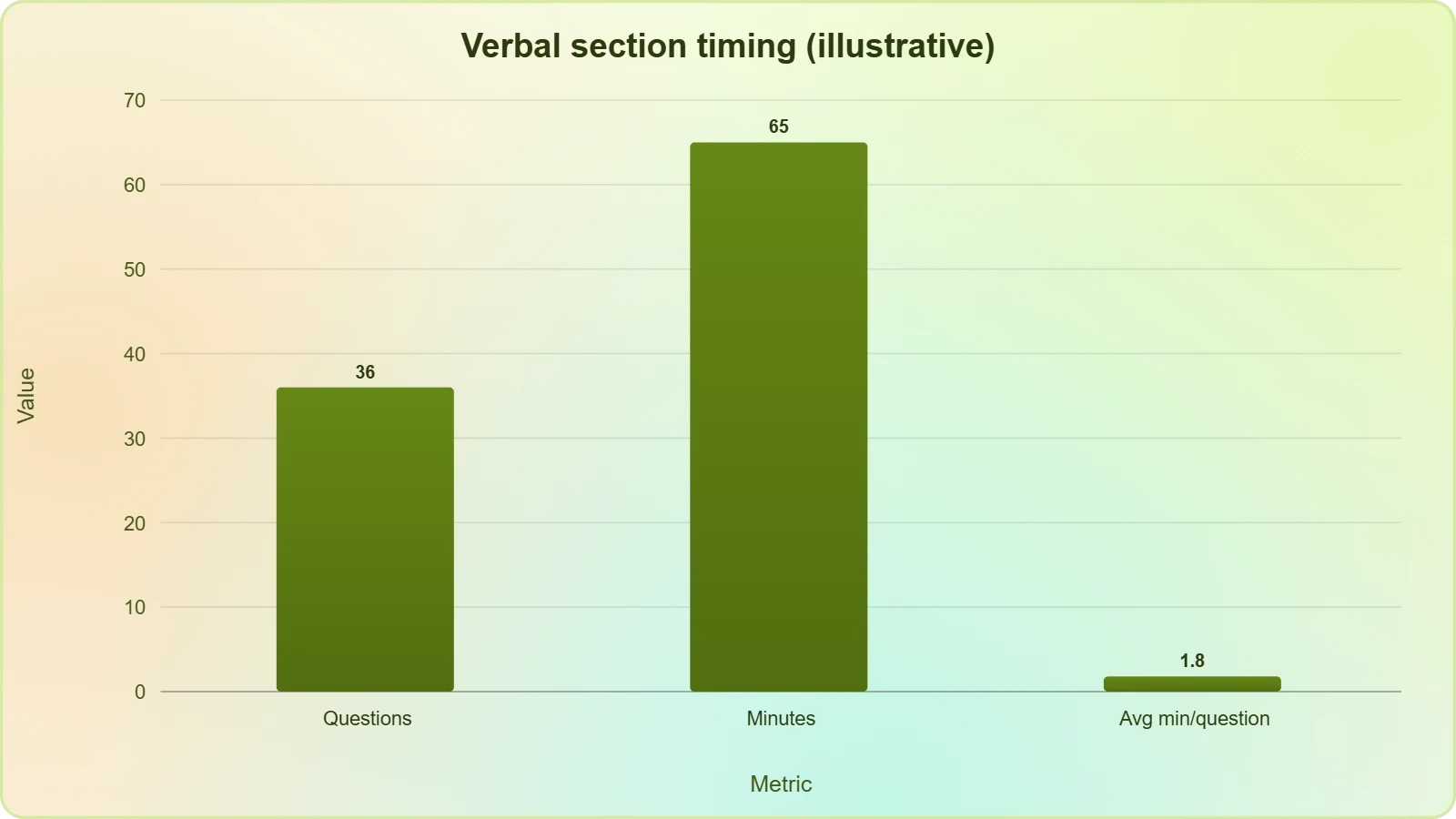
The section conventionally presents thirty-six questions to be completed within sixty-five minutes, yielding an average allocation of approximately one minute and forty-eight seconds per item. This temporal constraint is not incidental; it functions as a deliberate stressor that rewards efficient reading and decisive elimination of implausible options. Candidates who deliberate excessively on individual items risk systematic under-completion, a pattern associated with measurable score depression.
Question types are interleaved rather than grouped, requiring candidates to switch cognitive sets rapidly between syntactic repair, argument analysis, and passage-based inference. This interleaving complicates preparation, because fluency in one domain does not automatically transfer to another.
Empirical test-preparation literature suggests that mixed practice schedules produce superior retention and transfer relative to blocked practice, a finding consistent with the section's design philosophy.
The adaptive algorithm selects subsequent items based on cumulative performance, meaning that early errors can constrain the difficulty ceiling of later questions. This property has prompted debate about optimal pacing strategies, with some analysts advocating careful accuracy on initial items and others emphasising consistent throughput. The consensus position holds that balanced accuracy across the entire section outperforms front-loaded caution.
Score reporting converts raw performance into a scaled verbal score, typically ranging from six to fifty-one, which is subsequently incorporated into the composite total score. Because the composite aggregates verbal and quantitative results, a pronounced asymmetry between the two domains is visible to admissions readers. Such asymmetry may invite scrutiny regarding a candidate's readiness for quantitatively or verbally demanding coursework.
Adaptive Delivery and Score Scaling
The computer-adaptive engine estimates ability continuously, selecting items whose difficulty is calibrated to the candidate's running proficiency estimate. This item-response-theory framework yields efficient measurement but introduces path dependency: performance on early items influences the informational value of later ones.
Candidates should therefore regard the opening third of the section as disproportionately consequential for the final scaled result.
Scaled scores are derived through a transformation that maps raw performance onto a stable reporting metric, permitting comparison across administrations. Because the metric is equated, a verbal score of forty carries consistent meaning regardless of the specific item pool encountered.
Admissions readers can thus interpret scores comparatively without adjusting for test-form difficulty, a property that enhances the fairness of cross-candidate evaluation.
Percentile rankings accompany scaled scores and contextualise performance relative to the testing population. A verbal score that appears modest in absolute terms may nonetheless correspond to a competitive percentile, particularly in cohorts where quantitative aptitude predominates.
Candidates should therefore interpret their results through both absolute and relative lenses before drawing conclusions about programme fit.
Integration with the Composite Score
The composite total score aggregates verbal and quantitative performance, and this aggregation has interpretive consequences that extend beyond simple addition. A candidate with balanced scores across both domains may be judged differently from one with an identical total achieved through pronounced asymmetry. Admissions committees frequently examine the component profile, not merely the aggregate, when assessing readiness for specific curricula.
Verbal strength is particularly salient for programmes emphasising case discussion, negotiation, and written analysis, where precise expression and argument evaluation are daily requirements. Conversely, quantitative strength signals readiness for analytics-heavy coursework. The verbal section therefore contributes diagnostic information about a candidate's communicative and analytical profile that the composite alone would obscure.
Some institutions publish median verbal scores for admitted cohorts, and candidates can use these benchmarks to calibrate expectations. However, medians conceal substantial variance, and a score below the median does not preclude admission when other credentials compensate.
Contextual review remains the norm at most competitive programmes, and the verbal score functions as one signal among several.
Construct Validity and What the Section Measures
The section's construct validity rests on the claim that its items sample the cognitive operations required for graduate management study. Sentence Correction samples syntactic control under semantic constraint; Critical Reasoning samples argument evaluation; Reading Comprehension samples inferential synthesis.
Together they approximate the analytical literacy demanded by discussion-based curricula, though no standardised instrument captures the construct perfectly.
Critics have questioned whether Sentence Correction, in particular, measures a skill that graduate programmes value, given that formal grammar instruction is rarely part of management curricula. Defenders counter that the question type assesses clarity of expression and sensitivity to ambiguity, both of which are consequential in professional writing. The debate remains unresolved, but the section's persistence reflects institutional confidence in its predictive utility.
Empirical studies of predictive validity generally report modest but statistically significant correlations between verbal scores and subsequent academic performance. These correlations are stronger for programmes with substantial reading and writing demands and weaker for purely quantitative curricula. The evidence therefore supports qualified claims about predictive utility rather than strong causal assertions.
Sentence Correction: Syntactic Repair Under Semantic Constraint
Sentence Correction presents a sentence with a portion underlined, followed by five answer choices that offer alternative formulations of the underlined segment. Exactly one option produces a sentence that is grammatically sound and preserves the intended meaning.
The question type thus couples grammatical judgement with semantic fidelity, and candidates must satisfy both criteria simultaneously rather than optimising for either alone.
Anatomy of a Sentence Correction Item
Each item comprises a stimulus sentence, an underlined segment, and five options, the first of which typically reproduces the original wording verbatim. Candidates must determine whether the original is defective and, if so, which alternative repairs the defect without introducing new errors. The design rewards systematic comparison of options rather than intuitive preference for familiar phrasing.
Effective solution strategies involve scanning options for recurring differences, then testing each difference against grammatical rules and meaning requirements. This comparative approach conserves time and reduces the influence of stylistic bias. Candidates who read each option in full, without comparing, frequently exhaust the time budget and overlook decisive distinctions.
Meaning preservation is a frequently underestimated criterion. An option may be grammatically impeccable yet distort the original proposition through altered scope, shifted tense, or reversed logical relationships. The instruction to preserve meaning is therefore substantive, not decorative, and candidates should verify that the chosen option retains the stimulus's intended assertion.
Common traps include options that appear more concise but omit essential qualifiers, and options that correct one error while introducing another. The examination deliberately constructs distractors that exploit plausible-sounding but incorrect formulations. Recognition of these patterns develops through deliberate practice with detailed error analysis rather than through volume alone.
Grammatical Domains Tested
The grammatical content spans subject-verb agreement, pronoun reference, modifier placement, parallelism, verb tense and mood, and idiomatic construction. These domains are conventional in formal written English and are tested at a level of sophistication that assumes prior familiarity. Candidates are not expected to recite terminology but must recognise and repair violations in context.
Modifier placement receives particular attention because misplaced or dangling modifiers generate ambiguity that impairs comprehension. An introductory participial phrase must modify the grammatical subject of the main clause, and violations of this principle are frequent targets. Candidates should habitually verify that introductory modifiers attach to the intended noun.
Parallelism governs the coordination of grammatically equivalent elements, and its violation produces sentences that read awkwardly even when individual components are correct. Lists, comparisons, and correlative constructions are common sites of parallelism errors. The examination rewards sensitivity to structural symmetry across coordinated elements.
Idiomatic construction is the least rule-governed domain, since idioms resist derivation from general principles and must be acquired through exposure. Candidates are advised to prioritise rule-governed errors and to treat idiom as a tiebreaker rather than a primary diagnostic. Over-reliance on idiom intuition can mislead candidates whose exposure to formal written English is limited.
Meaning Preservation as a Co-Equal Criterion
The instruction to select the option that preserves meaning is frequently misread as a secondary consideration subordinate to grammatical correctness. In practice, the two criteria are co-equal, and an option that repairs grammar while distorting meaning is incorrect. Candidates should therefore verify both dimensions before committing to an answer.
Meaning distortions arise through several mechanisms, including altered logical scope, reversed causal relationships, and shifted temporal reference. An option may replace a conditional construction with a categorical one, thereby strengthening a claim beyond the original's warrant. Such alterations are subtle and require careful comparison of the proposition expressed by each option.
Consider a sentence asserting that a policy may reduce costs; an option substituting will for may strengthens the claim and thereby distorts meaning, even if the resulting sentence is grammatically flawless. The examination exploits this distinction deliberately, and candidates who prioritise grammar alone will select such distractors. Vigilance regarding modal verbs and qualifiers is therefore essential.
Strategic Elimination and Time Discipline
Efficient Sentence Correction performance depends on rapid elimination of options containing identifiable errors, followed by comparative evaluation of survivors. This strategy conserves cognitive resources and reduces the temptation to reread the entire sentence repeatedly. Candidates should develop a mental checklist of high-frequency error types to guide elimination.
Time discipline is particularly consequential in this question type, because the comparative method can expand indefinitely if not bounded. A practical heuristic allocates approximately ninety seconds per item, with immediate commitment once two options remain and one is demonstrably superior. Candidates who exceed this allocation systematically should review their pacing data.
Error logs are a valuable diagnostic instrument, recording not merely which items were missed but which error categories recurred. Aggregated over several practice sets, such logs reveal systematic weaknesses that targeted review can address. This evidence-led approach outperforms undirected practice, which tends to reinforce existing habits rather than correct them.
Common Misconceptions
A prevalent misconception holds that the shortest option is usually correct, a heuristic that occasionally succeeds but frequently fails when concision sacrifices necessary qualifiers. The examination includes concise distractors precisely to penalise this heuristic. Candidates should evaluate concision as one consideration among several rather than as a decisive rule.
Another misconception treats spoken-English intuition as a reliable guide, despite substantial divergence between colloquial and formal written conventions. Constructions acceptable in conversation may violate formal rules tested by the examination. Candidates whose exposure to formal prose is limited should supplement intuition with explicit rule study.
A third misconception assumes that all five options must be read in full before elimination begins. In practice, scanning for differences and eliminating on identifiable errors is more efficient. The comparative method exploits the fact that options differ in predictable ways, and full sequential reading squanders this structural advantage.
We Also Published
Critical Reasoning: Evaluating the Architecture of Arguments
Critical Reasoning presents a short argument, typically drawn from business, social science, or public policy contexts, followed by a question directing the candidate to perform a specific analytical operation. Operations include identifying assumptions, strengthening or weakening a conclusion, drawing inferences, and resolving apparent paradoxes. The question type measures the capacity to analyse argumentative structure rather than to recall substantive knowledge.
Argument Anatomy: Premises, Conclusions, and Assumptions
Every argument comprises premises offered as evidence and a conclusion purportedly supported by that evidence. The relationship between premises and conclusion is frequently mediated by unstated assumptions that the argument requires for its inference to hold. Identifying these assumptions is central to several question types and to argument evaluation generally.
Premises function as the evidential foundation and are, by convention, accepted as true within the argument's frame. The conclusion is the claim that the premises are intended to establish, and it may be stated explicitly or left implicit. Distinguishing premises from conclusions is a prerequisite for all subsequent analysis, and misidentification produces systematic errors.
Assumptions are propositions the argument treats as true without stating them, and they function as bridges between evidence and conclusion. A necessary assumption is one without which the inference collapses; a sufficient assumption guarantees the conclusion when combined with the premises. Question stems specify which variety is sought, and conflating the two produces predictable errors.
Scope shifts constitute a frequent flaw, wherein the conclusion addresses a broader or different domain than the premises support. An argument about a specific firm's practices may conclude with a general claim about industry behaviour, exceeding the evidential warrant. Recognition of scope shifts is essential for weakening and flaw questions.
Question Stems and Required Operations
Question stems direct specific operations, and accurate classification of the stem is the first step toward an efficient solution. Strengthen and weaken stems ask which option increases or decreases the likelihood of the conclusion; assumption stems ask what the argument requires; inference stems ask what must be true given the premises. Each operation demands a distinct analytical posture.
Strengthen and weaken questions do not require the option to prove or disprove the conclusion; they require a material effect on its plausibility. Candidates frequently reject correct options for insufficient decisiveness, seeking proof where the stem requests only support. Calibrating the required strength of evidence to the stem's wording is a crucial skill.
Inference questions invert the usual direction, asking what follows necessarily from the stated premises rather than what would support a conclusion. The correct option must be entailed by the premises, not merely consistent with them. Options that are plausible but not entailed are the principal distractors in this question type.
Paradox and discrepancy questions present apparently contradictory facts and ask for an explanation that reconciles them. The correct option must account for both facts simultaneously, and options addressing only one side of the discrepancy are incomplete. These items reward careful identification of the precise tension requiring resolution.
Formal and Informal Logic in Practice
Although the section does not require symbolic logic, familiarity with basic inference patterns aids recognition of valid and invalid argument forms. Conditional reasoning, contraposition, and the distinction between necessary and sufficient conditions recur across items. Candidates who command these patterns analyse arguments more rapidly and with fewer errors.
Conditional statements of the form "if P then Q" warrant careful treatment, since the inference from Q to P is invalid while the inference from not-Q to not-P is valid. The examination exploits confusion between these directions, presenting options that commit the converse error. Explicit attention to conditional structure prevents such errors.
Correlation and causation constitute another recurrent theme, with arguments inferring causal relationships from observed associations. Weakening options frequently propose alternative explanations or reverse the causal direction. Candidates should habitually ask whether an observed correlation admits of non-causal interpretation before accepting a causal conclusion.
Quantitative reasoning occasionally intrudes, particularly in arguments involving percentages, base rates, and averages. An argument may infer a change in absolute terms from a change in proportions, ignoring shifts in the underlying base. Sensitivity to these statistical subtleties distinguishes careful analysis from superficial reading.
Assumption Identification Techniques
The negation test offers a systematic method for identifying necessary assumptions: negate the candidate assumption and observe whether the argument's inference collapses. If the negation destroys the argument, the proposition is necessary; if the argument survives, it is not. This technique converts an intuitive judgement into a checkable procedure.
Assumption questions frequently present options that are plausible but unnecessary, and the negation test discriminates efficiently between them. An option may describe a reasonable state of affairs without being required for the inference. Candidates who rely on plausibility alone systematically over-select such options.
Sufficient assumption questions demand a different approach, since the required proposition must guarantee the conclusion when combined with the premises. Such options are often stronger than necessary assumptions and may introduce conditions the argument did not contemplate. Distinguishing necessary from sufficient assumptions is therefore essential for accurate stem interpretation.
Strengthen, Weaken, and Evaluate
Strengthen and weaken questions ask which option materially affects the argument's plausibility, and the correct answer need not be decisive. An option that eliminates an alternative explanation strengthens by narrowing the space of competing hypotheses. Conversely, an option that introduces a viable alternative weakens by expanding that space.
Evaluate questions present a question whose answer would determine the argument's validity, and the correct option identifies a genuinely consequential uncertainty. Candidates must distinguish questions whose answers would matter from those whose answers would be irrelevant. This question type tests sensitivity to the argument's evidential dependencies.
Across these question types, the most reliable strategy is to articulate the argument's structure before examining options. Premise, conclusion, and inferential gap should be identified explicitly, and options evaluated against that structure. Candidates who read options before analysing the argument are vulnerable to attractive but irrelevant distractors.
Inference and Paradox Questions
Inference questions require the identification of a proposition entailed by the premises, and the correct option must follow necessarily rather than merely plausibly. Options that are consistent with the premises but not entailed are the principal distractors.
Candidates should test each option by asking whether the premises could be true while the option is false.
Paradox questions present two facts that appear incompatible and ask for an explanation that reconciles them. The correct option must render both facts simultaneously intelligible, often by revealing a distinction the apparent contradiction obscured. Options that explain one fact while neglecting the other are incomplete and therefore incorrect.
Both question types reward careful reading of the stimulus before option evaluation, since the required operation depends on precise identification of what is asserted. Rushed reading produces misclassification and subsequent error. Deliberate initial analysis, though time-consuming, generally yields net time savings by reducing reconsideration.
Reading Comprehension: Inferential Synthesis of Academic Prose
Reading Comprehension presents passages of several hundred words drawn from academic disciplines, followed by questions probing comprehension at multiple levels. Questions range from explicit detail retrieval to inference, function analysis, and evaluation of the author's reasoning. The question type measures the capacity to extract structure and argument from dense prose under time pressure.
Passage Genres and Structural Patterns
Passages span the natural sciences, social sciences, humanities, and business-related topics, and each genre exhibits characteristic structural conventions. Scientific passages frequently present a hypothesis, describe evidence, and discuss implications or limitations. Social science passages often compare theoretical positions and evaluate their explanatory power.
Humanities passages may trace the evolution of an interpretation or examine the reception of a work, and their arguments are frequently more implicit than those in scientific writing. Business passages address organisational, economic, or strategic questions and often involve evaluative judgements. Recognising genre conventions aids prediction of passage structure and question focus.
Structural signposting—such as contrastive conjunctions, enumerations, and explicit thesis statements—guides efficient reading. Candidates should note these markers mentally, constructing a skeletal outline that supports later question answering. Passive reading without structural attention produces poor retention and necessitates repeated returns to the passage.
Passages occasionally present multiple perspectives without adjudicating between them, and questions may probe the relationship among those perspectives. Identifying which view the author endorses, if any, is consequential for several question types. Misattribution of the author's position is a frequent source of error.
Question Types and Cognitive Demands
Detail questions require location and accurate retrieval of explicitly stated information, and they reward efficient scanning rather than comprehensive rereading. Inference questions demand conclusions that follow from the passage without being stated, and they require careful attention to evidential boundaries. Function questions ask why a particular sentence or paragraph appears where it does.
Primary purpose questions ask for the passage's overall aim, and the correct option must capture the passage's scope without overstating or understating it. Options that describe a subordinate element as the main purpose are common distractors. Candidates should verify that the chosen option encompasses the passage's full argumentative arc.
Author attitude questions probe the stance the author adopts toward the subject, and the correct option must be calibrated to the passage's tone. Attitude options range from strongly critical to strongly supportive, and the passage's diction provides the relevant evidence. Overstating the author's commitment is a recurrent error.
Application questions ask candidates to extend the passage's reasoning to a novel situation, testing whether the underlying principle has been grasped. These items resist mere retrieval and require genuine comprehension of the argument's logic. They are frequently the most demanding items in a set.
Active Reading and Note-Taking Strategies
Active reading involves continuous interrogation of the passage's structure, argument, and purpose rather than passive absorption of content. Candidates should ask what the author is claiming, what evidence is offered, and what qualifications are attached. This interrogative posture improves retention and reduces the need for rereading.
Brief mental or scratch-paper outlines capture the passage's architecture without consuming excessive time. An outline might record the thesis, the principal supporting claims, and any concessions or limitations. Such outlines support efficient question answering by providing a navigational map of the passage.
Note-taking should be economical, since extensive notes consume time that question answering requires. The objective is a minimal scaffold sufficient to locate information, not a comprehensive summary. Candidates should calibrate note density to passage complexity and their own retention capacity.
Time Management Across Passage Sets
Reading Comprehension sets typically comprise a passage followed by several questions, and the time allocation must cover both reading and answering. A common heuristic allocates two to three minutes to reading and approximately one minute per question. Candidates should adjust these allocations according to passage difficulty and personal reading speed.
Strategic sequencing within a set can improve efficiency, with general questions answered before detail questions that require targeted returns to the passage. This ordering exploits the fact that general questions require the structural understanding already developed during reading. Detail questions then benefit from a navigational map established by the general questions.
Candidates should resist the temptation to reread the entire passage when a detail question proves difficult, since targeted scanning is generally more efficient. Locating the relevant sentence through structural memory conserves time. Indiscriminate rereading is a principal cause of time overruns in this section.
Preparation Strategy and Score Interpretation
Effective preparation for the verbal section integrates diagnostic assessment, targeted remediation, and sustained practice under realistic conditions. Candidates should begin with a full-length diagnostic to establish a baseline profile across the three question types. This profile then guides the allocation of study time toward the weakest domains rather than uniform coverage.
Diagnostic Assessment and Error Analysis
Diagnostic assessment identifies relative strengths and weaknesses across question types, enabling efficient allocation of preparation effort. A candidate may discover, for instance, that Critical Reasoning accuracy substantially exceeds Sentence Correction accuracy. Such a profile warrants disproportionate attention to the weaker domain, where marginal gains are largest.
Error analysis extends beyond recording incorrect answers to classifying the underlying causes of error. Causes may include conceptual gaps, misread stems, time pressure, or careless option evaluation. Distinguishing among these causes permits targeted remediation, whereas undifferentiated practice tends to reinforce existing patterns.
Aggregated error logs reveal systematic tendencies that individual review sessions may obscure. A candidate who consistently misclassifies assumption questions, for example, requires conceptual instruction rather than additional practice. Evidence-led diagnosis therefore precedes and informs practice design.
Practice Regimens and Realistic Conditions
Practice should approximate examination conditions, including strict timing, absence of interruption, and use of the same interface where possible. Practice conducted under relaxed conditions may inflate apparent proficiency and produce disappointing examination results. Realistic simulation is therefore essential for accurate self-assessment.
Mixed practice, interleaving question types as the examination does, develops the cognitive flexibility the section demands. Blocked practice, which drills a single question type repeatedly, may produce rapid initial gains that do not transfer to mixed conditions. Candidates should incorporate both, with mixed practice predominating as the examination approaches.
Review of completed practice sets should be as rigorous as the practice itself, with each error examined for its cause and each correct answer verified for sound reasoning. Correct answers reached through faulty reasoning represent latent weaknesses that may surface under different conditions. Verification therefore complements error analysis.
Interpreting Verbal Scores in Admissions Context
Verbal scores are interpreted comparatively, with admissions committees situating individual results within cohort distributions and programme expectations. A score above a programme's median signals readiness for verbally demanding coursework, while a score below the median invites contextual consideration. Neither outcome is determinative in isolation.
Programmes differ in their verbal expectations according to curricular emphasis, with consulting-oriented and general management programmes often weighting verbal performance heavily. Candidates should research programme-specific profiles rather than relying on aggregate rankings. This research informs both target-setting and application strategy.
Where verbal performance is modest relative to quantitative strength, candidates may address the asymmetry through application essays or supplementary materials. A demonstrated record of analytical writing can contextualise a lower verbal score. Such contextualisation is most persuasive when supported by concrete evidence rather than assertion.
Common Preparation Pitfalls
A frequent pitfall involves excessive content review at the expense of applied practice, producing familiarity without fluency. Candidates may memorise grammatical rules yet fail to apply them under time pressure. Practice should therefore predominate, with content review serving identified gaps rather than preceding practice wholesale.
Another pitfall is the pursuit of volume without analysis, whereby candidates complete numerous practice sets without examining their errors. This approach reinforces existing habits and yields diminishing returns. Deliberate, analysed practice of moderate volume generally outperforms extensive unexamined practice.
A third pitfall is neglect of pacing discipline, with candidates achieving high accuracy in untimed practice but failing to complete sections under examination conditions. Pacing should be practised explicitly from the outset, with timed sets forming the core of the regimen. Accuracy and speed must be developed concurrently rather than sequentially.
Synthesis: What the Verbal Section Ultimately Measures
The verbal section's three question types converge on a common construct: analytical literacy, understood as the capacity to parse complex prose, evaluate argumentative structure, and express propositions with precision. Sentence Correction addresses the expressive dimension, Critical Reasoning the evaluative dimension, and Reading Comprehension the receptive dimension. Together they sample a coherent, if imperfectly measured, cognitive domain.
Convergence of the Three Question Types
Despite their surface differences, the three question types share an underlying demand for precise reading and disciplined inference. Sentence Correction requires exact attention to meaning; Critical Reasoning requires exact attention to logical structure; Reading Comprehension requires exact attention to authorial purpose. Each penalises imprecise reading in characteristic ways.
The section thus rewards a unified disposition rather than three separate competencies, and preparation that emphasises this unity may transfer across question types. A candidate who habitually verifies meaning and structure will perform more consistently than one who treats each type as an isolated skill. Integrated preparation reflects this underlying coherence.
This convergence also explains why verbal performance correlates with performance on analytical writing tasks, despite the different response formats. Both demand the articulation and evaluation of propositions under constraint. The shared construct provides a theoretical basis for expecting such correlations.
Limits of Standardised Verbal Assessment
Standardised verbal assessment cannot capture every dimension of communicative competence, and the section's scope is deliberately bounded. It does not assess oral communication, collaborative discourse, or creative expression, all of which matter in management contexts. The score should therefore be interpreted as a partial indicator rather than a comprehensive measure.
Cultural and linguistic background may influence performance in ways unrelated to analytical ability, and the examination's designers have sought to minimise such effects through item review and fairness analysis. Residual effects may nonetheless persist, and admissions committees are generally advised to interpret scores contextually. Qualified interpretation is more defensible than strong inference from a single metric.
The section's predictive validity, while statistically significant, is modest, and it should be combined with other evidence in admissions decisions. Academic records, professional experience, and application materials collectively provide a richer picture. Over-reliance on any single measure risks distorting the evaluative process.
Implications for Candidates and Admissions Readers
Candidates should approach the verbal section as a test of reasoning discipline rather than of accumulated vocabulary, and preparation should reflect this framing. Targeted practice with rigorous error analysis yields greater returns than undirected reading or rote memorisation. Pacing discipline and structural reading habits are central to sustained improvement.
Admissions readers should interpret verbal scores alongside quantitative results and contextual information, attending to profile balance as well as absolute level. A pronounced asymmetry may warrant inquiry, while a balanced profile may warrant confidence. Contextual interpretation serves both institutional and candidate interests.
The section ultimately functions as one instrument within a broader evaluative apparatus, and its value lies in the comparative information it provides. Used judiciously, it contributes to defensible admissions judgements; used mechanically, it may obscure relevant qualities. The distinction between these uses is a matter of interpretive discipline.
From our network :
- Bitcoin Hits $100K: Crypto News Digest
- JD Vance Charlie Kirk: Tribute and Political Strategy
- Bitcoin price analysis: Market signals after a muted weekend
- How to migrate to postgres using logical replication and cutover
- The Diverse Types of Convergence in Mathematics
- How to design postgres partitions with native and hash methods
- Limits: The Squeeze Theorem Explained
- How to secure postgres connections across VPC, VPN, and cloud
- Limit Superior and Inferior
RESOURCES
- No results found.