The structural evolution of India's education system reflects intense tension between budgetary priorities, demographic realities, and constitutional promises. Over the past decade, institutional shifts have fundamentally altered the balance between public schooling and private delivery models across primary and tertiary tiers.
Socioeconomic expectations tied to the nation's vast youth cohort face acute headwinds from accelerating workplace automation and contraction in traditional entry-level white-collar recruitment. Citizen-led audits and public records underscore growing operational divergence across state-run facilities and private educational institutions nationwide.
Analyzing government expenditure data, institutional governance mandates, and pedagogical transformations reveals a complex realignment in national educational priorities. This analytical report examines the underlying mechanisms driving structural consolidation, capital debt transitions, and evolving civic discourse across India's educational landscape.
TL;DR Over the past decade, India's public education framework has experienced deep structural transformations, marked by the net closure of roughly 94,000 state-run schools alongside a corresponding expansion of 51,000 private institutions. While absolute Union budgetary funding has risen, education's share of total Union expenditure declined from 4.6% to 2.5%, remaining below the 6% GDP target. Simultaneously, capital grant replacements through the Higher Education Financing Agency (HEFA) and persistent youth underemployment have catalyzed grassroots civic movements questioning institutional priorities, pedagogical autonomy, and administrative accountability.
On This Page
- Structural Reconfiguration and Primary School Closures
- Budgetary Trajectories and Public Education Expenditure
- Capital Financing and Tertiary Institutional Autonomy
- Demographic Realities, Employment Pressures, and Civic Resistance
- Pedagogical Paradigms: Critical Inquiry Versus Conformity
- Policy Trajectories and Long-Term Structural Implications
Structural Reconfiguration and Primary School Closures
State-level administrative consolidation has altered the rural and urban public schooling landscape across India. Official data illustrates a pronounced contraction of government-operated facilities alongside rapid private-sector expansion, reshaping access benchmarks across diverse socio-economic communities.
The Scale of National School Consolidation
Official records from NITI Aayog reveal an unprecedented national transformation in public educational infrastructure. Between 2014 and 2025, India recorded a net decline of approximately 94,000 state-run primary and upper primary learning institutions nationwide.
Concurrently, the private educational footprint expanded dramatically, adding approximately 51,000 commercial and trust-managed schools. Policy planners frequently defend this systematic consolidation under school rationalization frameworks, arguing that merging low-enrollment campuses concentrates instructional resources effectively.
However, rural advocacy networks argue that systematic campus closures dislocate vulnerable first-generation learners disproportionately. Transportation deficiencies, regional poverty, and safety risks often prevent young students from reaching distant consolidated facilities across adjoining village clusters.
This physical contraction fundamentally shifts public obligations toward private alternatives in underserved educational zones. Families facing local school closures must choose between paying commercial tuition or terminating their children's formal foundational educational instruction entirely.
Facility Quality and Administrative Transparency
Community audits evaluating remaining government schools focus on foundational operational baselines. Observers monitor functional sanitation, consistent drinking water, reliable classroom electricity, perimeter security walls, active teacher attendance, and midday nutritional meal compliance.
While official repositories claim substantial compliance with statutory benchmarks, grassroots photographic inspections consistently document severe regional deficiencies. Incomplete sanitation repairs and chronic instructor vacancies frequently hamper instructional environments across multiple rural districts.
Administrative responses to civic oversight have grown increasingly defensive across several state jurisdictions. Rajasthan, for instance, implemented strict regulations barring unauthorized exterior visitors and photography within school compounds during academic operating hours.
While authorities defend these restrictions on child safety and student privacy grounds, critics contend that blanket bans eliminate crucial civic oversight. Curtailing independent verification mechanisms conceals infrastructural decay from public scrutiny and policy accountability debates.
Budgetary Trajectories and Public Education Expenditure
Public financial allocations demonstrate significant divergence between top-line aggregate expenditure expansions and proportional fiscal prioritizations. Detailed budgetary analyses reveal systematic contractions in education's claim over the consolidated national spending framework.
Aggregate Expansions Versus Proportional Reductions
Evaluating national educational spending requires distinguishing nominal figures from broader fiscal proportionality. In absolute rupee terms, the Union government allocated approximately Rs 1,39,289 crore toward the education sector for the 2026-27 fiscal calendar.
This gross expenditure represents a notable upward trajectory compared to previous decades. Political leadership frequently highlights these expanded rupee totals as unequivocal proof of expanding state support for human capital development across the country.
However, expressing these sums as a percentage of the total Union budget reveals a substantial relative contraction. The educational portfolio declined from approximately 4.6% of the consolidated federal budget in 2013-14 to roughly 2.5% in recent appropriations.
This declining fiscal footprint indicates that as national expenditure expanded to service infrastructure and sovereign obligations, education slipped in budgetary prioritization. Relative funding shifts limit systemic capacity to maintain modern operational standards across state jurisdictions.
The Persistent Gap Against National Policy Benchmarks
The gap between actual allocations and formal policy declarations remains a defining challenge of modern Indian education. The National Education Policy explicitly recommends allocating 6% of gross domestic product toward combined public educational spending.
However, total public investment across central and state tiers currently stagnates at approximately 4.1% of national GDP. This funding shortfall restricts structural modernization initiatives, laboratory expansions, teacher recruitment drives, and academic research subsidies nationwide.
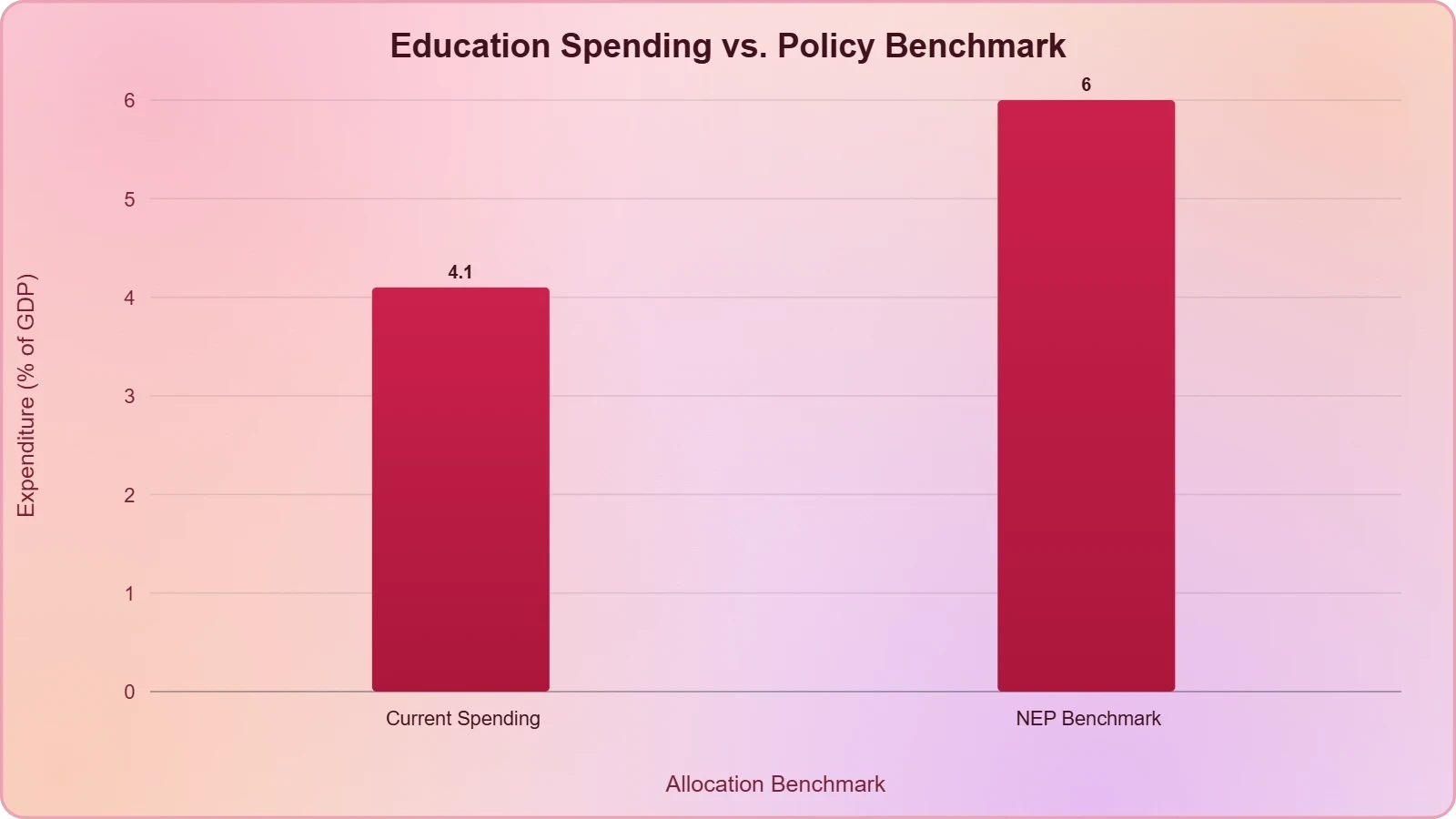
To quantify these structural investment targets mathematically, economists define the fiscal educational realization gap ##G_e## through the relationship:
Where ##T_{NEP} = 0.06 Y## represents the policy target, ##E_{actual}## denotes current spending, and ##Y## signifies gross domestic product. Bridging this persistent two-percentage-point deficit requires unprecedented fiscal realignments across both central and state legislative budgets.
We Also Published
Capital Financing and Tertiary Institutional Autonomy
In tertiary education, funding mechanisms have migrated from non-repayable public capital endowments toward institutional credit facilities. This strategic transition alters university balance sheets, governance priorities, and downstream fee structures across elite federal institutions.
The Emergence of the Higher Education Financing Agency
Established in 2017, the Higher Education Financing Agency (HEFA) transformed infrastructure development across premier academic institutions. Instead of receiving traditional budgetary capital grants, universities secure long-term commercial loans to fund campus expansions and technological infrastructure.
Under this tripartite structure, federal ministries subsidize interest liabilities while participating institutions service principal repayments. To meet debt amortization obligations, premier technical and central universities must generate independent internal operational revenues systematically.
Consequently, higher educational institutions face structural pressure to increase academic tuition fees, executive education pricing, and corporate patents. Critics caution that this credit-driven model encourages corporatization, shifting foundational financial burdens directly onto attending students.
This dynamic challenges the traditional mandate of public universities as egalitarian social ladders for economically disadvantaged scholars. Tuition inflation risks restricting access to prestigious technical, medical, and managerial institutions across lower-income demographics.
Institutional Autonomy and Administrative Oversight
Parallel to financial restructuring, state oversight across autonomous institutions has tightened through statutory appointments and curriculum frameworks. Regulatory directives increasingly guide faculty appointments, research grants, and seminar topics across centrally funded higher education campuses.
Proponents argue that centralized oversight aligns university curricula with national workforce development targets and technical priorities. Uniform governance aims to reduce administrative inefficiencies and standardize instructional quality across historically uneven university departments.
Conversely, faculty associations contend that bureaucratic intervention constrains academic freedom and intellectual exploration. Subjecting university governance to direct administrative guidance can suppress debate and critical inquiry on pressing social and macroeconomic challenges.
This dynamic highlights the evolving mission of higher education, balancing technical vocational training against critical scholarship. Policy shifts emphasize immediate vocational productivity while often sidelining humanities, social sciences, and independent foundational inquiry.
Demographic Realities, Employment Pressures, and Civic Resistance
The macroeconomic promise of India's demographic dividend faces persistent structural employment challenges. As technological disruption curbs traditional corporate hiring, frustrated young job seekers increasingly channel their discontent into coordinated civic mobilization.
Automation and the Shrinking Entry-Level Job Market
India's demographic transition has reached a crucial juncture where expanding working-age populations exceed formal employment generation. Entry-level white-collar and software services positions face contraction from automation, artificial intelligence, and algorithmic workflow deployment across corporate industries.
Historically, technical colleges offered reliable pathways into middle-class financial security through mass recruitment drives. However, commercial IT enterprises have rationalized intake quotas, leaving thousands of credentialed technical graduates underemployed across major urban centers.
Consequently, competition for stable civil service and state sector positions has intensified dramatically. Millions of university graduates compete for a handful of advertised administrative vacancies, reflecting broad-based imbalances across modern labor markets.
This structural employment bottleneck produces deep economic anxiety for families investing significant savings into technical degrees. Expected career dividends fail to materialize, fostering widespread disillusionment among educated young cohorts nationwide.
The Rise of Grassroots Youth Mobilization
Frustration over employment scarcity and public infrastructure decay recently sparked intense civic mobilization across digital platforms. Tensions escalated when the Chief Justice of India characterized unemployed youths using public information petitions as pests attacking state institutions.
The comment provoked widespread outrage among educated youth, catalyzing the satirical Cockroach Janta Party movement. Activists reclaimed the pejorative label, transforming it into an organized campaign monitoring transparency and administrative accountability across government institutions.
The campaign deployed citizen verification teams to document infrastructural conditions within state-run public schools nationwide. Armed with smartphones and Right to Information requests, youth activists compiled evidence of dilapidated classrooms, dry taps, and broken boundaries.
This movement illustrates how digital platforms empower young citizens to confront bureaucratic complacency directly. By auditing public services, youth communities transform economic frustration into constructive civic oversight, demanding systemic governance accountability from state institutions.
Pedagogical Paradigms: Critical Inquiry Versus Conformity
Beyond fiscal allocations and employment metrics, modern discourse centers on the fundamental purpose of formal instruction. Competing educational philosophies balance critical, independent reasoning against standardized workforce instruction designed for immediate market integration.
The Classical Vision: Developing Judgment and Civic Intellect
India's educational philosophy historically prioritized democratic intellect, critical judgment, and universal humanism. Thinkers like Rabindranath Tagore, Maulana Abul Kalam Azad, and the post-independence Radhakrishnan Commission framed universities as centers for cultivating independent consciousness.
Tagore emphasized holistic inquiry connected with nature, warning that mechanical schooling merely trains individuals for administrative compliance. Similarly, Azad championed accessible public education as the foundation of democratic citizenship and communal cohesion across post-colonial India.
The Radhakrishnan Commission asserted that higher learning institutions must prioritize intellectual autonomy above industrial utility. Academics aimed to equip students with ethical courage, analytical rigor, and independent reasoning skills necessary to critique state policies constructively.
In this classical view, classroom instruction serves broad civic and moral purposes beyond vocational credentialing. Developing independent analytical judgment protects democratic institutions against unchecked authoritarian tendencies and social decay.
Market Realities and Pragmatic Household Choices
Contemporary realities, however, have steered educational priorities toward utilitarian market outcomes. Families facing competitive employment landscapes view engineering, computer applications, and commercial certifications as rational defenses against chronic economic insecurity.
Liberal arts and theoretical sciences frequently register steep enrollment declines as students bypass non-vocational programs. Under pressure to fund schooling through personal debt, households prioritize degrees offering immediate employment prospects over broader intellectual exploration.
National educational policy and funding frameworks reinforce this preference through budget distributions. Financial resources consistently favor applied technical disciplines, while humanities and social sciences programs encounter chronic underfunding and administrative neglect.
While technical proficiencies meet essential digital economy requirements, marginalizing critical inquiry risks producing compliant technocrats. A robust educational framework must balance practical employment preparation with rigorous civic and analytical scholarship.
Policy Trajectories and Long-Term Structural Implications
The transformation of India's education system will shape social mobility and governance for future generations. Current trends require balancing national technical ambitions against equitable public access, fiscal health, and democratic accountability.
Balancing Technical Skilling with Democratic Resilience
Technological advancement requires a skilled workforce capable of operating complex digital platforms and industrial facilities. Investing in engineering programs, digital classrooms, and vocational institutes remains vital for sustaining international economic competitiveness.
However, technical competencies alone cannot substitute for ethical evaluation, civic responsibility, and critical inquiry. When schooling neglects historical context and analytical debate, students graduate unprepared to navigate complex socio-political realities and constitutional responsibilities.
Preserving democratic traditions requires educational institutions that encourage diverse viewpoints and question conventional policies. Critical thinking in classrooms helps nurture informed voters, independent researchers, and accountable civic leaders across society.
Policy planners must recognize that rigorous analytical scholarship complements technical innovation rather than hindering it. Fostering both practical competencies and independent judgment ensures sustainable civic and economic development nationwide.
Recalibrating Fiscal Models and Civic Transparency
Revitalizing India's public education infrastructure requires bridging the gap between actual expenditures and the 6% GDP target. Central and state governments must prioritize primary learning environments, ensuring every campus maintains basic sanitation, electricity, and qualified teachers.
Simultaneously, tertiary funding models require critical re-evaluation to shield students from mounting fee burdens. While market partnerships offer valuable research commercialization opportunities, core university infrastructure funding should rely on robust public allocations rather than student loans.
Equally critical is restoring civic transparency and public verification across state schools and university campuses. Banning citizen oversight, photography, and public information inquiries weakens community trust and compromises instructional accountability.
India's long-term prosperity depends on an education system that is financially resilient, broadly accessible, and intellectually autonomous. Fostering critical inquiry alongside technical excellence ensures the nation's youth realize their full democratic and economic potential.
From our network :
- Limit Superior and Inferior
- Bitcoin price analysis: Market signals after a muted weekend
- How to secure postgres connections across VPC, VPN, and cloud
- How to migrate to postgres using logical replication and cutover
- The Diverse Types of Convergence in Mathematics
- Limits: The Squeeze Theorem Explained
- JD Vance Charlie Kirk: Tribute and Political Strategy
- Bitcoin Hits $100K: Crypto News Digest
- How to design postgres partitions with native and hash methods
RESOURCES
- No results found.