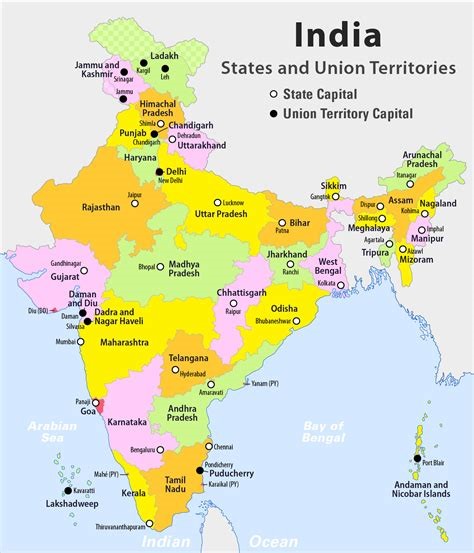
Memorize Indian states and capitals with proven strategies to ace competitive exams and enhance your geographical knowledge. This article breaks down all 28 states and 8 union territories, offering techniques to retain information effortlessly while exploring governance structures. You'll learn to memorize Indian states and capitals through regional grouping and practical applications.
On This Page
India's intricate administrative framework comprises 28 states and 8 union territories, each with unique capitals that are essential knowledge for competitive exams and general awareness. This guide helps you to memorize Indian states and capitals through structured learning and contextual insights. Understanding these geographical divisions not only aids in exam preparation but also enriches your grasp of India's federal structure.
An Overview of India's Political Geography
India's states and union territories form the bedrock of its governance system, established to manage regional diversity and administrative efficiency. This classification dates back to the reorganization of states on linguistic lines, promoting local governance and cultural identity. Each entity operates under distinct constitutional provisions, influencing their capital cities and leadership roles.
| State | Capital |
|---|---|
| Himachal Pradesh | Shimla |
| Punjab | Chandigarh |
| Haryana | Chandigarh |
| Uttarakhand | Dehradun |
| Uttar Pradesh | Lucknow |
| State | Capital |
|---|---|
| Andhra Pradesh | Amaravati |
| Karnataka | Bengaluru |
| Kerala | Thiruvananthapuram |
| Tamil Nadu | Chennai |
| Telangana | Hyderabad |
| State | Capital |
|---|---|
| Bihar | Patna |
| Jharkhand | Ranchi |
| Odisha | Bhubaneswar |
| West Bengal | Kolkata |
| State | Capital |
|---|---|
| Rajasthan | Jaipur |
| Gujarat | Gandhinagar |
| Maharashtra | Mumbai |
| Goa | Panaji |
| State | Capital |
|---|---|
| Arunachal Pradesh | Itanagar |
| Assam | Dispur |
| Manipur | Imphal |
| Meghalaya | Shillong |
| Mizoram | Aizawl |
| Nagaland | Kohima |
| Sikkim | Gangtok |
| Tripura | Agartala |
| State | Capital |
|---|---|
| Madhya Pradesh | Bhopal |
| Chhattisgarh | Raipur |
| Union Territory | Capital |
|---|---|
| Andaman & Nicobar Islands | Sri Vijaya Puram (formerly Port Blair) |
| Chandigarh | Chandigarh |
| Dadra & Nagar Haveli and Daman & Diu | Daman |
| Delhi (NCT) | New Delhi |
| Jammu & Kashmir | Srinagar S / Jammu W |
| Ladakh | Leh S / Kargil W |
| Lakshadweep | Kavaratti |
| Puducherry | Puducherry |
State Dynamics and Administrative Roles
States in India enjoy significant autonomy, with powers delineated in the Constitution to legislate on various subjects. Their capitals often serve as hubs for political, economic, and cultural activities, reflecting historical and strategic importance. For instance, capitals like Mumbai and Kolkata are not just administrative centers but also economic powerhouses.
Union Territories' Governance Models
Union territories, governed directly by the central government, exhibit varied administrative setups. Some, like Delhi and Puducherry, have elected legislatures and chief ministers, blending autonomy with central oversight. This dual approach ensures tailored governance while maintaining national integrity and resource allocation.
Memorizing States and Capitals Effectively
Learning all 28 states and their capitals can seem daunting, but structured techniques make it manageable. Group states by regions or use mnemonic devices to associate names with memorable phrases. Regular revision and quizzes reinforce retention, turning rote memorization into an engaging educational experience.
Geographical Groupings for Better Recall
Divide India into zones like North, South, East, West, and Central, listing states and capitals within each. This method leverages spatial memory, helping you to memorize Indian states and capitals by visualizing maps. For example, southern states include Karnataka with Bengaluru and Tamil Nadu with Chennai.
Applying Knowledge in Real-World Contexts
Beyond exams, knowing capitals aids in understanding regional politics, tourism, and economic policies. Discuss current events tied to state capitals to deepen comprehension. This practical application ensures that memorization translates into useful, long-term knowledge.
Leadership Structures Across Administrative Units
The heads of states and union territories vary, reflecting India's federal diversity. States are led by chief ministers who oversee day-to-day governance, while union territories may have lieutenant governors or administrators. Exceptions like Delhi and Jammu and Kashmir feature elected chief ministers, highlighting evolving autonomy.
Roles of Chief Ministers and Governors
Chief ministers in states implement policies and manage resources, answerable to state legislatures. In union territories, governors or administrators execute central directives, ensuring alignment with national interests. This distinction underscores the balance between regional aspirations and centralized control.
Evolution of Governance in Special Cases
Union territories like Delhi have seen governance reforms, granting more powers to elected bodies. Historical changes, such as the bifurcation of Jammu and Kashmir, illustrate how administrative boundaries adapt to political and social needs, affecting capital designations.
Essential Insights for Aspirants
Mastering India's states and capitals is a foundational step for competitive exams and civic literacy. Focus on consistent practice, utilize interactive tools, and relate facts to broader geopolitical trends. This holistic approach not only prepares you for tests but also fosters a deeper appreciation of India's unity in diversity.
RESOURCES
- How To Learn States of India with Trick | Remember All The 29 ...
- Is it possible to memorize all the Indian states in a minute? - Quora
- How to memorize 29 states of India easily - YouTube
- I don't know most state capitals, and it's never once been revealed ...
- Indian States and Their Capitals Class 9 | Trick to Remember ...
- Memorizing 50 state capitals in 5th grade class
- Tricks to remember Indian states and capitals - Easy way to Learn ...
- Fun and Easy Way of Learning Indian States and Capitals
- Memorizing the states/provinces/regions/departments/etc. of ...
- Memorizing states and their capitals - Homework and Study Help ...
- States and Capitals of India 2025: Easy Learning Guide
- States and Capitals of India: Easy Learning Guide for Students
- States Capitals
- State The States and Capitals on the App Store
- States and Capitals
From our network :
- How to secure postgres connections across VPC, VPN, and cloud
- How to design postgres partitions with native and hash methods
- Limits: The Squeeze Theorem Explained
- JD Vance Charlie Kirk: Tribute and Political Strategy
- Bitcoin price analysis: Market signals after a muted weekend
- The Diverse Types of Convergence in Mathematics
- Bitcoin Hits $100K: Crypto News Digest
- How to migrate to postgres using logical replication and cutover
- Limit Superior and Inferior