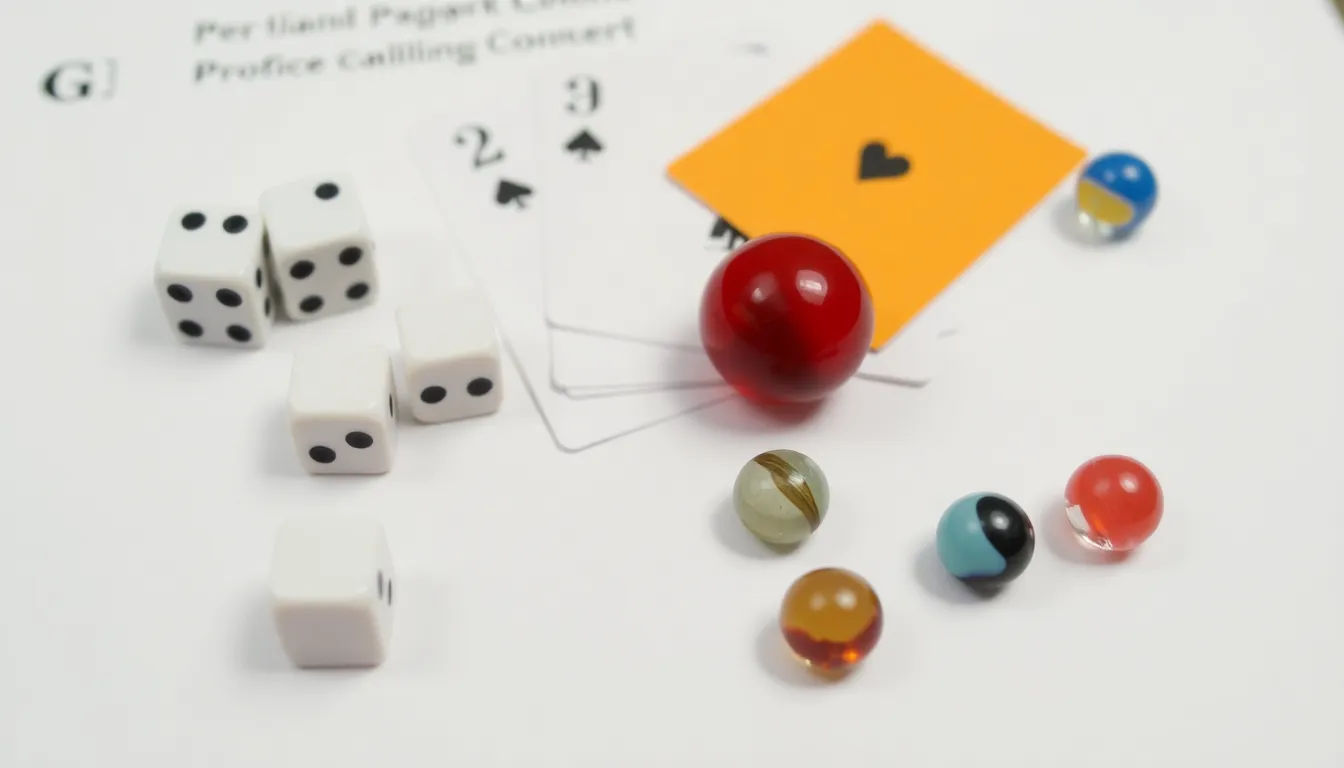
Probability questions are a staple of the GRE, and mastering them can significantly boost your score. This guide provides a structured approach to tackling probability problems, offering essential concepts and practice questions. You'll learn to calculate probabilities with confidence, understanding the core principles that underpin these types of questions, and improving your test-taking skills.
On This Page
- Understanding Probability Fundamentals
- Probability Problems to Conquer
- Problem 1: Coin Toss
- Problem 2: Dice Roll
- Problem 3: Card Selection
- Problem 4: Marble Selection
- Problem 5: Committee Selection
- Problem 6: Conditional Probability
- Problem 7: Independent Events
- Problem 8: Multiple Choice Test
- Problem 9: Probability with Replacement
- Problem 10: Probability without Replacement
- Problem 11: Probability of at least one event
- Problem 12: Probability of a specific outcome
- Problem 13: Probability with two dice
- Problem 14: Probability in a survey
- Problem 15: Probability of consecutive events
- Key Takeaways
We Also Published
Welcome to the comprehensive guide designed to help you ace probability questions on the GRE. This post provides 15 carefully selected problems, each designed to test your understanding of key concepts and enhance your problem-solving skills. To succeed on the GRE, you must calculate probabilities effectively. Let's dive in and sharpen your probability skills!
Understanding Probability Fundamentals
Probability is the mathematical measure of the likelihood that an event will occur. It's expressed as a number between 0 and 1, where 0 indicates impossibility and 1 indicates certainty. Understanding this fundamental concept is the cornerstone of solving complex probability problems. The problems below will help you to calculate probabilities effectively.
Basic Probability Concepts
Probability is calculated as the number of favorable outcomes divided by the total number of possible outcomes. For example, the probability of rolling a 4 on a six-sided die is 1/6, as there is one favorable outcome (rolling a 4) and six possible outcomes (numbers 1 through 6). This simple formula is the foundation upon which more complex calculations are built.
Furthermore, the concept of independent and dependent events is critical. Independent events do not affect each other, while dependent events do. For independent events, the probability of both occurring is the product of their individual probabilities. For dependent events, the probability changes based on previous outcomes.
Finally, the use of permutations and combinations becomes crucial. Permutations are used when the order of selection matters, and combinations are used when the order does not. Knowing when to apply each method is essential for accurate probability calculations. These methods are vital for dealing with selection scenarios.
Probability Problems to Conquer
Below are 15 probability problems that mirror the style and difficulty of GRE questions. Each problem is designed to challenge your understanding and enhance your test-taking skills. Work through each one carefully, applying the concepts you've learned. Remember, practice is key to mastering probability. To calculate probabilities effectively, you will need to practice a lot.
Problem 1: Coin Toss
A fair coin is tossed three times. What is the probability of getting at least two heads?
Problem 2: Dice Roll
A six-sided die is rolled twice. What is the probability that the sum of the two rolls is 7?
Problem 3: Card Selection
A card is drawn from a standard deck of 52 cards. What is the probability that it is a king or a heart?
Problem 4: Marble Selection
A bag contains 5 red marbles, 3 blue marbles, and 2 green marbles. If two marbles are drawn without replacement, what is the probability that both are red?
Problem 5: Committee Selection
A committee of 3 people is to be formed from a group of 7 men and 5 women. What is the probability that the committee consists of 2 men and 1 woman?
Problem 6: Conditional Probability
If P(A) = 0.6, P(B) = 0.5, and P(A and B) = 0.3, what is P(A | B)?
Problem 7: Independent Events
Events A and B are independent. If P(A) = 0.4 and P(B) = 0.7, what is P(A or B)?
Problem 8: Multiple Choice Test
A multiple-choice test has 4 options for each question. If a student guesses randomly on each question, what is the probability of getting a correct answer?
Problem 9: Probability with Replacement
A bag contains 4 white balls and 6 black balls. Two balls are drawn with replacement. What is the probability of drawing one white ball and one black ball?
Problem 10: Probability without Replacement
A box contains 3 red balls and 4 blue balls. Two balls are drawn without replacement. What is the probability that both balls are blue?
Problem 11: Probability of at least one event
The probability of event A occurring is 0.3, and the probability of event B occurring is 0.5. If A and B are independent, what is the probability that at least one of them occurs?
Problem 12: Probability of a specific outcome
A spinner has 8 equal sections, numbered 1 through 8. What is the probability of the spinner landing on an even number?
Problem 13: Probability with two dice
Two dice are rolled. What is the probability that the sum of the numbers rolled is greater than 9?
Problem 14: Probability in a survey
In a survey, 60% of people like coffee, and 70% like tea. If 40% like both, what is the probability that a person likes either coffee or tea?
Problem 15: Probability of consecutive events
A bag contains 7 green balls and 3 yellow balls. If three balls are drawn without replacement, what is the probability that the first ball is green, the second is yellow, and the third is green?
Key Takeaways
Mastering probability requires a solid grasp of fundamental concepts, including calculating probabilities, understanding independent and dependent events, and applying permutations and combinations. Practice is key to success. You can greatly improve your performance on the GRE by consistently practicing these and similar problems. You now know how to calculate probabilities effectively!
| Problem | Topic | Solution (Brief) |
|---|---|---|
| 1 | Coin Toss | 4/8 |
| 2 | Dice Roll | 6/36 |
| 3 | Card Selection | 16/52 |
| 4 | Marble Selection | 20/90 |
| 5 | Committee Selection | 105/455 |
| 6 | Conditional Probability | 0.6 |
| 7 | Independent Events | 0.82 |
| 8 | Multiple Choice Test | 1/4 |
| 9 | Probability with Replacement | 24/100 |
| 10 | Probability without Replacement | 12/42 |
| 11 | Probability of at least one event | 0.65 |
| 12 | Probability of a specific outcome | 4/8 |
| 13 | Probability with two dice | 6/36 |
| 14 | Probability in a survey | 0.9 |
| 15 | Probability of consecutive events | 63/720 |
RESOURCES
- No results found.
From our network :
- Bitcoin price analysis: Market signals after a muted weekend
- The Diverse Types of Convergence in Mathematics
- How to secure postgres connections across VPC, VPN, and cloud
- JD Vance Charlie Kirk: Tribute and Political Strategy
- How to design postgres partitions with native and hash methods
- Limits: The Squeeze Theorem Explained
- Limit Superior and Inferior
- How to migrate to postgres using logical replication and cutover
- Bitcoin Hits $100K: Crypto News Digest