Higher education institutions serve as premier conduits for cross-border knowledge creation, intellectual diplomacy, and cultural exchange. Through specialized international fellowships, scholars build sustainable partnerships that address complex pedagogical and social challenges across diverse academic landscapes. These global initiatives reinforce the foundational role of research universities in fostering mutual understanding.
exemplifies this collaborative spirit through sustained faculty achievements in international research and creative production. When educators secure distinguished competitive honors, they expand scholarly networks while elevating the public profile of comprehensive urban universities. Such milestones validate rigorous inquiry across scientific, educational, and creative fields.
This analytical study examines the systemic impact of prominent international fellowships, focusing on academic mobility between the United States and India. Concurrently, it examines how interdisciplinary achievements, from international fieldwork to competitive cinematic recognition, reflect the multifaceted mission of contemporary university faculties navigating modern scholarship.
TL;DR Faculty honors at California State University, Los Angeles highlight the vital intersection of cross-border scholarship and creative excellence. The prestigious Fulbright-Nehru Academic and Professional Excellence Award deepens academic cooperation between the United States and India, providing a structured mechanism for collaborative research and pedagogical innovation. Concurrently, narrative film achievements across international festivals demonstrate that public urban universities thrive by balancing high-impact global diplomacy with acclaimed creative scholarship.
On This Page
- The Fulbright-Nehru Fellowship and Bilateral Academic Exchange
- Cal State LA Faculty Distinction and Global Scholarly Engagement
- Cinematic Arts and Faculty Creative Output in Higher Education
- Quantitative Frameworks in Cross-Border Grant Allocation
- Comparative Analysis of Institutional Impact Across Disciplines
- Strategic Horizons for International Academic Diplomacy
The Fulbright-Nehru Fellowship and Bilateral Academic Exchange
International fellowship programs establish deliberate institutional pathways designed to cultivate sustained transnational scholarship between sovereign nations. By providing dedicated resources, structured governance, and mutual oversight, these initiatives enable scholars to undertake complex investigations that transcend traditional geographic and disciplinary borders.
Historical Foundations of United States-India Educational Partnerships
The bilateral educational pact between the United States and India reflects decades of diplomatic dialogue and shared democratic values. Formally established through collaborative treaties, this foundation allows scholars to engage directly with local knowledge structures across the subcontinent.
Over the years, the program evolved from traditional technical assistance into an equitable intellectual partnership. Both sovereign nations contribute funding and strategic oversight, ensuring that selected projects align with contemporary developmental, educational, and scientific priorities in both jurisdictions.
Indian higher educational institutions offer comprehensive platforms for exploring regional innovation and socio-economic dynamics. American researchers entering these spaces encounter robust research environments, enabling rigorous examination of public policy, pedagogical reform, and sustainable economic modernization.
Consequently, the United States-India Educational Foundation serves as a bridge connecting public institutions. Scholars returning to American campuses disseminate empirical insights, thereby enriching home curricula while cultivating permanent professional channels that benefit prospective undergraduate and graduate researchers.
Structure and Mandate of Academic and Professional Excellence Awards
The Academic and Professional Excellence Award represents the highest tier of bilateral fellowship support. Designed for experienced scholars and seasoned practitioners, it facilitates either intensive research, specialized teaching, or a calibrated combination of both methodologies.
Recipients must demonstrate clear project feasibility, institutional alignment with Indian host organizations, and potential long-term educational outcomes. The rigorous peer-review evaluation screens for intellectual merit while assessing the applicant's capacity to serve as an effective ambassador.
In the discipline of education, these fellowships frequently target systemic policy analysis, curriculum development, and equity-focused learning strategies. Scholars immerse themselves in local classrooms, teacher training institutes, and state departments to evaluate operational realities firsthand.
Awardees work alongside Indian counterparts to produce actionable scholarly monographs, joint conference presentations, and scalable instructional models. This direct collaboration ensures findings reflect nuanced cultural context rather than theoretical assumptions applied from abroad.
We Also Published
Cal State LA Faculty Distinction and Global Scholarly Engagement
Comprehensive public urban universities perform a central role in democratizing access to international research networks. When their faculty members secure competitive external honors, these achievements highlight the robust intellectual capacity embedded within accessible public higher education systems.
Institutional Investment in International Research Mobility
California State University, Los Angeles maintains a dedicated institutional infrastructure supporting faculty participation in international scholarship. These initiatives recognize that direct immersion in global educational environments revitalizes classroom teaching and expands undergraduate research opportunities.
Public universities face unique challenges when balancing demanding instructional schedules with external research commitments. By facilitating leaves of absence and providing administrative sponsorship, campuses empower faculty to pursue prestigious fellowships without interrupting overall academic continuity.
Scholars who secure competitive federal or bilateral grants bring significant institutional prestige back to their home departments. Their successes demonstrate that teaching-centered universities can produce field-defining scholarship capable of securing peer-reviewed recognition on world stages.
Moreover, international mobility programs establish permanent partnerships between American departments and overseas faculties. These sustained linkages frequently produce student exchange initiatives, collaborative research grant proposals, and published comparative studies that enrich the entire academic community.
Pedagogical Exchange and Collaborative Curricular Development
Pedagogical exchange serves as the cornerstone of international educational awards. Visiting scholars introduce novel theoretical approaches to host classrooms while absorbing alternative instructional practices shaped by local historical, linguistic, and cultural conditions.
In educational research, observing diverse classroom ecologies challenges prevailing assumptions regarding curriculum design and student engagement. Scholars analyze how local educational administrators resolve resource constraints, implement standardized directives, and support diverse student populations effectively.
Upon returning to their home institutions, awardees integrate these cross-cultural insights into teacher preparation programs. Prospective educators learn to design flexible, culturally responsive curricula that reflect the complexities of increasingly globalized, urban public school districts.
This circular flow of knowledge validates the primary mission of bilateral academic exchanges. International fellowship experiences transform abstract comparative literature into concrete classroom strategies, elevating pedagogical standards across both host and sending institutions.
Cinematic Arts and Faculty Creative Output in Higher Education
Scholarly contribution within higher education encompasses creative endeavors alongside traditional scientific research. Universities increasingly celebrate artistic works, such as theatrical direction and filmmaking, recognizing peer-reviewed festival selections as rigorous indicators of professional excellence.
Stephen Rothman and the Festival Success of Effortless Perfection
Parallel to international academic distinctions, creative arts faculty at California State University, Los Angeles achieve significant external validation. Professor Stephen Rothman directed the short film titled Effortless Perfection, illustrating the vital connection between active artistic practice and collegiate teaching.
The short film captured critical interest, securing seven laurels across six competitive film festivals. Such widespread recognition confirms the project's technical execution, narrative resonance, and thematic relevance within contemporary independent cinematic forums.
A notable milestone occurred on May 11 when the film screened at the Big Apple Film Festival. Hosted in New York City, this juried event provides an influential platform for independent filmmakers to showcase compelling work before industry peers and critics.
Festival accolades function as the creative equivalent of scholarly citations. They confirm that faculty members maintain professional relevance within commercial and artistic spheres, ensuring their mentoring remains aligned with contemporary industry expectations and evolving artistic practices.
Narrative Film as Scholarly Research and Artistic Dissemination
Within university tenure and promotion frameworks, creative output undergoes thorough peer evaluation analogous to scientific review. Narrative filmmaking requires extensive dramaturgy, aesthetic direction, and technical collaboration, serving as an intensive mode of qualitative humanistic inquiry.
Projects like Effortless Perfection examine complex interpersonal psychology and modern societal tensions through visual storytelling. By probing cultural expectations of success and composure, the film engages in meaningful social critique through accessible narrative structures.
Directing faculty transfer current production experiences directly into department workshops. Students learn camera staging, performance coaching, and post-production workflows from educators who actively navigate the challenges of contemporary independent distribution and festival curation.
Furthermore, active faculty film projects frequently offer practical production roles for undergraduate and graduate students. This apprenticeship model bridges classroom instruction and professional creative industries, significantly enhancing post-graduation career readiness in competitive media markets.
Quantitative Frameworks in Cross-Border Grant Allocation
Award selection processes for international fellowships and juried creative recognitions utilize structured evaluative frameworks. Decision panels rely on qualitative rubrics and multi-attribute scoring systems to objectively evaluate intellectual merit, applicant preparedness, and projected institutional returns.
Multi-Criteria Decision Analysis for Fellowship Selection
Selection committees utilize multi-criteria decision models to grade cross-border fellowship submissions. Reviewers assess candidate portfolios across several quantitative indicators, ensuring candidates meet high standards of academic excellence and cross-cultural adaptability.
The total grant appraisal score ##S## can be formalized mathematically as a weighted linear combination of normalized criterion scores ##x_i## multiplied by their designated programmatic weights ##w_i##, satisfying the normalization condition ##\sum_{i=1}^n w_i = 1##:
Applicants must satisfy minimum threshold scores across every parameter before receiving an institutional nomination. This rigorous evaluation ensures selected awardees possess the professional maturity necessary to conduct nuanced research within host institutions overseas.
By balancing academic merit with diplomatic efficacy, the selection rubric identifies researchers capable of sustained binational engagement. The resulting fellowships yield meaningful publications while strengthening bilateral cultural linkages over extended administrative periods.
Computational Modeling of International Citation Influence
To analyze the impact of international scholarly exchange, academic institutions often implement computational tracking tools. The following Python script demonstrates how evaluators calculate composite research impact scores across multiple collaboration metrics:
def calculate_exchange_impact(citations: int, joint_papers: int, international_keynotes: int) -> float:
    """
    Compute normalized composite scholarly impact index for international faculty fellows.
    """
    w_cit = 0.40
    w_pap = 0.35
    w_key = 0.25

    # Normalization scaling factors based on discipline averages
    norm_citations = min(citations / 250.0, 1.0) * 100.0
    norm_papers = min(joint_papers / 5.0, 1.0) * 100.0
    norm_keynotes = min(international_keynotes / 10.0, 1.0) * 100.0

    composite_index = (w_cit * norm_citations) + (w_pap * norm_papers) + (w_key * norm_keynotes)
    return round(composite_index, 2)

# Illustrative faculty evaluation
score = calculate_exchange_impact(citations=185, joint_papers=4, international_keynotes=7)
print(f"Scholarly Collaboration Index: {score} / 100.0")
Computational tools enable research deans to assess the ongoing returns of institutional investments in international travel. Quantitative data reveal that collaborative publications authored with foreign colleagues achieve higher long-term citation rates than purely domestic studies.
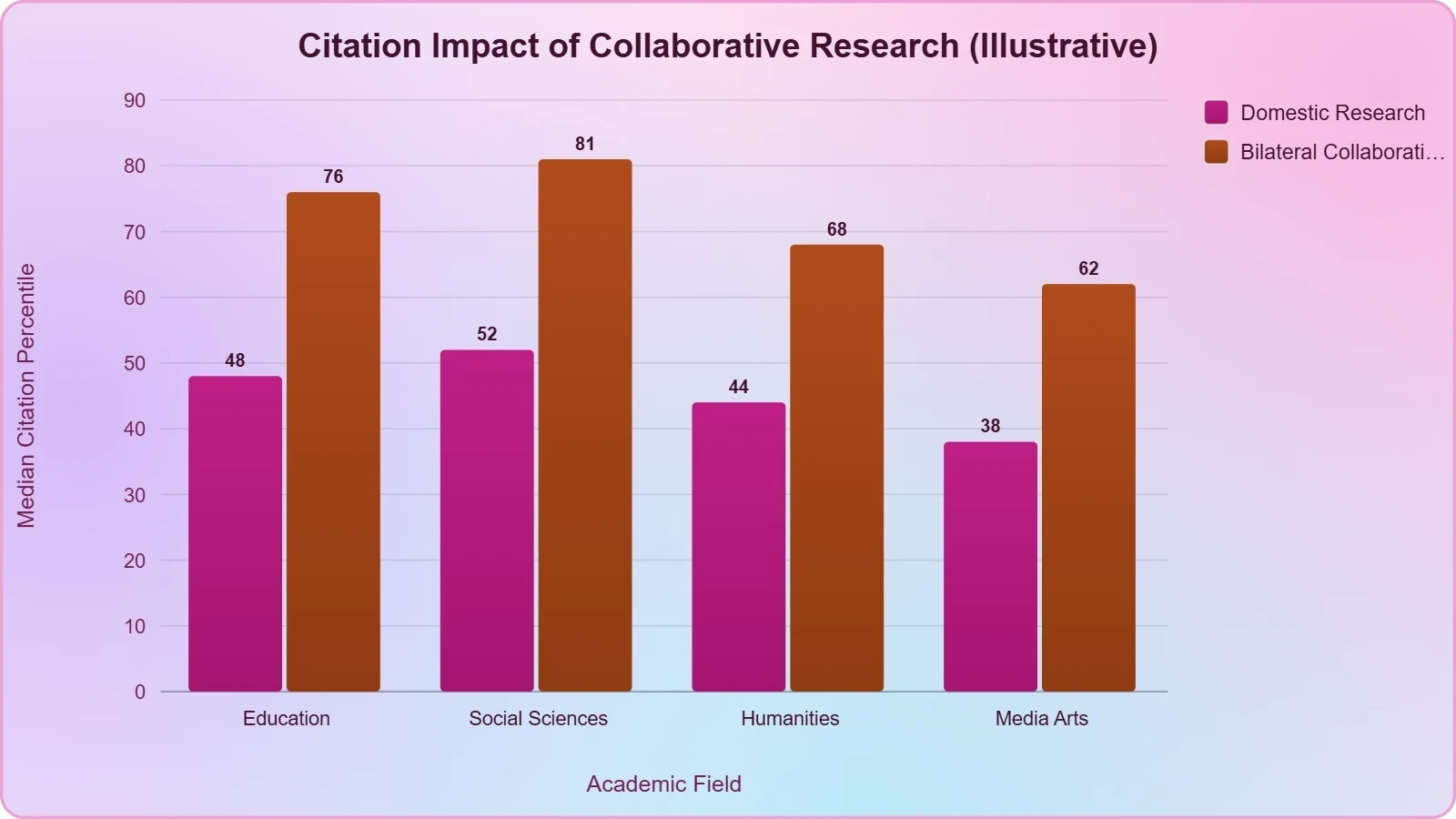
These empirical findings justify comprehensive university support for competitive faculty fellowships. Allocating targeted institutional resources toward international mobility expands research visibility while elevating the global standing of regional comprehensive campuses.
Ultimately, systematic data collection demonstrates that cross-border scholarship enriches both host and sending institutions. Collaborative research produces durable bibliometric footprints that attract ambitious graduate students and substantial external grant funding.
Comparative Analysis of Institutional Impact Across Disciplines
The convergence of advanced educational research and creative cinematic production illustrates the intellectual diversity characterizing comprehensive state universities. Supporting varied scholarly expressions enables academic institutions to meet broad civic, cultural, and industrial mandates.
Synergies Between Creative Production and Applied Social Research
While applied educational research and cinematic storytelling employ distinct methodological workflows, they address parallel cultural themes. Both domains investigate human development, societal equity, and how community narratives shape personal perceptions of competence and identity.
Educational researchers analyze structural challenges within classroom environments, whereas filmmakers dramatize internal psychological struggles under external societal pressures. Together, these complementary forms of scholarship foster a nuanced understanding of contemporary social conditions.
Within a unified university community, interdisciplinary dialogues between education and arts faculties spark innovative collaborative research. Education specialists partner with media arts faculty to create engaging instructional documentaries and curriculum-aligned digital learning tools.
Students benefit directly from this rich interdisciplinary environment. Engaging with active researchers and working artists fosters adaptable critical thinking skills, preparing graduates to address complex professional challenges across education, communication, and public administration.
Long-Term Institutional Metrics and Public University Prestige
Faculty achievements significantly influence university ranking metrics, philanthropic giving, and legislative support. High-profile international fellowships and prestigious film festival honors validate institutional investments in faculty professional development programs.
For public urban institutions like California State University, Los Angeles, national and global accolades challenge traditional status hierarchies in higher education. They demonstrate that regional comprehensive universities deliver world-class scholarship alongside primary teaching missions.
These faculty milestones enhance student recruitment and retention rates. Prospective scholars actively seek mentors who are recognized authorities in their fields, providing undergraduates direct access to elite academic networks and creative industries.
Sustained institutional recognition creates positive feedback loops across campuses. Successful fellowship cycles inspire junior colleagues to pursue ambitious external awards, fostering an enduring culture of intellectual rigor and creative innovation.
Strategic Horizons for International Academic Diplomacy
International academic exchanges operate as effective instruments of public diplomacy, fostering enduring institutional connections during periods of shifting geopolitical alignments. By prioritizing mutual intellectual inquiry, these initiatives build trust between academic communities worldwide.
Navigating Cross-Cultural Research Networks and Governance
Executing fieldwork in foreign jurisdictions requires sophisticated understanding of regional administrative and regulatory environments. Visiting scholars must navigate institutional review boards, government permissions, and local academic protocols before initiating extensive field research.
Collaborating with local faculty hosts eases administrative procedures and guarantees adherence to regional ethical norms. Mutual respect and intellectual equity remain essential for establishing sustainable research partnerships that endure beyond initial fellowship funding cycles.
In disciplines such as educational leadership, foreign researchers must honor local pedagogical traditions. Imposing external educational models without accounting for community dynamics risks generating flawed conclusions that fail to support local school improvement efforts.
When conducted thoughtfully, bilateral exchanges produce shared frameworks that enrich educational research across both participating nations. Scholars build collaborative networks capable of addressing shared educational challenges, from classroom equity to digital technology adoption.
Sustaining Faculty Fellowships Amid Shifting Global Geopolitics
International higher education initiatives face ongoing challenges from fluctuating geopolitical priorities and constrained state budgets. Maintaining stable funding for programs like the Fulbright-Nehru fellowship requires bipartisan commitment from both participating federal governments.
Universities must continually articulate the public value of international research partnerships to legislative stakeholders. Demonstrating how global scholarly exchanges enhance local economic resilience and cultural diplomacy helps safeguard vital educational exchange budgets.
Campuses can also explore collaborative funding structures with philanthropic foundations and corporate partners. Diversifying grant sources reduces vulnerability to shifting government appropriations, ensuring faculty mobility opportunities remain accessible to emerging scholars.
Sustained support for international scholarly exchange remains vital for maintaining global intellectual leadership. By championing faculty achievement across disciplines, universities fulfill their fundamental purpose as vibrant centers of international learning and cross-cultural understanding.
From our network :
- How to migrate to postgres using logical replication and cutover
- Bitcoin Hits $100K: Crypto News Digest
- How to secure postgres connections across VPC, VPN, and cloud
- How to design postgres partitions with native and hash methods
- Limit Superior and Inferior
- Limits: The Squeeze Theorem Explained
- JD Vance Charlie Kirk: Tribute and Political Strategy
- The Diverse Types of Convergence in Mathematics
- Bitcoin price analysis: Market signals after a muted weekend
RESOURCES
- No results found.