India's tertiary education landscape has undergone a monumental transformation over the past decade, characterized by unprecedented institutional expansion, surging student enrollments, and noteworthy shifts in social equity. According to recent analytical findings published by SBI Research, targeted policy interventions and sustained public demand have democratized access to university campuses nationwide.
This structural evolution reflects significant progress in gender parity, with female scholars establishing parity across advanced degree programs and outnumbering male counterparts in foundational scientific disciplines. Concurrently, historically underrepresented communities now comprise the clear majority of enrolled learners, signaling meaningful advancement toward inclusive academic participation across regional corridors.
Despite these measurable quantitative achievements, systemic friction persists regarding instructional capacity, public budgetary allocations, and pedagogical governance frameworks. Addressing persistent faculty vacancies and aligning institutional outputs with global productivity demands remain essential objectives for policymakers seeking to translate quantitative institutional expansion into enduring technological and scientific leadership.
TL;DR India's higher education system expanded substantially over the past decade, doubling universities and expanding student capacity past 4.5 crore learners with near-equal gender parity. While elite institutions like IITs and IIMs achieved record corporate placements and compensation benchmarks, structural shortages in faculty recruitment, stagnant public expenditure around 1 percent of GDP, and centralized testing vulnerabilities require strategic legislative and fiscal remedies.
On This Page
- Expansion of Higher Education Infrastructure Across India
- Student Enrolment Dynamics and Demographic Shifts
- Premier Institutions and Elite Employment Outcomes
- Faculty Ecosystem and Lingering Capacity Vacancies
- Macroeconomic Funding and Institutional Governance
- Strategic Imperatives for Quality and Global Competitiveness
Expansion of Higher Education Infrastructure Across India
The physical and organizational footprint of Indian tertiary education expanded rapidly between fiscal year 2014 and fiscal year 2024, creating hundreds of new universities and thousands of affiliated colleges across disparate regional territories to satisfy rising educational aspirations.
University and College Growth Metrics
Institutional growth metrics demonstrate a deliberate decentralization of advanced learning across Indian states. The national university count surged from 723 entities in FY14 to 1,289 by FY24, reflecting unprecedented public and private investments in comprehensive academic establishments nationwide.
Collegiate institutions mirrored this expansive trajectory, expanding from 36,634 registered colleges to 48,246 within the same ten-year window. This rapid physical development aimed to absorb millions of secondary school graduates seeking undergraduate credentials within accessible geographical proximities.
Standalone institutions specialized in polytechnic, teacher training, and vocational curricula also increased substantially. Their numbers rose from 11,664 in FY14 to 15,221 by FY24, reinforcing intermediate technical capabilities and specialized vocational delivery systems across diverse districts.
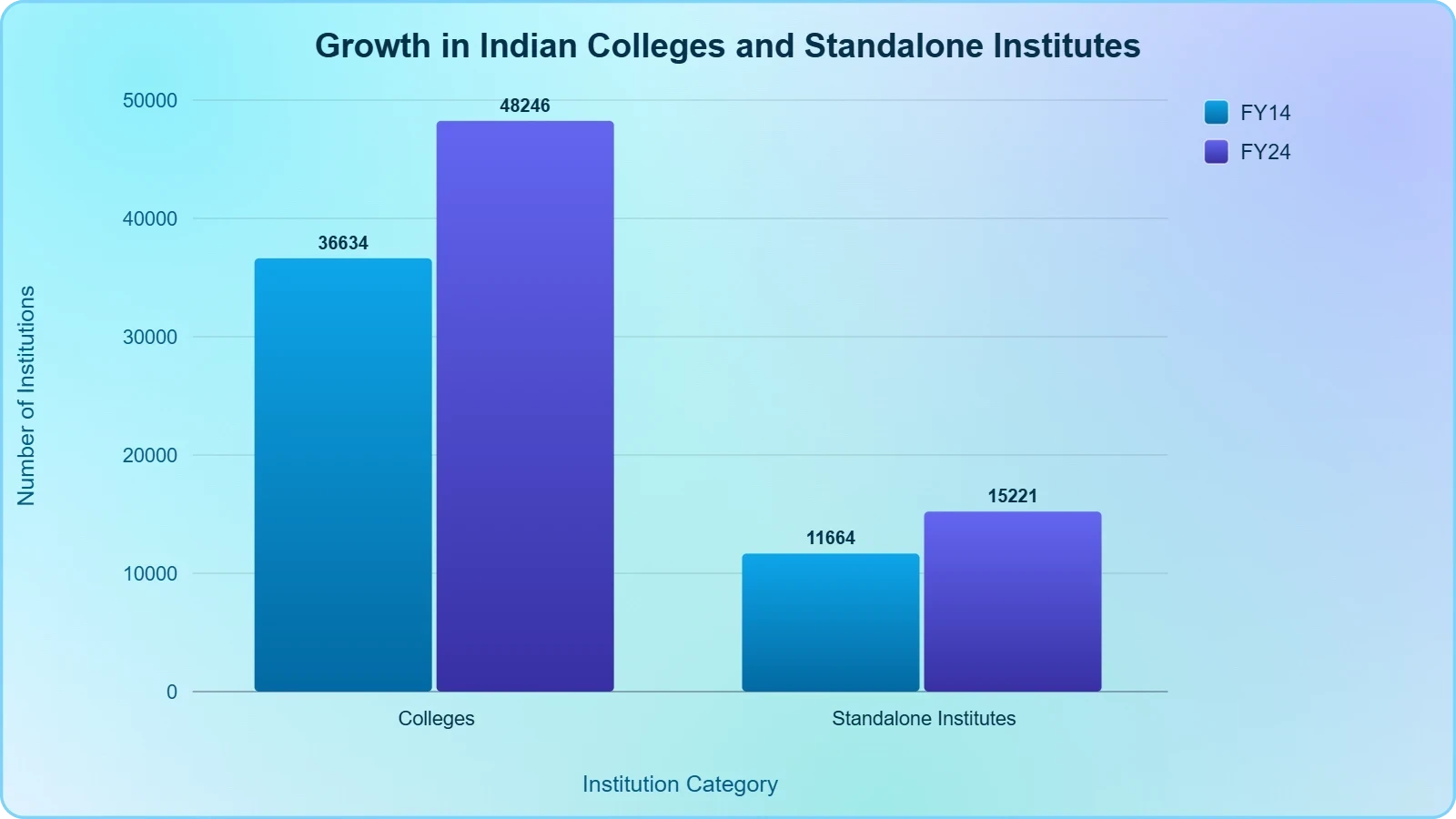
The compound annual growth rate of tertiary institutions demonstrates how state governments and private education trusts combined resources. This sustained physical infrastructure buildout established vital groundwork for accommodating expanding matriculation numbers across diverse demographic groups.
Regional Distribution and Standalone Entities
The geographic allocation of new educational campuses highlights a concentrated effort to mitigate historical rural-urban imbalances. Peripheral economic zones gained collegiate access, decreasing long-distance migratory burdens historically imposed on students seeking post-secondary qualifications.
Standalone institutes played an essential role in delivering technical competencies outside traditional metropolitan corridors. These academies expanded diploma certifications in electrical systems, civil drafting, and software maintenance, supporting industrial clusters situated within tier-two and tier-three economies.
State-level regulatory bodies streamlined institutional charter approvals to accelerate private capital deployment. Consequently, regional universities diversified academic programming, offering multidisciplinary coursework designed to integrate conventional humanities disciplines with applied technological subjects.
Despite these notable structural enhancements, spatial disparities persist in specialized laboratory equipment and modern library networks. Closing these internal institutional disparities represents the subsequent hurdle in establishing balanced regional academic ecosystems across all provinces.
Student Enrolment Dynamics and Demographic Shifts
Total learner enrollments expanded beyond unprecedented national milestones during the previous decade, characterized by notable demographic diversification that elevated representation among historically marginalized socioeconomic cohorts and achieved measurable gender equilibrium.
Parity Across Genders and Disciplines
Aggregate student enrollment surpassed 4.5 crore learners by FY24, reflecting expansive demographic participation across higher educational tiers. Male and female student shares attained virtually equivalent levels, validating sustained initiatives targeted toward improving female educational attainment.
Gender distributions within foundational disciplines exhibited especially remarkable structural realignments. At the undergraduate level, female candidates systematically outnumbered male peers within pure science degree programs, overturning historical imbalances long observed across STEM pipelines.
Doctoral research programs exhibited comparable parity trends over the same evaluation period. Female postgraduate scholars achieved near-equal representation among active PhD candidates nationwide, illustrating expanding female persistence through advanced theoretical and experimental degree tracks.
The institutionalization of targeted female student subsidies, residential hostel constructions, and transport grants materially contributed to this matriculation shift. Female scholars increasingly leveraged tertiary education to secure pathways toward professional autonomy and technical vocations.
Inclusion of Underrepresented Demographics
Socioeconomic democratisation evolved swiftly alongside gender gains. Students belonging to Scheduled Castes, Scheduled Tribes, and Other Backward Classes collectively comprised approximately 62 percent of total post-secondary enrollments in FY24, transforming campus cultural landscapes.
Constitutional affirmative action structures and targeted scholarship transfers functioned as pivotal engines for this broadening enrollment foundation. First-generation learners from agrarian backgrounds entered university classrooms in record numbers, diversifying academic discourse and professional talent pools.
The gross enrolment ratio reflected these demographic influxes, evidencing accelerated expansion in communities that previously registered minimal secondary-to-tertiary progression. Digital admissions mechanisms diminished administrative barriers that historically suppressed enrollment applications from remote regional hamlets.
Sustaining this inclusive trajectory requires extensive investments in campus mentorship and academic retention frameworks. Ensuring vulnerable learners transition efficiently into high-productivity employment represents an essential mandate for sustaining long-term social mobility across emerging demographics.
Premier Institutions and Elite Employment Outcomes
India’s flagship technological and administrative institutions registered notable physical and economic expansion, marked by a growing cohort of apex centers and robust corporate remuneration trajectories for graduating cohorts over the past decade.
Expansion of IITs, IIMs, and NITs
The collective footprint of apex national institutions expanded markedly to address burgeoning industrial demand for executive talent. The combined total of IITs, IIMs, and NITs climbed from 59 campuses in FY14 to 76 by FY26.
Establishing modern Indian Institutes of Technology expanded engineering research capacity into developing economic corridors. Concurrently, regional Indian Institutes of Management introduced executive business leadership pedagogy to emerging commercial hubs across non-metropolitan federal territories.
This deliberate institutional proliferation decentralized elite pedagogy, widening opportunities for gifted secondary students across various states. Brand prestige and rigorous entrance examination architectures maintained exceptionally competitive student quality criteria across all recently incorporated campuses.
The capital outlay required for these greenfield premier campuses stimulated local educational ecosystems. Adjacent secondary institutions and auxiliary technological facilities evolved systematically around these new federal academic centers, elevating regional educational standards.
Placement Records and Median Compensation
Graduating student recruitment from elite academic centers registered dramatic volume gains. Annual employment offers extended to IIM graduates grew from approximately 7,500 in FY16 to nearly 13,700 by FY24, reflecting surging corporate demand for professional managers.
Graduation placements from the Indian Institutes of Technology mirrored this upward trajectory. Total IIT hiring numbers expanded from roughly 9,500 in FY16 to approximately 17,500 in FY24, underpinned by global technological shifts in cloud architectures and automated software systems.
Median compensation figures across the IIT, IIM, and NIT tripartite cluster more than doubled between FY16 and FY24. In the management segment, median remuneration packages for IIM graduates crossed Rs 40 lakh annually in FY24.
These escalating salary levels underscore strong commercial willingness to remunerate top-tier technical and managerial graduates. However, they also illuminate an expanding wage disparity between elite federal academies and ordinary state-affiliated collegiate institutions nationwide.
We Also Published
Faculty Ecosystem and Lingering Capacity Vacancies
While the academic workforce expanded substantially to manage surging undergraduate rolls, persistent recruitment deficits across central universities threaten pedagogical quality and intellectual output standards across key disciplines.
Academic Workforce Expansion
The total instructional faculty across Indian post-secondary institutions expanded notably to sustain ballooning classrooms. Faculty headcounts grew from 13.7 lakh professors and lecturers in FY14 to approximately 17.3 lakh instructors by FY24 nationwide.
Gender representation within this expanding teaching cohort registered meaningful structural advancement. Women comprised 45 percent of all tertiary educators by FY24, creating prominent professional role models for female scholars entering technical and scholarly degree pathways.
Junior recruitment drives across state-level institutions and polytechnics facilitated this aggregate workforce growth. These appointments introduced contemporary digital pedagogical methodologies into classrooms, helping modernize standard instructional techniques across evolving degree modules.
Continuous faculty professional development frameworks were deployed concurrently to enhance pedagogical efficacy. Despite these programmatic enhancements, overall staffing levels struggled to match rapid enrollment expansion, placing severe pressure on existing student-to-teacher instructional ratios.
Sanctioned Post Vacancy Challenges
A pressing operational vulnerability within Indian tertiary education remains the extensive volume of unfilled instructional chairs. Nearly one-third of all sanctioned teaching positions in centrally funded universities and institutes remain vacant, hampering curricular execution.
This vacancy deficit is acute at the senior professor tier, where advanced subject expertise is non-negotiable. Bureaucratic hiring hurdles, stringent accreditation requirements, and geographic mismatches frequently delay onboarding cycles across critical departments.
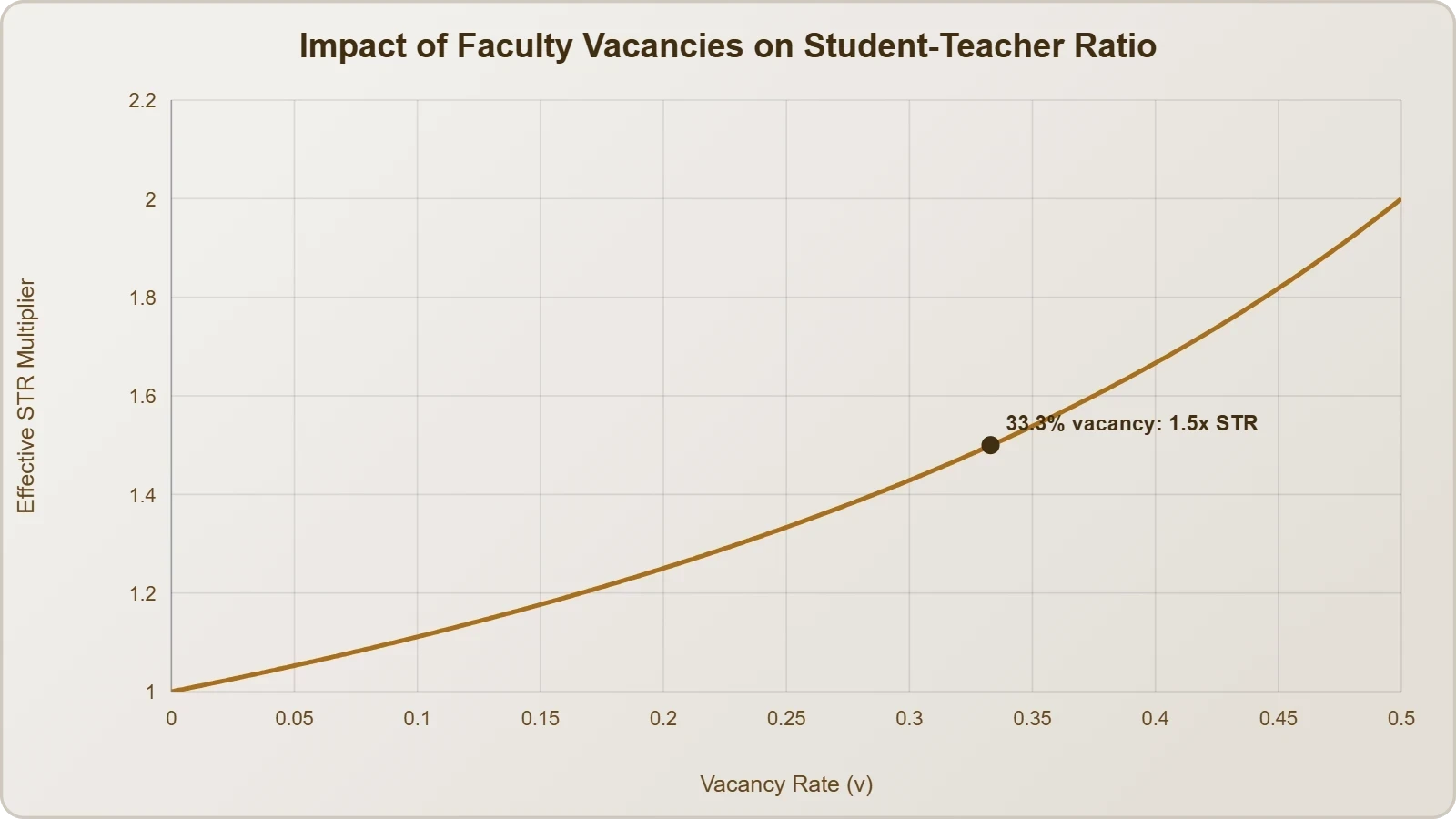
To analyze instructional workload burdens, mathematical relationships between enrolled student bodies ##S## and appointed active faculty ##F_a## highlight systemic pressures when vacancies ##V## are substantial relative to sanctioned posts ##F_s##:
When one-third of sanctioned posts remain unoccupied, the effective student-teacher ratio deteriorates by roughly 50 percent, limiting seminar discussion opportunities, capping personal research mentorship, and reducing advanced graduate publication volumes across prominent university departments.
Macroeconomic Funding and Institutional Governance
Accelerating demographic demands have encountered fiscal limits, as public spending on post-secondary institutions remained relatively stagnant as a proportion of overall national output over the preceding ten fiscal cycles.
Fiscal Allocations and Research Grants
Despite prominent enrollment growth, public fiscal allocations for tertiary education remained approximately 1 percent of aggregate government expenditure. This static fiscal baseline constrained infrastructural modernizations across state-run university laboratories and institutional digital computing environments.
The absence of expanding budgetary allocations restricted university research initiatives, leaving academic departments heavily reliant on outdated apparatus. Most public research institutions struggled to fund advanced experimental facilities necessary for high-impact global journal publications.
SBI Research underscored this capital constraint, urging elevated sovereign expenditures across basic research domains. Modern university ecosystems require sustained budgetary commitments to establish state-of-the-art facilities capable of supporting sophisticated biotechnology and advanced microelectronics projects.
Expanding private philanthropic endowments and corporate social responsibility partnerships represents an increasingly essential mechanism for closing fiscal gaps. Encouraging competitive research funding grants can bridge university laboratory operations with emergent industrial production priorities.
Legislative Recommendations for Testing Bodies
Governance bottlenecks in standardized evaluation sparked calls for institutional restructuring. Analysts proposed converting the National Testing Agency into an independent statutory entity, empowering it with parliamentary oversight and robust legal protocols against security lapses.
Codifying testing authority mandates through statutory frameworks would safeguard testing protocols against unauthorized distribution. Dedicated statutory autonomy shields testing administrators from organizational volatility, assuring fair competition for competitive admissions across medical and engineering seats.
The report also recommended examining a constitutional amendment affirming free and fair tertiary educational opportunities. Elevating equal educational access to a defined legal right would legally commit regional administrative bodies to eliminate infrastructural imbalances.
Establishing autonomous administrative oversight over testing protocols protects examination security. Decoupling admissions evaluations from shifting departmental policies ensures administrative consistency and maintains public trust in competitive university selection mechanisms across all states.
Strategic Imperatives for Quality and Global Competitiveness
Bridging the persistent divide between classroom theory and dynamic market prerequisites requires systemic curricular innovation, deep corporate alignment, and aggressive integration of practical technical skills across degree frameworks.
Vocational Integration and Curriculum Reform
Indian universities face continuous pressure to update legacy syllabi that emphasize rote memorization over applied problem-solving. Aligning academic curricula with private sector requirements demands modular degree designs that incorporate industry-recognized certifications directly into undergraduate transcripts.
Vocational training programs require substantial scaling to furnish employment avenues for graduates outside elite technical programs. Introducing comprehensive apprenticeships directly into polytechnic diplomas will ensure graduates obtain functional proficiencies demanded by contemporary automation employers.
To quantify vocational deployment and curriculum matching efficiency, institutional administrators frequently monitor automated data tracking models written in Python, analyzing student certification transitions:
def assess_vocational_readiness(enrolled_students, certified_vocational, placement_target):
    # Calculate vocational absorption and competency readiness
    vocational_ratio = certified_vocational / enrolled_students
    readiness_index = vocational_ratio * 100.0
    gap_metric = max(0.0, placement_target - readiness_index)
    return {
        "readiness_index": round(readiness_index, 2),
        "target_deficit": round(gap_metric, 2),
        "status": "Optimal" if gap_metric == 0 else "Intervention Required"
    }

# Compute diagnostic values for regional institution
metrics = assess_vocational_readiness(12500, 4800, 50.0)
print(f"Readiness: {metrics['readiness_index']}% | Status: {metrics['status']}")
Utilizing algorithmic tracking helps educational administrators identify specific departmental shortfalls where vocational certifications lag student enrollment figures. Early identification allows universities to intervene quickly, establishing corporate skill-building partnerships before senior students begin competitive placement cycles.
Structural Roadmap for Sustainable Development
Establishing durable international competitiveness requires Indian universities to build cooperative partnerships with commercial industrial enterprises. Corporate co-sponsored research centers can provide direct funding and practical research exposure, allowing postgraduates to address applied engineering problems.
Mitigating regional disparities in student-teacher ratios remains essential for sustaining national educational quality. State governments must expedite transparent faculty appointments to ensure non-metropolitan university colleges deliver instructional quality equivalent to urban academic institutions.
Simultaneously, expanding global academic collaborations through joint research initiatives and student exchanges will expose domestic researchers to leading scientific practices. Such partnerships accelerate innovation, raising the international ranking profiles of India's prominent public institutions.
By pairing broad physical expansion with aggressive faculty hiring and targeted fiscal investment, India can transform its expansive university system into a premier global engine of scholarly innovation, intellectual capital, and inclusive economic growth.
From our network :
- How to secure postgres connections across VPC, VPN, and cloud
- The Diverse Types of Convergence in Mathematics
- JD Vance Charlie Kirk: Tribute and Political Strategy
- Bitcoin Hits $100K: Crypto News Digest
- Bitcoin price analysis: Market signals after a muted weekend
- Limits: The Squeeze Theorem Explained
- How to migrate to postgres using logical replication and cutover
- Limit Superior and Inferior
- How to design postgres partitions with native and hash methods
RESOURCES
- No results found.