The Graduate Management Admission Test and the Graduate Record Examinations both function as gateways to graduate study, yet their verbal components are constructed upon markedly different psychometric philosophies. The GMAT Verbal section, administered by the Graduate Management Admission Council, is engineered to predict success within management education, and its question architecture reflects that commercial and analytical orientation.
By contrast, the GRE Verbal Reasoning measure, administered by the Educational Testing Service, adopts a broader disciplinary remit, assessing vocabulary depth and reading comprehension in ways that serve applicants across the humanities, social sciences, and natural sciences. Understanding these divergent design intentions is essential for any candidate weighing which examination to sit.
Comparative analysis of the two instruments reveals that differences extend well beyond surface-level question counts or nominal time limits. The GMAT has undergone substantial revision through its Focus Edition, which restructured the verbal component into a streamlined Critical Reasoning and Reading Comprehension format, removing Sentence Correction entirely.
On This Page
The GRE retains its established triad of Text Completion, Sentence Equivalence, and Reading Comprehension items, each calibrated to probe lexical precision and inferential reading. These structural choices carry profound implications for preparation strategy, because the cognitive skills rewarded by each examination are not perfectly interchangeable, and a candidate's natural aptitudes may align more closely with one instrument than the other.
The following examination synthesises evidence drawn from official test specifications, concordance research, and published admissions guidance to delineate precisely how the two verbal sections diverge. It addresses question formats, timing architecture, scoring mechanics, vocabulary demands, and the portability of preparation between the two tests.
For readers deciding which examination to take, or for those wondering whether their existing preparation carries over, the analysis offers a structured, evidence-led framework rather than anecdotal advice. Claims regarding predictive validity and score concordance are qualified where the published evidence remains contested or institution-specific.
TL;DR The GMAT Verbal and GRE Verbal sections differ fundamentally in structure, timing, and the cognitive skills they reward. The GMAT Focus Edition verbal component comprises Critical Reasoning and Reading Comprehension items delivered under stringent adaptive timing, rewarding analytical argumentation and precise logical inference. The GRE Verbal Reasoning section combines Text Completion, Sentence Equivalence, and Reading Comprehension, placing greater emphasis on advanced vocabulary and contextual lexical reasoning. Scoring scales, adaptive mechanics, and section-level timing also diverge substantially. Preparation is only partially transferable between the two instruments, and candidates should select the examination whose verbal architecture best matches their demonstrated aptitudes and target programmes.
Structural Architecture of the Two Verbal Sections
The structural composition of each verbal section constitutes the most immediate and consequential point of divergence between the two examinations. The GMAT Focus Edition delivers its verbal content through a compact, tightly timed module, whereas the GRE presents a longer and more varied verbal battery.
These architectural choices shape not only the stamina demands placed upon candidates but also the breadth of verbal competencies each test purports to measure. The following subsections examine question typology, item counts, and the underlying construct validity claims advanced by each testing body.
Question Typology and Item Composition
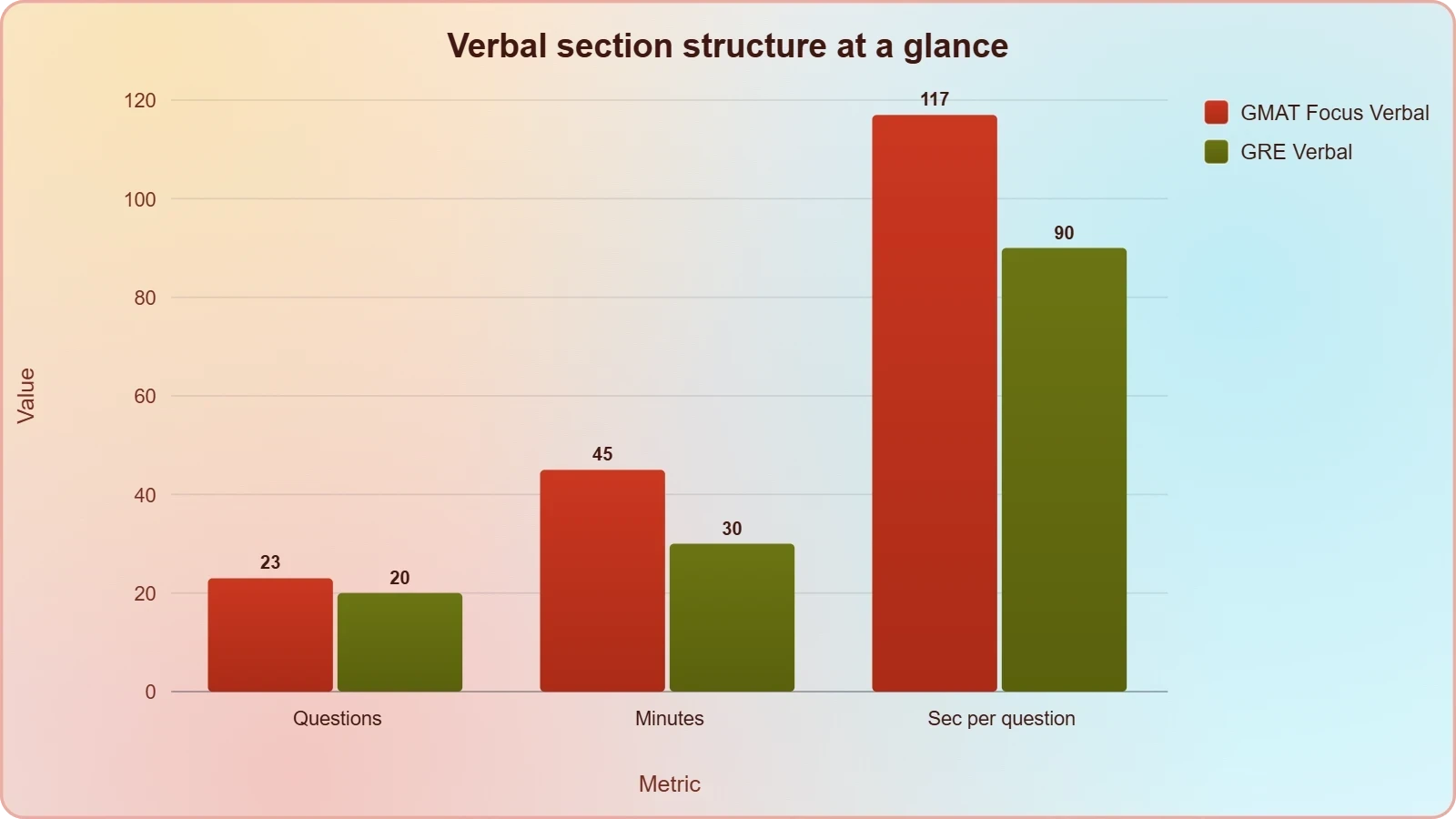
The GMAT Focus Edition verbal section contains exactly twenty-three questions distributed across two item families: Critical Reasoning and Reading Comprehension. Critical Reasoning items present short arguments and require candidates to evaluate assumptions, strengthen or weaken claims, identify flaws, or draw warranted inferences.
Reading Comprehension passages, typically three to four in number, accompany associated question sets that probe main idea, detail, inference, and logical structure. Sentence Correction, long a signature GMAT feature, has been entirely eliminated from the Focus Edition.
The GRE Verbal Reasoning section, by contrast, comprises twenty questions per section across two sections in the standard administration, yielding forty verbal items in total. These are distributed among Text Completion, Sentence Equivalence, and Reading Comprehension question types.
Text Completion items present one to three blanks within a short passage, requiring candidates to select words that render the passage coherent and logically consistent. Sentence Equivalence items ask candidates to choose two words from six options that produce sentences alike in meaning.
This typological divergence carries substantive consequences for preparation. A candidate who has drilled Sentence Correction extensively for the legacy GMAT will find that effort largely non-transferable to the Focus Edition, which no longer assesses formal grammar.
Conversely, the GRE's Text Completion and Sentence Equivalence formats demand a working command of nuanced vocabulary that the GMAT verbal section does not directly test. The construct each examination claims to measure therefore differs at the level of granular skill specification.
Reading Comprehension appears on both examinations, yet the passages and question stems are calibrated differently. GMAT passages tend toward business, economics, and social science content with dense argumentative structures, while GRE passages span the sciences, humanities, and social sciences with greater disciplinary breadth.
Question stems on the GRE more frequently require inference beyond the literal text, whereas GMAT stems often reward precise logical parsing of argumentative structure.
Item-level difficulty on both examinations is calibrated through extensive pretesting, though the mechanisms differ. The GMAT employs item response theory within its adaptive delivery, while the GRE uses a section-level adaptive model in which performance on the first verbal section determines the difficulty of the second.
This distinction in adaptive architecture is examined in greater detail in subsequent sections, as it materially affects test-day strategy and score stability.
Section Length and Stamina Demands
The GMAT Focus Edition verbal section is completed in forty-five minutes, yielding an average of approximately 1.95 minutes per question across twenty-three items. This compressed timing creates intense pacing pressure, particularly on Reading Comprehension sets where a single passage may support three or four questions.
Candidates must therefore develop the capacity to extract argumentative structure rapidly and to triage questions efficiently under strict temporal constraints.
The GRE Verbal Reasoning section allows thirty minutes per section across two sections, with twenty questions in each, yielding an average of ninety seconds per question. Although the per-question allowance is nominally tighter than the GMAT's, the GRE's two-section structure distributes cognitive load across a longer total verbal testing period of sixty minutes.
Stamina demands therefore differ qualitatively: the GMAT rewards sustained intensity over a shorter window, while the GRE rewards endurance across a more extended verbal battery.
These timing architectures interact with question typology in ways that candidates frequently underestimate. A GRE Text Completion item with three blanks may consume two or more minutes, whereas a single-blank item may be resolved in under a minute, producing highly variable per-item pacing.
The GMAT's more uniform item structure permits steadier pacing, though Reading Comprehension sets introduce their own temporal clustering. Effective preparation must therefore simulate the specific temporal rhythm of the target examination.
Published score-use guidance from admissions offices suggests that neither timing model is inherently superior; rather, each is aligned with the examination's broader construct. The GMAT's compressed verbal module reflects its integration within a total testing experience of approximately two hours and fifteen minutes for the Focus Edition.
The GRE's longer verbal battery reflects its role as a general graduate admissions instrument serving diverse disciplinary constituencies with varying verbal demands.
Adaptive Mechanics and Delivery Models
The GMAT Focus Edition employs a question-level adaptive algorithm in which each item is selected based on the candidate's cumulative performance on preceding items. This item-level adaptivity produces a highly individualised testing experience, with the difficulty of subsequent questions calibrated in real time.
The algorithm's precision in estimating ability is high, though the experience can feel unpredictable to candidates unaccustomed to shifting difficulty.
The GRE employs a section-level adaptive model, often described as multi-stage testing. The first verbal section is of fixed, moderate difficulty; performance on that section determines whether the second verbal section is drawn from an easier or harder pool.
This architecture produces a more predictable test experience, as candidates encounter a coherent difficulty band within each section rather than item-by-item recalibration. The trade-off is somewhat lower precision in ability estimation at the individual level.
These adaptive models carry distinct strategic implications. Under GMAT item-level adaptivity, early questions carry disproportionate weight because they anchor the ability estimate, and a strong opening sequence unlocks harder items that permit higher scores.
Under GRE section-level adaptivity, the first verbal section functions as a critical gatekeeper, and performance there determines access to the higher-scoring second section. Preparation should therefore emphasise accuracy on early items in both cases, though the mechanisms differ.
Research on adaptive testing suggests that item-level models generally yield more efficient ability estimation per item administered, which partly explains the GMAT's shorter verbal section. Section-level models prioritise test security and reviewability, allowing candidates to revisit and change answers within a section, a facility the GMAT Focus Edition does not offer. This reviewability difference is a practical consideration that some candidates weigh heavily when selecting an examination.
Construct Validity and Institutional Reception
Both testing bodies publish construct validity evidence supporting the use of their verbal measures in admissions. The GMAT's verbal component is positioned as a predictor of analytical reasoning and communication demands within management curricula, and validity studies report meaningful correlations with early business school performance.
The GRE's verbal measure is positioned more broadly as an indicator of readiness for graduate-level reading and reasoning across disciplines.
Institutional reception varies considerably. Many business schools accept both examinations without preference, and published concordance tables permit approximate score comparison. However, some programmes exhibit implicit or explicit preferences, and admissions guidance occasionally notes that the GMAT is viewed as more directly aligned with quantitative and analytical demands of management education. Candidates should verify programme-specific policies rather than assume universal equivalence.
Concordance research linking GMAT and GRE scores is methodologically complex and should be interpreted cautiously. Published concordance tables provide approximate equivalences, but these mappings are derived from population-level statistical models and do not guarantee individual-level equivalence.
A candidate's relative performance on the two examinations may diverge from concordance predictions because the verbal constructs are not identical. Qualified interpretation of concordance data is therefore advisable.
The construct validity debate also concerns whether the GRE's vocabulary-heavy items predict graduate reading ability more effectively than the GMAT's argument-focused items. Evidence on this point is mixed and discipline-dependent.
For humanities and social science programmes, GRE verbal scores may carry greater diagnostic weight, whereas for management programmes the GMAT's analytical orientation may be viewed as more proximal to curricular demands. Programme-specific research is recommended.
We Also Published
Cognitive Skills and Question-Level Demands
Beyond structural architecture, the two verbal sections reward distinguishable cognitive competencies, and this distinction is arguably more consequential for preparation than item counts or timing. The GMAT verbal module foregrounds formal argument analysis and logical inference, while the GRE verbal battery foregrounds lexical precision and contextual reading.
Candidates whose aptitudes align strongly with one cognitive profile may find that examination substantially more tractable. The following subsections examine the specific skill demands embedded within each question family.
Critical Reasoning and Argument Analysis
GMAT Critical Reasoning items present compact arguments drawn from business, policy, and scientific contexts, requiring candidates to identify assumptions, evaluate evidence, and determine which conclusion is logically supported. The cognitive demand is essentially formal: candidates must parse premise-conclusion structures and detect logical gaps with precision. This skill set aligns closely with the analytical reasoning demanded in management education and professional decision-making.
The argument structures encountered in Critical Reasoning items frequently involve causal claims, statistical evidence, and analogical reasoning, each requiring distinct evaluative strategies. Candidates must recognise, for instance, when a correlation is being improperly treated as causation, or when a sample is unrepresentative.
These competencies are cultivated through deliberate practice with argument mapping and logical fallacy identification, and they transfer only partially to GRE question types.
Text Completion and Lexical Precision
GRE Text Completion items require candidates to select words that render a short passage coherent, with one to three blanks per item and multiple choices per blank. The task demands both lexical knowledge and sensitivity to contextual clues such as contrast markers, causal connectors, and structural parallelism. Success depends on recognising the logical relationship among clauses and selecting vocabulary consistent with that relationship.
Sentence Equivalence items present a single sentence with one blank and six answer choices, of which exactly two produce sentences alike in meaning. This format tests vocabulary depth and the ability to recognise synonymy and near-synonymy under contextual constraint.
The requirement to select two correct answers introduces a distinctive error mode, as candidates must be confident in both selections rather than merely identifying one plausible word.
Reading Comprehension Across Disciplines
Reading Comprehension appears on both examinations but is calibrated differently. GMAT passages tend toward argumentative density, often presenting a position and counterposition that candidates must disentangle. Questions frequently ask which statement would weaken or strengthen the author's claim, or which inference is best supported. The emphasis falls on logical structure rather than disciplinary content knowledge.
GRE Reading Comprehension passages span the natural sciences, social sciences, and humanities, and questions probe main idea, detail, inference, and authorial attitude. Some GRE questions require selecting all answer choices that apply, a format demanding comprehensive evaluation rather than single-answer selection.
The disciplinary breadth of GRE passages means candidates cannot rely on domain familiarity and must instead apply general reading strategies across unfamiliar content.
Vocabulary Breadth and Contextual Inference
Vocabulary demand constitutes one of the sharpest practical differences between the examinations. The GRE explicitly tests advanced vocabulary through Text Completion and Sentence Equivalence, and preparation typically involves systematic study of high-frequency word lists. The GMAT Focus Edition does not test vocabulary directly, though Reading Comprehension passages assume educated professional fluency. Candidates with weaker lexical resources may therefore find the GRE verbal section more demanding.
Contextual inference is tested on both examinations but in different forms. GRE Text Completion requires inferring meaning from surrounding clauses and selecting vocabulary accordingly, a task that blends lexical knowledge with reading comprehension. GMAT Critical Reasoning requires inferring unstated assumptions from argumentative structure, a task that blends logical analysis with careful reading. Both are valuable competencies, yet they are cultivated through different preparation regimes.
Scoring, Timing, and Test-Day Strategy
Scoring mechanics and timing architecture exert a decisive influence on test-day strategy, and candidates frequently underestimate how profoundly these structural features shape achievable outcomes. The GMAT reports verbal performance on a scaled section score that contributes to a composite total, while the GRE reports verbal reasoning on a separate 130–170 scale.
Understanding these scoring systems, together with the adaptive mechanics examined earlier, permits candidates to formulate realistic target scores and pacing plans. The following subsections address scoring scales, pacing strategy, and the practicalities of section management.
Score Scales and Percentile Interpretation
The GMAT Focus Edition reports verbal performance on a scaled section score, and the total score combines verbal and quantitative performance with data insights. Percentile rankings are published and updated periodically, permitting candidates to interpret their standing relative to the testing population.
Because the Focus Edition is relatively recent, percentile tables should be consulted in their most current published form rather than assumed from legacy GMAT data.
The GRE reports Verbal Reasoning on a 130–170 scale in one-point increments, with percentile ranks published alongside score reports. A score of 160 or above typically corresponds to a strong percentile standing, though exact percentiles shift with population performance.
Candidates should interpret percentile data cautiously, as the GRE testing population differs from the GMAT population and direct percentile comparison across examinations is not strictly valid.
Pacing and Time-Management Protocols
Pacing strategy must be calibrated to the specific timing architecture of the target examination. Under GMAT Focus conditions, candidates have approximately 1.95 minutes per verbal item, and Reading Comprehension sets require careful time budgeting to avoid disproportionate expenditure on a single passage.
A disciplined protocol might allocate a fixed ceiling per item and abandon excessively time-consuming questions to preserve overall completion.
Under GRE conditions, the ninety-second average per item masks substantial variation across question types. Multi-blank Text Completion items may legitimately consume two minutes, while single-blank items should be resolved swiftly.
Candidates should practise with timed sets that replicate the actual distribution of question types rather than uniform pacing drills, as the latter may cultivate unrealistic temporal expectations.
Section Management and Reviewability
Reviewability differs sharply between the examinations and carries practical strategic consequences. The GMAT Focus Edition does not permit candidates to return to previous questions within the verbal section, meaning each answer must be finalised before advancing. This constraint rewards decisive answering and penalises perfectionist revisiting. Candidates must therefore cultivate the discipline to commit to answers under uncertainty.
The GRE permits review and answer changes within each verbal section, allowing candidates to flag uncertain items and revisit them if time permits. This facility rewards strategic deferral: a candidate may mark a difficult item, complete the remainder of the section, and return with remaining time.
Effective use of this facility requires disciplined time tracking to ensure that review does not consume time needed for unanswered items.
Retake Policies and Score Reporting
Retake policies differ between the examinations and should inform test-day planning. The GMAT permits retakes subject to published waiting periods and annual limits, and score reporting includes all scores from the preceding five years unless the candidate exercises a score cancellation option.
The GRE permits retakes with a twenty-one-day interval and offers a ScoreSelect option allowing candidates to send only their preferred scores.
These policies carry strategic implications for candidates who anticipate multiple attempts. The GRE's ScoreSelect facility provides greater control over which scores reach admissions committees, potentially reducing the perceived risk of a weak initial attempt.
The GMAT's reporting model requires candidates to consider score cancellation carefully, as cancelled scores are not reported but the cancellation itself may be visible to institutions under some reporting conventions.
Preparation Transferability and Strategic Selection
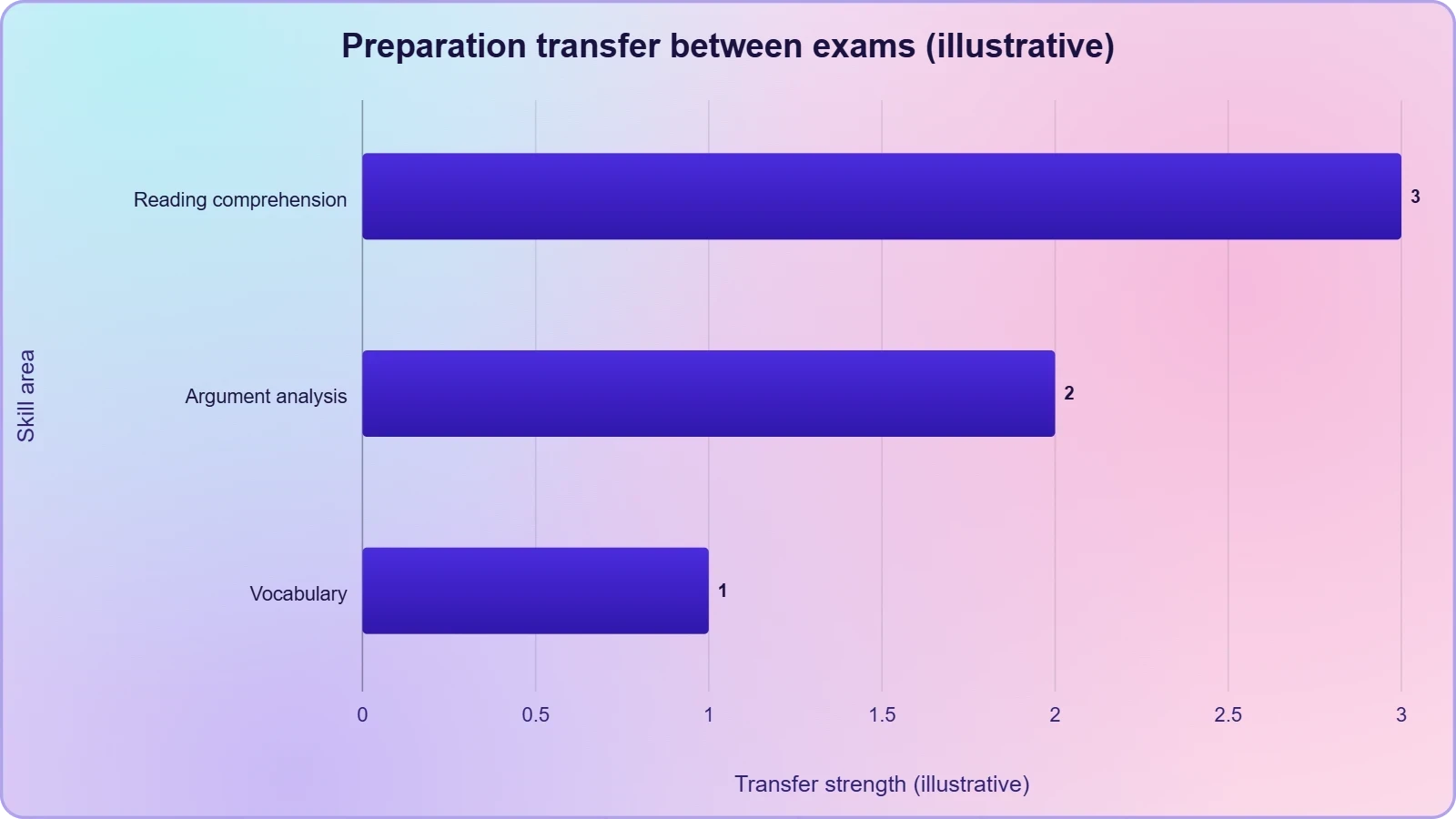
A central practical question for candidates concerns the degree to which preparation for one examination transfers to the other. The evidence suggests that transfer is partial and asymmetric: reading comprehension skills transfer reasonably well, argument analysis transfers moderately, and vocabulary preparation transfers poorly to the GMAT because the Focus Edition does not test vocabulary directly.
Candidates who have already invested substantially in one examination should therefore assess transferability carefully before switching. The following subsections examine preparation overlap, diagnostic approaches, and selection criteria.
Overlap and Divergence in Preparation Content
Reading comprehension preparation transfers most readily between the examinations, as both require structural parsing, main idea identification, and inference from text. However, passage content and question stem conventions differ, so candidates should practise with examination-specific materials rather than assuming general reading practice suffices.
Argument analysis preparation transfers moderately, as GMAT Critical Reasoning cultivates logical evaluation skills that assist GRE reading comprehension inference questions.
Vocabulary preparation transfers poorly to the GMAT Focus Edition, which does not test lexical knowledge directly. Conversely, candidates who have prepared extensively for GMAT Critical Reasoning will find that GRE Text Completion and Sentence Equivalence require substantially different competencies.
The asymmetry of transfer means that candidates switching from GRE to GMAT may retain more usable preparation than those switching in the opposite direction.
Diagnostic Assessment and Baseline Measurement
Diagnostic assessment constitutes the most reliable method for determining which examination aligns with a candidate's aptitudes. A full-length, officially produced practice test under timed conditions provides a baseline verbal score and reveals question-type strengths and weaknesses.
Candidates should complete diagnostics for both examinations before committing to a preparation pathway, as self-assessment without timed practice frequently proves inaccurate.
Diagnostic results should be interpreted with attention to question-type breakdowns rather than aggregate scores alone. A candidate may perform strongly on reading comprehension but weakly on vocabulary-based items, suggesting the GMAT may be more favourable. Conversely, strong lexical performance and weaker argument analysis may favour the GRE. Item-level diagnostic analysis therefore informs strategic selection more effectively than overall score comparison.
Programme Requirements and Admissions Signals
Programme requirements should be verified directly with target institutions, as acceptance policies vary and may change between admissions cycles. Many business schools accept both examinations, but some programmes publish preferences or report median scores for one examination only.
Candidates should consult current admissions websites and, where ambiguity persists, contact admissions offices directly rather than relying on secondary sources.
Admissions signalling effects are difficult to quantify and should be treated cautiously. Some admissions guidance suggests that the GMAT is viewed as more directly aligned with management education, though empirical evidence for differential treatment is limited and institution-specific.
Candidates should prioritise demonstrated performance on the examination they are most likely to score well on, while remaining attentive to any explicit programme preferences.
Decision Framework for Examination Selection
A structured decision framework assists candidates in selecting between the examinations. The framework should incorporate diagnostic performance, target programme requirements, preparation time available, and personal aptitude profile. Candidates with strong logical analysis and weaker vocabulary may favour the GMAT, while those with strong lexical resources and broad reading experience may favour the GRE. Programme requirements function as a binding constraint where preferences exist.
Time available for preparation is a further consideration. The GMAT Focus Edition's narrower verbal syllabus may permit more rapid preparation for candidates with strong analytical skills, whereas the GRE's vocabulary demands may require longer lexical preparation.
Candidates should estimate preparation timelines realistically and select the examination whose syllabus aligns with the time available, rather than assuming equal preparation burdens.
Concordance, Predictive Validity, and Institutional Evidence
The final analytical dimension concerns the empirical evidence linking verbal scores to admissions outcomes and the concordance research that permits approximate cross-examination comparison. This evidence is methodologically complex and should be interpreted with appropriate qualification, as concordance tables describe population-level relationships rather than individual-level equivalence.
Predictive validity studies likewise report correlations that vary by programme, criterion, and cohort. The following subsections examine concordance methodology, predictive validity findings, and the practical implications for candidates.
Concordance Table Methodology and Limitations
Concordance tables are constructed through statistical linking procedures that map scores from one examination onto the scale of another, typically using data from candidates who have taken both tests. The resulting mappings are approximate and carry confidence intervals that are rarely reported in public-facing tables.
Candidates should therefore treat concordance figures as indicative rather than definitive, particularly when their scores fall near a decision threshold.
The limitations of concordance methodology are well documented in psychometric literature. Linking procedures assume population invariance that may not hold across changing test populations, and the constructs measured by the two examinations are not identical.
A concorded score therefore represents a statistical approximation rather than a guarantee that admissions committees will treat the two scores as equivalent. Qualified interpretation is essential.
Predictive Validity for Graduate Performance
Predictive validity research examines the correlation between verbal scores and subsequent graduate performance, typically measured by grades or faculty ratings. Published studies report modest but statistically significant correlations, with verbal scores generally predicting performance less strongly than quantitative scores in quantitative-heavy programmes. In humanities and social science programmes, verbal scores may carry greater predictive weight, though evidence remains programme-specific.
The interpretation of predictive validity findings requires caution because criterion measures themselves are imperfect. Graduate grades exhibit restricted variance and limited reliability, which attenuates observed correlations. Moreover, predictive validity coefficients are population-specific and may not generalise across institutions or cohorts.
Candidates should therefore regard predictive validity evidence as one input among many rather than as a definitive guide to examination selection.
Institutional Preferences and Reporting Practices
Institutional preferences regarding the two examinations vary and are often communicated implicitly through median score reporting. Some programmes publish median GMAT scores without corresponding GRE data, which may create a perception of preference that is not formally stated.
Candidates should examine programme reporting practices carefully and, where possible, consult admissions officers directly to clarify acceptance policies and any preferences.
Reporting practices also affect how scores are perceived. The GRE's ScoreSelect option allows candidates to send only preferred scores, which may present a more favourable profile than a full score history. The GMAT's reporting model includes prior scores unless cancelled, which may present a more complete but potentially less favourable picture. Candidates should understand these reporting mechanics before deciding which examination to take.
Qualified Conclusions and Evidence Gaps
The evidence base supporting examination selection is substantial but incomplete. Construct validity, predictive validity, and concordance research all provide useful guidance, yet none delivers definitive individual-level prescriptions. Candidates should therefore combine empirical evidence with diagnostic performance and programme requirements rather than relying on any single source. Qualified, evidence-led decision-making is preferable to reliance on anecdotal advice or reputational claims.
Evidence gaps remain regarding the Focus Edition specifically, as its introduction is relatively recent and independent validity research is still accumulating. Claims about the Focus Edition's predictive properties should therefore be treated as provisional pending further published research.
Candidates should monitor official updates and independent psychometric analyses as they become available, and should interpret early claims with appropriate caution.
From our network :
- JD Vance Charlie Kirk: Tribute and Political Strategy
- Limits: The Squeeze Theorem Explained
- Bitcoin price analysis: Market signals after a muted weekend
- Bitcoin Hits $100K: Crypto News Digest
- How to migrate to postgres using logical replication and cutover
- The Diverse Types of Convergence in Mathematics
- Limit Superior and Inferior
- How to secure postgres connections across VPC, VPN, and cloud
- How to design postgres partitions with native and hash methods
RESOURCES
- No results found.