
On This Page
- Understanding Work Done by Constant Forces
- Analyzing Work Done by Variable Forces
- The Work-Energy Theorem Explained
- Kinetic Energy and Momentum Relationship
- Potential Energy in Conservative Fields
- Conservation of Mechanical Energy
- Understanding Power and Efficiency
- Conservative vs Non-Conservative Forces
- Solving Equilibrium Problems
- Collisions and Impulse Dynamics
- NEET Problem-Solving Strategies
Understanding Work Done by Constant Forces
Work is defined in physics as the product of the component of the force in the direction of the displacement and the magnitude of this displacement. For NEET aspirants, recognizing when a force is constant is the first step toward applying the correct algebraic formula without needing calculus. When the magnitude and direction of the force remain unchanged throughout the motion, the calculation remains straightforward and predictable.
The Dot Product Definition
Mathematically, work is the scalar product of the force vector and the displacement vector, represented as ##W = \vec{F} \cdot \vec{d}##. This simplifies to
, where ##\theta## is the angle between the force and displacement vectors. Understanding the cosine component is vital for NEET problems involving inclined planes or horizontal pulling.
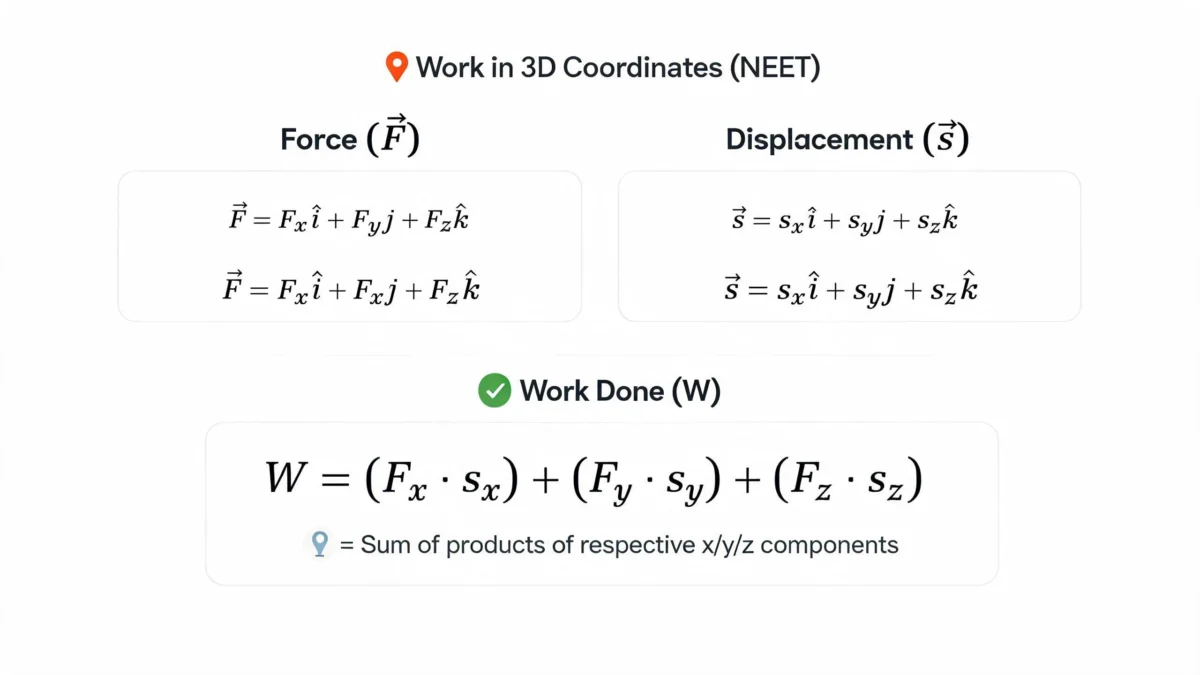
In three-dimensional coordinate systems, if force and displacement are given in unit vector notation, work is calculated by summing the products of their respective components. For example, if ##\vec{F} = F_x \hat{i} + F_y \hat{j}## and ##\vec{d} = x \hat{i} + y \hat{j}##, then ##W = F_x x + F_y y##. This vector approach avoids trigonometric complexities in many competitive exam scenarios.
Work Formula Quick Guide
This table summarizes how to calculate work using vectors and components.
| Concept | Explanation | Application |
|---|---|---|
| Scalar product | Work is the scalar product of force and displacement: W = F · d | Use when force and displacement are both known as vectors |
| Angle form | W = Fd cosθ, where θ is the angle between force and displacement | Useful for inclined planes and horizontal pulling |
| Cosine component | Only the component of force along displacement contributes to work | Check whether the force helps or opposes motion |
| 2D component form | If F = Fx i + Fy j and d = x i + y j, then W = Fx x + Fy y | Reduces trig steps in coordinate-based problems |
| Vector method advantage | Work can be found by adding matching components | Handy for NEET-style multi-component questions |
- Work is a scalar quantity.
- The cosine term becomes important whenever force is not along displacement.
Positive, Negative, and Zero Work
The sign of work depends entirely on the angle ##\theta##. Work is positive when the force has a component in the direction of displacement (##0 \le \theta < 90^\circ##), meaning the force helps the motion. This is commonly seen when an engine accelerates a car or a person lifts a weight upward.
Negative work occurs when the force opposes the motion (##90^\circ < \theta \le 180^\circ##), such as friction acting on a sliding block or air resistance. Zero work is a frequent NEET trick question, occurring when the force is perpendicular to displacement (##\theta = 90^\circ##), like centripetal force in circular motion or a person carrying a load horizontally.
Analyzing Work Done by Variable Forces
In many real-world scenarios, the force applied to an object changes as it moves, making simple multiplication insufficient. Variable forces require a more dynamic approach, often involving integration or graphical analysis to find the total energy transferred. NEET frequently tests this through spring forces or position-dependent force functions provided in the question stem.
Integration Methods for Non-Uniform Force
When force is a function of position, ##F(x)##, the work done is the integral of the force over the displacement interval. The formula is expressed as
. This allows students to handle forces that increase or decrease linearly or non-linearly with distance, such as electrostatic or gravitational forces.
To solve these problems quickly, students must be comfortable with basic integration rules for polynomials. If a force is given as ##F = kx^2##, the work done from ##x=0## to ##x=L## is ##\frac{1}{3}kL^3##. Practicing these definite integrals ensures that you can handle varying force magnitudes without hesitation during the actual exam.
Graphical Interpretation of Area Under Curve
A highly effective shortcut for NEET is the graphical method, where work done is equal to the area under the Force-Displacement (F-x) graph. For a constant force, this area is a rectangle, while for a linearly varying force, it usually forms a triangle or trapezoid. Visualizing the problem often prevents calculation errors.
If the graph dips below the x-axis, that area represents negative work and must be subtracted from the total. Students should practice calculating areas of standard geometric shapes quickly. This visual approach is particularly useful when the force function is complex to integrate but easy to plot on a coordinate plane.
The Work-Energy Theorem Explained
The Work-Energy Theorem is perhaps the most powerful tool in mechanics for NEET, linking dynamics to kinematics. It states that the net work done by all forces acting on a body is equal to the change in its kinetic energy. This principle allows you to bypass acceleration and time variables, focusing solely on initial and final states.

Relationship Between Work and Kinetic Energy
The theorem is mathematically stated as
. Here, ##W_{net}## includes work done by conservative, non-conservative, internal, and external forces. If you know the initial velocity and the total work performed, finding the final speed becomes a simple matter of algebraic rearrangement.
Kinetic energy is defined as ##K = \frac{1}{2}mv^2##, which is always a non-negative scalar quantity. When positive work is done on an object, its kinetic energy increases, and it speeds up. Conversely, negative work decreases kinetic energy, causing the object to slow down, which is a fundamental concept in braking distance problems.
Application in Complex Mechanical Systems
In NEET, you might encounter systems with multiple forces like gravity, friction, and tension acting simultaneously. Instead of writing ##F=ma## for every component, sum the work done by each force. For instance, in a block-pulley system, the total work done by gravity and friction equals the change in the total kinetic energy of the system.
This theorem is also applicable to variable forces where acceleration is not constant. By calculating the work done through integration or area, you can find the final velocity without ever needing to solve the kinematic equations of motion. This saves precious time during the physics section of the medical entrance exam.
Kinetic Energy and Momentum Relationship
While kinetic energy and momentum both depend on mass and velocity, they represent different physical perspectives. Kinetic energy is a scalar related to the work-energy theorem, while momentum is a vector related to impulse and collisions. Understanding their mathematical link is crucial for solving ratio and percentage-based MCQ questions.
Mathematical Derivation for NEET
The relationship between kinetic energy (K) and linear momentum (p) is given by the formula
. This derivation comes from substituting ##v = p/m## into the standard kinetic energy formula. This specific form is extremely useful when the mass of an object is constant and momentum changes.
Alternatively, momentum can be expressed in terms of kinetic energy as ##p = \sqrt{2mK}##. Knowing these two variations allows students to jump directly to the answer when a problem provides one value and asks for the other. It eliminates the intermediate step of calculating velocity, reducing the risk of decimal errors.
Solving Ratio-Based Problems
NEET often asks how kinetic energy changes if momentum is doubled, or vice versa. Using the formula
(for constant mass), if momentum increases by 100% (doubles), the kinetic energy increases by 300% (becomes four times). These proportionalities are frequent favorites for examiners testing conceptual clarity and quick math.
For two bodies with the same momentum, the lighter body will have more kinetic energy because ##K## is inversely proportional to ##m##. Conversely, if two bodies have the same kinetic energy, the heavier body will have more momentum. Mastering these qualitative comparisons helps in eliminating incorrect options in multiple-choice questions instantly.
Potential Energy in Conservative Fields
Potential energy is the energy stored in a system due to its configuration or position within a conservative force field. It is a relative quantity, meaning we usually define a reference point where the potential energy is zero. In the context of NEET, gravitational and elastic potential energies are the primary focuses for mechanical problems.
Gravitational Potential Energy Dynamics
Near the Earth's surface, gravitational potential energy is calculated using
, where ##h## is the height above a chosen reference level. It is important to remember that this formula is an approximation valid only for small heights compared to the Earth's radius. For larger distances, the universal law of gravitation must be applied.
The change in potential energy is independent of the path taken; it only depends on the initial and final vertical positions. This path-independence is the hallmark of a conservative force. In NEET problems, always choose a reference level (like the ground or the lowest point of motion) that simplifies your calculations to zero.
We Also Published
Elastic Potential Energy in Springs
When a spring is compressed or stretched by a distance ##x## from its equilibrium position, it stores elastic potential energy. The formula for this energy is
, where ##k## is the spring constant. This energy is always positive regardless of whether the spring is stretched or compressed.
This quadratic relationship means that doubling the displacement quadruples the stored energy. NEET problems often involve a block hitting a spring or a mass suspended from a spring. In these cases, the conversion between kinetic energy and elastic potential energy is the key to finding maximum compression or velocity.
Conservation of Mechanical Energy
The principle of conservation of mechanical energy states that if only conservative forces do work, the total mechanical energy (sum of kinetic and potential) remains constant. This is a fundamental law that simplifies motion analysis in systems where friction and air resistance are negligible. It is the "gold standard" for solving NEET mechanics questions.
Conditions for Energy Conservation
For mechanical energy to be conserved, the work done by non-conservative forces (like friction or tension in some cases) must be zero. The mathematical expression is
. This equation allows you to equate the total energy at two different points in time or space to solve for unknowns.
If non-conservative forces are present, the energy lost to heat or sound must be accounted for using the modified equation: ##E_i + W_{nc} = E_f##. Recognizing when to use the simple conservation law versus the work-energy theorem is a skill that separates top scorers. Most NEET "ideal" problems assume no energy loss unless friction is explicitly mentioned.
Vertical Circular Motion Applications
A classic application of energy conservation is a mass tied to a string moving in a vertical circle. At the highest point, the minimum velocity required to maintain the circle is ##\sqrt{gr}##. By using energy conservation between the top and bottom points, we can find the velocity at the bottom to be ##\sqrt{5gr}##.
These specific results are worth memorizing for the exam. The tension in the string also varies, and energy conservation helps determine the velocity at any angle ##\theta##. Understanding how potential energy converts to kinetic energy as the object swings downward is essential for solving these high-yield NEET physics problems.
Understanding Power and Efficiency
Power is defined as the rate at which work is done or energy is transferred. In the NEET syllabus, power problems often bridge the gap between kinematics and real-world machinery. It is a scalar quantity measured in Watts (Joules per second), and understanding its relationship with force and velocity is crucial for solving MCQs.
Instantaneous vs Average Power
Average power is the total work done divided by the total time taken,
. Instantaneous power, however, is the power at a specific moment, calculated as the dot product of force and velocity:
. If force and velocity are in the same direction, this simplifies to ##P = Fv##.
Students should be careful with units, as NEET may use horsepower (1 hp = 746 W) or kilowatts. Problems involving pumps lifting water or vehicles accelerating against constant resistance often require calculating the power required to maintain a certain speed. Always ensure velocity is in meters per second before applying the formula.
Calculating Efficiency in Real Machines
No real machine is 100% efficient due to energy losses like friction and heat. Efficiency (##\eta##) is the ratio of useful output power to the total input power, usually expressed as a percentage. The formula is
. This concept is frequently applied to electric motors or heat engines.
In NEET problems, you might be given the input power of a motor and asked to find how much weight it can lift in a certain time. You must first multiply the input power by the efficiency to find the actual work-producing power. Ignoring efficiency is a common mistake that leads to choosing the wrong option in the exam.
Conservative vs Non-Conservative Forces
Distinguishing between conservative and non-conservative forces is vital for determining whether mechanical energy is conserved in a system. This distinction dictates which problem-solving strategy—conservation of energy or the work-energy theorem—is most appropriate for a given NEET question. It also relates to the concept of potential energy functions.
Path Independence and Closed Loops
A force is conservative if the work done by it in moving a particle between two points is independent of the path taken. Gravity, electrostatic force, and spring force are primary examples. For these forces, the total work done in a closed loop (returning to the starting point) is always zero, which is a key theoretical point.
Because the work depends only on endpoints, we can define a potential energy function for these forces. In NEET, if you see a force field where ##W## depends on the trajectory, you know it is non-conservative. This understanding prevents you from incorrectly applying potential energy formulas to dissipative systems like friction.
Impact of Friction on Energy
Friction is the most common non-conservative force encountered in physics problems. The work done by friction is always negative because it opposes the relative motion, and this energy is dissipated as heat. Since the work done by friction depends on the path length, it cannot be recovered as mechanical energy.
In systems with friction, mechanical energy is not conserved; instead, it decreases over time. To solve such problems, you must use
. NEET often asks for the "loss in energy," which is simply the magnitude of the work done by friction. Mastering this allows for accurate analysis of sliding blocks and rolling objects.
Solving Equilibrium Problems
Equilibrium in mechanics occurs when the net force on an object is zero. However, when viewed through the lens of energy, equilibrium is defined by the first derivative of the potential energy function. This energy-based approach is often faster for determining the stability of a system than force-balancing methods.
Stable, Unstable, and Neutral Equilibrium
Equilibrium occurs where the slope of the potential energy curve is zero, i.e.,
. Stable equilibrium exists at a local minimum of potential energy, where a small displacement results in a restoring force. Think of a ball at the bottom of a bowl; it naturally returns to its center.
Unstable equilibrium occurs at a local maximum of potential energy, where a displacement causes the object to move further away, like a ball balanced on top of a hill. Neutral equilibrium happens when potential energy is constant over a range, meaning the object stays in its new position after being moved. NEET tests these concepts using ##U(x)## graphs.
Potential Energy Curve Analysis
To identify the type of equilibrium mathematically, you must look at the second derivative of the potential energy function. If
, it is stable; if
, it is unstable; and if it equals zero, it is neutral. This calculus-based check is a foolproof way to answer stability questions.
Graphs of ##U## vs ##x## are common in NEET physics. Students should practice identifying these points visually. The force at any point can be found using ##F = -dU/dx##, which means the force is the negative slope of the curve. This relationship is a fundamental bridge between potential energy and dynamics.
Collisions and Impulse Dynamics
Collisions involve the interaction of two or more bodies over a very short time interval, where internal forces are much larger than external ones. While momentum is conserved in all isolated collisions, kinetic energy is not always preserved. This section of the NEET syllabus requires a clear understanding of energy transfer during impacts.
Elastic and Inelastic Collisions
In a perfectly elastic collision, both total linear momentum and total kinetic energy are conserved. These usually involve subatomic particles or ideal billiard balls. For NEET, you should memorize the velocity formulas for 1D elastic collisions, as deriving them from scratch during the exam is too time-consuming.
In inelastic collisions, momentum is conserved, but kinetic energy is lost (usually to heat or deformation). If the bodies stick together after impact, it is a "perfectly inelastic" collision, resulting in the maximum possible loss of kinetic energy. Most real-world collisions fall somewhere in between, characterized by a specific coefficient of restitution.
Coefficient of Restitution Calculations
The coefficient of restitution (##e##) is the ratio of the relative velocity of separation to the relative velocity of approach. It is given by
. For elastic collisions, ##e=1##; for perfectly inelastic ones, ##e=0##. For all other real collisions, ##0 < e < 1##.
NEET often asks for the height a ball reaches after multiple bounces on the floor. If a ball is dropped from height ##H##, the height after the first bounce is ##e^2H##, and after ##n## bounces, it is ##e^{2n}H##. Memorizing these patterns and the energy loss formula
is highly beneficial.
NEET Problem-Solving Strategies
Success in NEET Physics depends not just on knowing formulas, but on knowing when to use them. Work, Energy, and Power problems can often be solved in multiple ways, but the energy approach is usually the most efficient. Developing a systematic workflow for these problems will help you handle the pressure of the exam day.
Identifying Energy Shortcuts
Always check if energy conservation can be applied before jumping into kinematics. If the problem doesn't ask for time or acceleration, the work-energy theorem is likely your best friend. For example, finding the speed of a block at the bottom of a curved friction-less track is much easier with energy than with forces.
Look for keywords like "minimum speed," "maximum compression," or "stop distance." These terms usually signal that you should set up an energy balance equation. By identifying these cues, you can skip unnecessary steps and move directly to the calculation phase, which is vital for maintaining a good pace in the exam.
Time Management for Physics MCQs
Physics often takes the most time in NEET, so efficiency is key. Practice rounding numbers and using approximations where the options are far apart. For instance, using ##g = 10## instead of ##9.8## can save seconds on every gravity-related problem without sacrificing much accuracy for multiple-choice selections.
If a problem seems too complex, check if it can be solved using dimensional analysis or by testing the boundary conditions of the options. Often, only one option will have the correct units or make physical sense at the limits (like when mass goes to zero). These "test-taking" skills are just as important as your physics knowledge for a top rank.
From our network :
- Limits: The Squeeze Theorem Explained
- How to migrate to postgres using logical replication and cutover
- How to secure postgres connections across VPC, VPN, and cloud
- JD Vance Charlie Kirk: Tribute and Political Strategy
- Limit Superior and Inferior
- How to design postgres partitions with native and hash methods
- The Diverse Types of Convergence in Mathematics
- Bitcoin Hits $100K: Crypto News Digest
- Bitcoin price analysis: Market signals after a muted weekend
RESOURCES
- No results found.