
On This Page
- Introduction to Acceleration Due to Gravity
- Variation of g with Height (Altitude)
- Variation of g with Depth (Below Surface)
- Comparing Height and Depth Variations
- Effect of Earth's Shape on g
- Variation of g due to Earth's Rotation
- Impact of Latitude on Gravitational Pull
- Practical NEET Numerical Problem Strategies
- Common Conceptual Pitfalls in Gravity
- Advanced Topics: Weightlessness and Orbit
- Summary and Revision Tips for NEET
Introduction to Acceleration Due to Gravity
The acceleration due to gravity, denoted as ##g##, is the acceleration gained by an object due to the Earth's gravitational pull. For NEET aspirants, understanding that this value is not constant everywhere is vital for solving mechanics problems. It serves as a cornerstone for both kinematics and dynamics in the standard physics curriculum.
Defining the Standard Value of g
At the surface of the Earth, the standard value is approximately ##9.8 \, m/s^2##. This value is derived assuming the Earth is a perfect, non-rotating sphere with uniform density. However, because the Earth is an oblate spheroid, this standard value fluctuates depending on your specific location.
The Role of Newton’s Law of Gravitation
Newton's Universal Law of Gravitation provides the mathematical foundation for calculating ##g##. The formula is expressed as ##g = \frac{GM}{R^2}## , where ##G## is the gravitational constant, ##M## is the mass of Earth, and ##R## is the radius. This relationship highlights how gravity is inversely proportional to the square of the distance from the center.
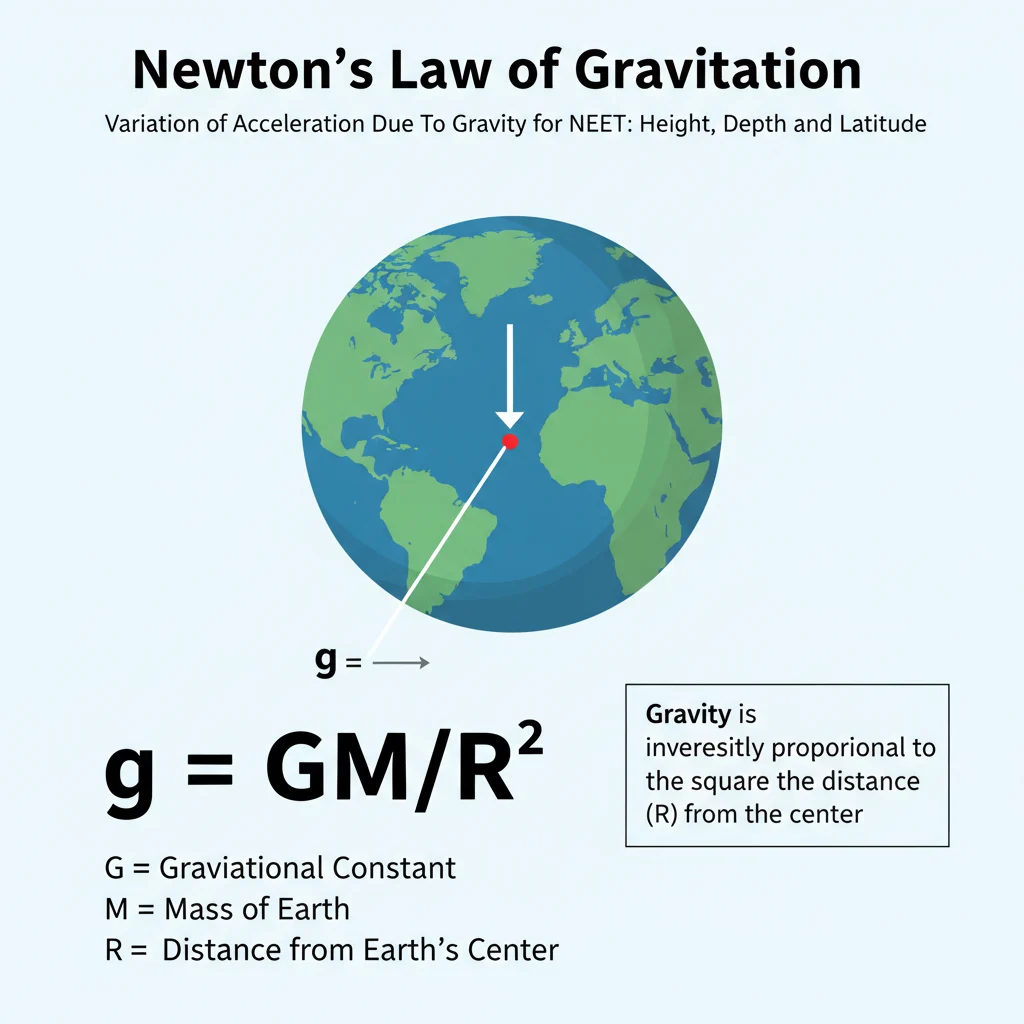
In competitive exams, you must recognize that any change in ##R## or the effective mass will alter the value of ##g##. Whether you move away from the surface or dig deep into the crust, the parameters change. This conceptual framework is essential for deriving variations in height and depth.
Finally, remember that ##g## is a vector quantity directed towards the center of the Earth. While we often use its magnitude for calculations, its direction is crucial in vector-based physics problems. Constant practice with these fundamentals ensures a solid base for advanced gravitational topics.
Variation of g with Height (Altitude)
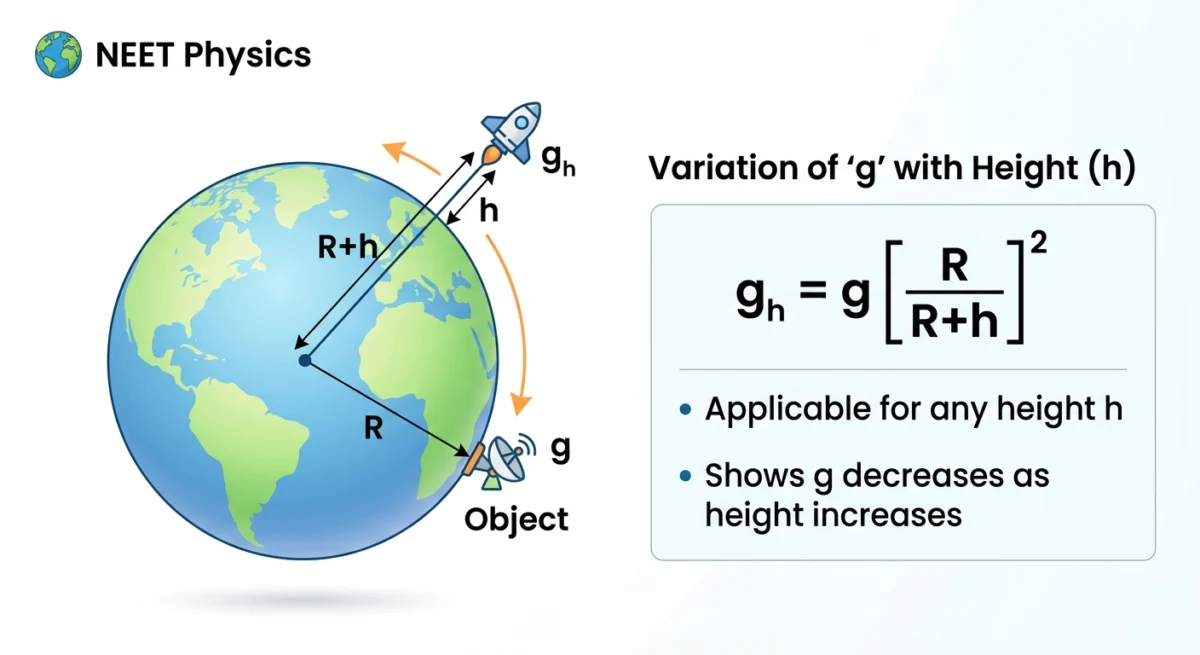
As an object moves upward from the surface of the Earth, the distance from the Earth's center increases. According to the inverse square law, this increase in distance leads to a decrease in the gravitational pull. This variation is a frequent topic in NEET physics papers.
The Exact Formula for Height
When an object is at a height ##h## above the surface, the new acceleration ##g_h## is calculated using the total distance ##R+h##. The exact formula is ##g_h = g \left( \frac{R}{R+h} \right)^2## . This formula is applicable for any height, whether small or comparable to the Earth's radius.
Approximation for Small Altitudes
For heights much smaller than the Earth's radius (##h \ll R##), we use a simplified binomial expansion. The approximate formula becomes
. This linear approximation is highly useful for quick calculations in competitive exams when ##h## is a few kilometers.
It is important to note that gravity decreases more rapidly with height than it does with depth. For every kilometer you rise, the percentage decrease in ##g## is twice as much as the decrease seen when descending. This comparison is a common conceptual question in medical entrance tests.
Understanding the limits of these formulas prevents calculation errors during the exam. If the height is given as a fraction of ##R##, always use the exact formula. If the height is very small, the linear approximation will save you valuable time.
Variation of g with Depth (Below Surface)
When you move below the Earth's surface, the variation of ##g## follows a different mathematical logic. Unlike height, where only distance changes, moving into the Earth means the "effective mass" pulling you downward also decreases. This dual change results in a linear decrease in gravity.
Linear Relationship with Depth
The formula for acceleration due to gravity at a depth ##d## is given by
. This indicates that ##g## decreases linearly as you go deeper into the Earth. It is one of the simplest formulas to remember for the NEET physics syllabus.
Gravity at the Center of the Earth
At the center of the Earth, the depth ##d## becomes equal to the radius ##R##. Substituting this into the formula, we find that
. This means an object would experience weightlessness at the very center of the planet because the gravitational forces from all sides cancel out.
The variation with depth assumes that the Earth has a uniform density throughout its volume. While the actual Earth has layers of varying density, for NEET purposes, the uniform density model is standard. This simplifies the integration required to derive the formula.
Graphically, the relationship between ##g## and the distance from the center is linear inside the Earth. Once you cross the surface, the relationship becomes an inverse square. Mastering this transition is key to answering graphical interpretation questions.
Comparing Height and Depth Variations
Comparing how ##g## changes with altitude versus depth is a classic analytical exercise. Students often get confused about which factor causes a faster decline in gravitational acceleration. Clear visualization of the two formulas helps in distinguishing their behaviors effectively.
Rate of Change Comparison
If we compare the two linear approximations, we see that
and
. If ##h = d##, the decrease in gravity at a height is twice the decrease at the same depth. This "factor of two" rule is a vital shortcut for NEET.
Graphical Representation of g vs Distance
The graph of ##g## versus distance ##r## from the center shows a straight line starting from the origin up to ##r = R##. Beyond the surface, the curve follows a ##1/r^2## path, asymptotically approaching zero. Identifying this specific graph is a common task in physics assessments.
We Also Published
In many problems, you might be asked to find the height and depth where the value of ##g## is the same. By equating the two formulas, you can solve for the relationship between ##h## and ##d##. Typically, for small changes, the height required is half the depth for the same gravity reduction.
This comparative study reinforces the physical intuition that the surface is the point of maximum gravity. Moving in either direction—up into space or down into the core—results in a weaker gravitational field. Keep this principle in mind to avoid common conceptual errors.
Effect of Earth's Shape on g
The Earth is not a perfect sphere; it is an oblate spheroid, meaning it is flattened at the poles and bulges at the equator. This geometric reality has a significant impact on the value of ##g##. It explains why your weight changes slightly as you travel between different latitudes.
Oblate Spheroid Geometry
Because of the equatorial bulge, the equatorial radius (##R_e##) is approximately 21 kilometers longer than the polar radius (##R_p##). Since gravity is inversely proportional to the square of the radius, the larger radius at the equator leads to a smaller gravitational pull.
Gravity at Poles vs Equator
The value of ##g## is maximum at the poles and minimum at the equator. Using the formula ##g = GM/R^2##, the smaller ##R_p## results in a higher ##g_{pole}##. This variation due to shape accounts for a difference of about ##0.018 \, m/s^2## in acceleration.
NEET questions often ask about the percentage difference or the reason for the weight increase when moving from the equator to the pole. The primary reason is the decrease in the distance to the Earth's center. Understanding the shape effect is the first step in mastering latitude variations.
While the shape effect is small compared to altitude changes, it is measurable and scientifically significant. In high-precision physics, these differences must be accounted for. For students, it serves as an excellent example of how geometry influences physical laws.
Variation of g due to Earth's Rotation
The rotation of the Earth on its axis introduces a centrifugal force that acts outward from the axis of rotation. This force effectively opposes the inward pull of gravity, leading to a reduction in the apparent value of ##g##. This effect is most pronounced at the equator.
Centrifugal Force and Latitude
At any latitude ##\phi##, the centrifugal acceleration is
. This acceleration acts radially outward from the axis, not the center of the Earth. Therefore, its component opposing gravity must be calculated using trigonometric projections for accurate results.
Effective Gravity Formula
The effective acceleration due to gravity ##g'## at a latitude ##\phi## is given by
. Here, ##\omega## is the angular velocity of the Earth's rotation. This formula shows that the reduction is dependent on the square of the cosine of the latitude.
If the Earth were to stop rotating, the value of ##g## would increase everywhere except at the poles. The rotation effect is a dynamic variation, unlike the static variation caused by the Earth's shape. Both effects combine to determine the final local value of gravity.
For NEET, you should be prepared to calculate what happens if the Earth's rotation speed changes. If ##\omega## increases, the effective gravity at the equator decreases. At a certain high speed, objects at the equator could even experience weightlessness.
Impact of Latitude on Gravitational Pull
Latitude is the angular distance of a place north or south of the Earth's equator. As we have seen, both the shape of the Earth and its rotation contribute to how ##g## varies with latitude. This section synthesizes these effects into a practical understanding for students.
Minimum Gravity at the Equator
At the equator, the latitude ##\phi = 0^\circ##. This makes ##\cos \phi = 1##, resulting in the maximum subtraction from the standard gravity value. Additionally, the equatorial radius is at its largest, further minimizing the local acceleration due to gravity.
Maximum Gravity at the Poles
At the poles, the latitude ##\phi = 90^\circ##. Since ##\cos 90^\circ = 0##, the centrifugal effect disappears entirely. Combined with the fact that the polar radius is the smallest, the poles experience the highest value of ##g## on the Earth's surface.
Students should remember that at the poles, only the shape effect matters, while at the equator, both shape and rotation effects are maximized. This makes the poles the most "stable" point for gravitational measurements. It also explains why launch sites for satellites are often chosen near the equator.
When solving numericals, always check if the question specifies the latitude. A common trick in NEET is to ask for the change in weight when a body is moved from the equator to the pole. You must sum the effects of both radius change and rotation.
Practical NEET Numerical Problem Strategies
Solving physics problems in a competitive environment requires more than just knowing formulas; it requires strategy. For topics like the variation of ##g##, being able to quickly identify which formula applies can save minutes of time. Practice is essential for developing this intuition.
Identifying the Correct Formula
The first step is determining if the change is due to height, depth, or rotation. If height is mentioned, check if it is "small" (less than 500 km) to use the approximation. If the height is a significant fraction of the radius, the exact square law formula is mandatory.
Handling Percentage Change Questions
Percentage change questions are very common. Remember that the percentage change in ##g## for a small height ##h## is
. For depth, it is simply
. These shortcuts are invaluable during the exam.
Always keep the units consistent, especially the Earth's radius, which is typically taken as ##6400 \, km##. Converting everything to SI units (meters) before calculation prevents decimal errors. Many students lose marks simply by forgetting to convert kilometers to meters.
Finally, read the question carefully to see if it asks for the "change in gravity" or the "new value of gravity." These are two different quantities. The "change" is the difference, while the "new value" is the final result after subtraction or addition.
Common Conceptual Pitfalls in Gravity
Even top students can fall into traps when dealing with gravitational concepts. Identifying these pitfalls early in your preparation can prevent simple mistakes on the day of the NEET exam. Gravity is intuitive, but its mathematical nuances can be deceptive.
Mass vs Weight Distinction
One of the most frequent errors is confusing mass with weight. Mass is an intrinsic property that does not change with height, depth, or latitude. Weight, however, is the product of mass and local gravity (##W = mg##) and varies exactly as ##g## does.
Misinterpreting the Inverse Square Law
Students often apply the inverse square law inside the Earth, which is incorrect. Inside the Earth, the gravity is proportional to the distance from the center (##g \propto r##). The inverse square law (##g \propto 1/r^2##) only applies outside the Earth's surface.
Another pitfall is forgetting the "square" in the rotation formula. The term is ##\cos^2 \phi##, not just ##\cos \phi##. Squaring the cosine significantly changes the value, especially at intermediate latitudes like 45 degrees. Always double-check your trigonometric identities.
Avoid assuming that ##g## is always ##9.8 \, m/s^2## in every problem. If a problem mentions "at a height" or "at the poles," the standard value is merely a reference point. Using the wrong value of ##g## will lead to an incorrect answer in multi-step mechanics problems.
Advanced Topics: Weightlessness and Orbit
While basic variations are common, NEET occasionally touches on advanced applications like weightlessness in satellites. This occurs because the satellite and the person inside are both "falling" towards Earth with the same acceleration. This state is known as free fall.
Gravity Inside a Satellite
Inside a satellite orbiting at height ##h##, the effective gravity is zero. This is because the centripetal acceleration required for the orbit exactly matches the local gravitational acceleration ##g_h##. Consequently, objects inside appear to float without any support force.
Apparent Weight in Elevators
The concept of varying gravity is also applied to elevators. When an elevator accelerates upward, the apparent gravity increases (##g + a##). When it moves downward, it decreases (##g - a##). This is a practical application of the principles of non-inertial frames and effective gravity.
Understanding these scenarios helps in solving problems where multiple forces are at play. Gravity is the primary force, but acceleration of the frame of reference creates an "apparent" gravity. This distinction is crucial for problems involving springs, pendulums, or fluid pressure.
For competitive exams, practice problems involving a pendulum's time period at different heights. Since
, any variation in ##g## directly affects the time period. This combines gravitation with simple harmonic motion, a favorite topic for exam setters.
Summary and Revision Tips for NEET
As you wrap up your study of gravitational variation, a quick summary helps consolidate the information. Revision should focus on the conditions under which each formula is valid. Creating a formula sheet is highly recommended for last-minute preparation before the exam.
Quick Reference Formula Table
Summarize your formulas: Height (Exact and Approx), Depth, and Rotation. Note down the specific values for the poles and the equator. Having these in a single table allows for rapid mental recall during the physics section of the NEET paper.
Final Strategies for Competitive Exams
Focus on solving previous years' questions (PYQs) related to this topic. Often, the same conceptual patterns repeat with different numerical values. If you can master the relationship between height and depth variations, you are already ahead of many candidates.
Remember that physics is about understanding the "why" behind the "how." Why does gravity decrease with depth? Because the mass above you no longer pulls you down. Why does it decrease with rotation? Because centrifugal force pushes you out.
Stay confident and keep practicing. The variation of acceleration due to gravity is a logical and predictable topic. With the right focus on formulas and their derivations, you will be well-equipped to handle any question that comes your way in the NEET exam.
From our network :
- Limit Superior and Inferior
- Bitcoin Hits $100K: Crypto News Digest
- How to secure postgres connections across VPC, VPN, and cloud
- How to design postgres partitions with native and hash methods
- How to migrate to postgres using logical replication and cutover
- Bitcoin price analysis: Market signals after a muted weekend
- The Diverse Types of Convergence in Mathematics
- Limits: The Squeeze Theorem Explained
- JD Vance Charlie Kirk: Tribute and Political Strategy
RESOURCES
- Variation of Acceleration due to Gravity with Height | PHYSICS | NEET
- Sajha Notes on Instagram: "Variation of acceleration due to gravity
- 11 chap 8 | Gravitation 04 |Acceleration due to gravity g ... - YouTube
- Acceleration Due To Gravity – Formula, Unit And Values - Unacademy
- Variation of Acceleration due to Gravity with Height for IIT-JEE and ...
- Variation of Acceleration due to Gravity - Instagram
- Variation of acceleration due to gravity- Complete Notes! Follow us ...
- The graph correctly represents the variation of acceleration due to ...
- NEET 2024 PYQ – Acceleration | Edugene Classes | Facebook
- Acceleration Due to Gravity and its Variation With Altitude and Depth ...
- 3. Variation in Acceleration due to gravity | Gravitation - YouTube
- Acceleration Due to Gravity – Formula, Unit and Values - BYJU'S
- Gravitation Important Topics — NEET-UG - Super Tutor
- Gravitation | Physics | NEET Previous Year Questions
- If velocity is a vector and acceleration is a change in velocity ... - Reddit