
On This Page
- Understanding the Fundamentals of Simple Harmonic Motion
- Key Parameters and Equations of SHM
- Kinematics of Simple Harmonic Motion
- Dynamics of Spring-Mass Systems
- The Simple Pendulum and Small Angle Approximation
- Energy Transformations in SHM
- Graphical Representation of SHM Variables
- Damped and Forced Oscillations for NEET
- Problem-Solving Strategies for NEET Physics
- Common Pitfalls and Conceptual Clarifications
- Integrating SHM with Other Physics Chapters
Understanding the Fundamentals of Simple Harmonic Motion
Simple Harmonic Motion is a specific type of periodic motion where the restoring force is directly proportional to the displacement from the equilibrium position. In this motion, the object moves back and forth through a central point, which we call the mean position.
Defining Periodic and Oscillatory Motion
Periodic motion repeats itself at regular intervals of time, such as the rotation of the Earth or the movement of a clock's hands. However, not all periodic motions are oscillatory; oscillation specifically involves a to-and-fro movement about a fixed mean position.
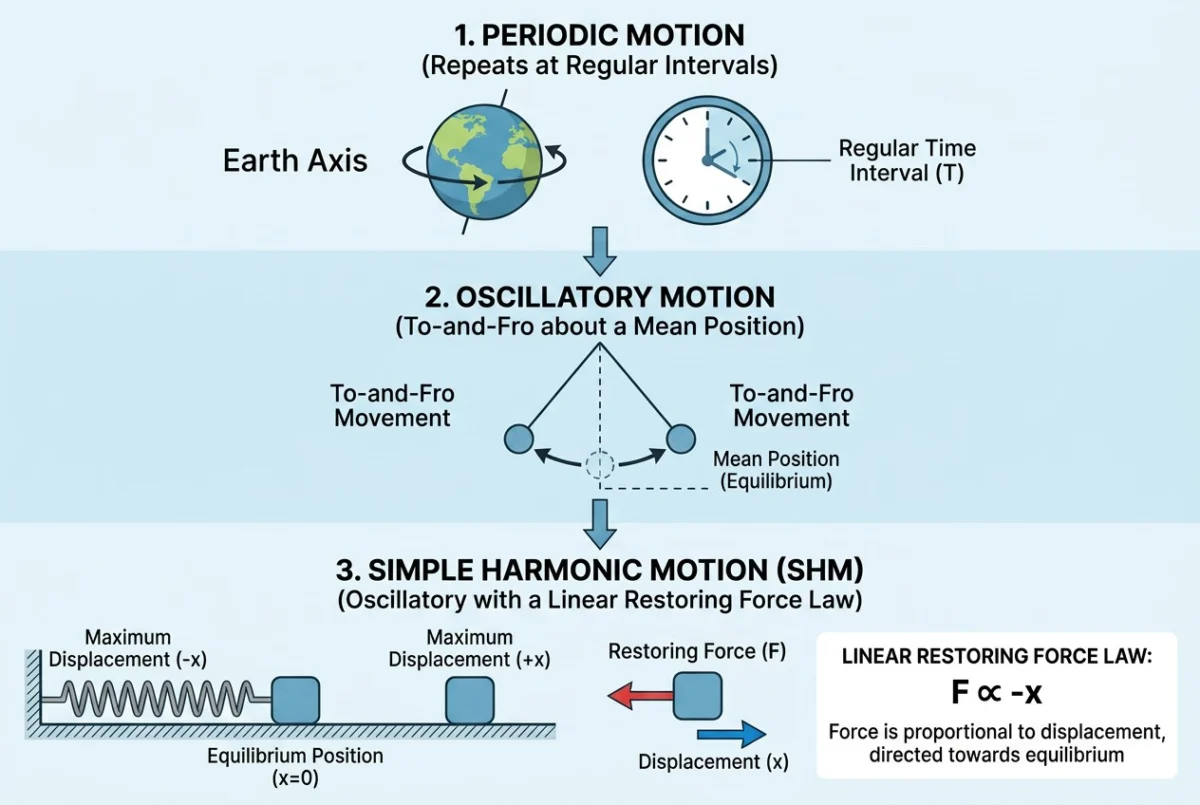
For a motion to be classified as Simple Harmonic, it must follow a linear restoring force law. This means that the farther you pull an object from its center, the stronger the force pushing it back becomes, always acting toward the equilibrium.
The Restoring Force and Displacement Relationship
The mathematical expression for this relationship is defined by Hooke's Law, typically written as
. Here, ##F## represents the restoring force, ##k## is the force constant, and ##x## is the displacement from the mean position.
The negative sign in the equation is crucial for NEET aspirants to understand. It signifies that the force and displacement are always in opposite directions, ensuring the system always tries to return to its stable equilibrium point.
Key Parameters and Equations of SHM
To master SHM for NEET, one must become familiar with the primary variables that describe the motion. These variables include amplitude, time period, and frequency, which define the physical extent and timing of the oscillation.
Amplitude, Time Period, and Frequency
Amplitude, denoted as ##A##, is the maximum displacement of the particle from its mean position. It represents the "peak" of the motion and is essential for calculating the total energy contained within the oscillating system.
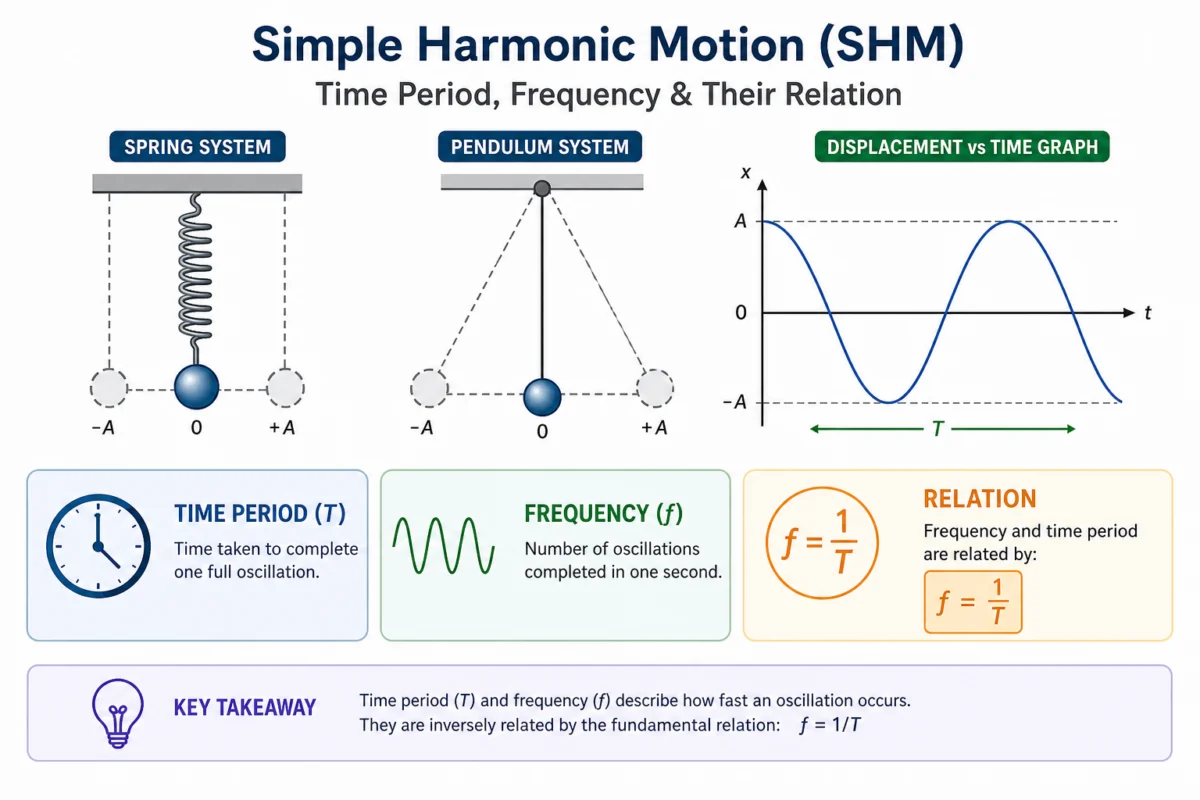
The time period ##T## is the duration taken to complete one full oscillation, while frequency ##f## is the number of oscillations per second. They are related by the formula ##T = \frac{1}{f}## , a fundamental relation in physics.
Phase and Phase Constant Explained
Phase describes the state of motion of a particle at any given instant, indicating both its position and direction. It is represented by the argument of the sine or cosine function in the displacement equation.
The phase constant, or epoch, tells us where the particle was at ##t = 0##. Understanding this helps in solving problems where the motion does not start exactly at the mean or extreme positions during the observation.
Kinematics of Simple Harmonic Motion
Kinematics in SHM involves studying the displacement, velocity, and acceleration of the particle without focusing on the forces causing the motion. These three variables are mathematically linked through differentiation and integration.
Displacement and Velocity Equations
The displacement of a particle in SHM is usually expressed as ##x(t) = A \sin(\omega t + \phi)##. This periodic function shows how the position varies over time, oscillating between the positive and negative values of amplitude.
Velocity is the rate of change of displacement, found by differentiating the position equation. The velocity in SHM is given by ##v = \omega \sqrt{A^2 - x^2}##, showing that velocity is maximum at the mean position and zero at the extremes.
Acceleration and Maximum Values
Acceleration is the derivative of velocity and is directly proportional to displacement but in the opposite direction. The standard equation for acceleration in SHM is
, which perfectly aligns with the definition of the restoring force.
Maximum acceleration occurs at the extreme positions where displacement is equal to ##A##. Conversely, at the mean position where ##x = 0##, the acceleration is zero, even though the velocity of the particle is at its absolute maximum.
Dynamics of Spring-Mass Systems
The spring-mass system is the most common physical model used to demonstrate SHM in NEET questions. It involves a mass attached to a spring that obeys Hooke's Law, providing a clear visualization of restoring forces.
Vertical and Horizontal Spring Oscillations
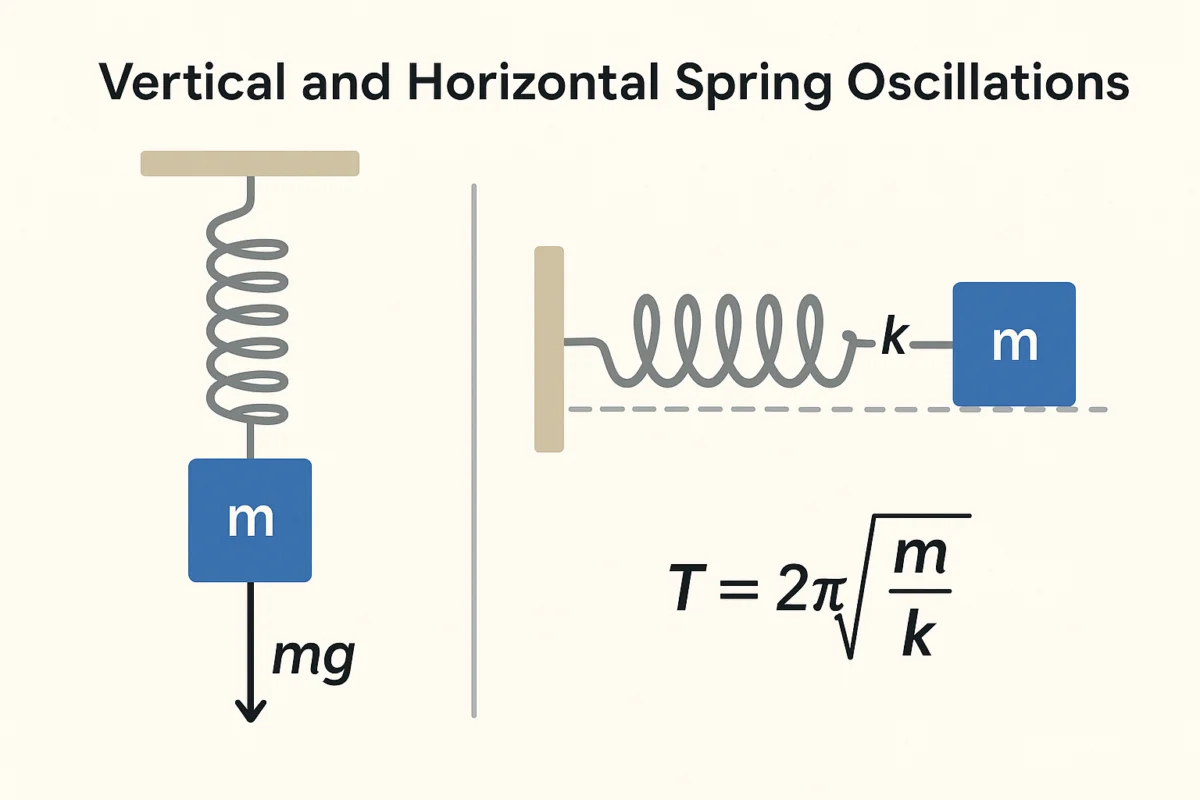
In a horizontal system, the only restoring force is provided by the spring. However, in a vertical system, gravity stretches the spring to a new equilibrium point, but the time period of oscillation remains independent of the gravitational constant.
The time period for any basic spring-mass system is calculated using the formula
. This shows that the time period depends only on the mass and the spring constant, not on the amplitude.
Effective Spring Constant in Series and Parallel
When multiple springs are used, we must calculate the effective spring constant. For springs in series, the reciprocal of the effective constant is the sum of the reciprocals, while for parallel springs, the constants are simply added together.
We Also Published
Understanding these combinations is vital for solving complex NEET problems. Parallel combinations result in a stiffer system with a shorter time period, whereas series combinations make the system more flexible, increasing the time required for one oscillation.
The Simple Pendulum and Small Angle Approximation
A simple pendulum consists of a point mass suspended by a massless, inextensible string. While its motion is technically circular, for small angles, it approximates Simple Harmonic Motion with remarkable accuracy and predictable patterns.
Deriving the Time Period of a Pendulum
For a simple pendulum, the restoring force is a component of gravity, specifically ##mg \sin(\theta)##. For small angles, ##\sin(\theta) \approx \theta##, allowing us to treat the motion as linear SHM with a specific period.
The time period of a simple pendulum is given by
. This formula highlights that the period depends only on the length of the string and the acceleration due to gravity, not the mass.
Factors Affecting Pendulum Motion
Changes in the environment, such as moving the pendulum to a different planet or a lift accelerating upwards, change the effective value of ##g##. This "effective gravity" directly alters the time period, a common topic for NEET numericals.
Temperature can also affect the pendulum by changing the length of the string through thermal expansion. As the length increases in summer, the time period increases, causing the pendulum clock to run slower than it should.
Energy Transformations in SHM
Energy in SHM is a dynamic exchange between kinetic and potential forms. While the individual energies fluctuate throughout the cycle, the total mechanical energy of the system remains constant in an ideal, non-damped environment.
Kinetic Energy and Potential Energy Variations
Kinetic energy is at its maximum at the mean position where velocity is highest, calculated as
. As the particle moves toward the extremes, this energy is converted into potential energy.
Potential energy is maximum at the extreme positions where the displacement is greatest. It is represented by the equation
, reflecting the work done against the restoring force to displace the mass.
Conservation of Total Mechanical Energy
The sum of kinetic and potential energy at any point in the oscillation is always equal to
. This total energy is proportional to the square of the amplitude and the square of the frequency.
In NEET exams, questions often ask for the displacement where kinetic energy equals potential energy. By setting the two equations equal, one can find that this occurs at a displacement of ##x = \pm A/\sqrt{2}## from the mean.
Graphical Representation of SHM Variables
Graphs are an excellent way to visualize the relationships between displacement, velocity, and acceleration. NEET often includes graphical analysis questions to test a student's conceptual depth regarding phase differences and energy distribution.
Phase Relationships Between Displacement and Velocity
The displacement-time graph follows a sine or cosine curve, while the velocity-time graph is shifted by a phase of ##\pi/2##. This means that when displacement is zero, velocity is at its maximum, and vice versa.
Acceleration-time graphs are out of phase with displacement by ##\pi## radians. Effectively, the acceleration graph is an inverted version of the displacement graph, always pulling the particle back toward the zero-line on the horizontal axis.
Analyzing Energy-Displacement Graphs
The energy-displacement graph shows a parabolic relationship for both potential and kinetic energy. The potential energy curve is a "U" shape opening upwards, while the kinetic energy curve is an inverted "U" shape.
The intersection of these two parabolas represents the point where the energies are equal. The total energy line is a horizontal straight line, indicating that energy is conserved regardless of the particle's position during the oscillation.
Damped and Forced Oscillations for NEET
In the real world, oscillations do not continue forever due to resistive forces like air friction. Understanding how these forces affect the motion is crucial for advanced physics problems in the NEET entrance examination.
Characteristics of Damping Forces
Damping occurs when a force proportional to velocity acts against the direction of motion. This leads to a gradual decrease in the amplitude of the oscillation over time, though the frequency often remains nearly constant.
The energy of a damped oscillator dissipates into the surroundings as heat. NEET students should recognize that the mechanical energy is no longer conserved in these systems, requiring an external power source to maintain the motion.
Resonance and External Driving Forces
Forced oscillations occur when an external periodic force is applied to a system. If the frequency of the external force matches the natural frequency of the system, the amplitude increases dramatically, a phenomenon known as resonance.
Resonance has many practical applications and dangers, from tuning a radio to the structural failure of bridges. In the NEET context, calculating the resonant frequency and understanding its effects on amplitude are key learning objectives.
Problem-Solving Strategies for NEET Physics
Solving SHM problems efficiently requires a mix of formula memorization and conceptual clarity. Developing a systematic approach helps in tackling both direct numericals and complex, multi-concept questions involving springs and pendulums.
Identifying SHM in Complex Systems
The first step in any problem is to confirm if the motion is truly SHM by checking if ##a \propto -x##. Once confirmed, identifying the equilibrium position is essential, as all displacements must be measured from that specific point.
In systems with multiple forces, such as a floating cylinder or a liquid in a U-tube, the same SHM principles apply. Focus on finding the net restoring force and equating it to ##-kx## to find the effective spring constant.
Shortcut Formulas for Quick Calculations
For NEET, speed is just as important as accuracy. Memorizing shortcuts for the time period of combined springs or the effect of a moving frame on a pendulum can save valuable minutes during the actual examination.
Using the relationship ##v_{max} = \omega A## and ##a_{max} = \omega^2 A## allows for quick transitions between different kinematic variables. Always keep an eye on the units, ensuring that angular frequency and frequency are not confused.
Common Pitfalls and Conceptual Clarifications
Many students lose marks in SHM due to simple misunderstandings of the fundamental definitions. Clarifying these common pitfalls can significantly boost a student's confidence and performance in the physics section of the NEET exam.
Distinguishing Between g and g_eff
A common mistake is using the standard value of gravity when the pendulum is in an accelerating lift or on an inclined plane. In such cases, one must use the effective acceleration, which is the vector sum of all accelerations.
For a pendulum in a lift moving up with acceleration ##a##, the effective gravity becomes ##g + a##. If the lift is in free fall, the effective gravity is zero, and the pendulum will not oscillate at all.
Misinterpreting Phase Differences
Students often struggle with the lead and lag concepts in phase. It is vital to remember that velocity leads displacement by ##90^\circ##, and acceleration leads velocity by another ##90^\circ##, making acceleration ##180^\circ## ahead of displacement.
When comparing two different SHM equations, ensure they are both in the same trigonometric form (either both sine or both cosine). This standardization is necessary before calculating the phase difference between two oscillating particles or waves.
Integrating SHM with Other Physics Chapters
SHM is not an isolated topic; it serves as the foundation for several other chapters in the NEET syllabus. Recognizing these connections helps in building a holistic understanding of the subject and tackling integrated questions.
Connections to Waves and Sound
The study of waves is essentially the study of SHM traveling through a medium. Every particle in a string or air column undergoing wave motion is actually performing SHM about its own individual mean position.
Concepts like phase, frequency, and amplitude carry over directly from SHM to wave optics and acoustics. Mastering the simple spring-mass system makes it much easier to understand the vibration of air columns in organ pipes or strings.
SHM in Electrostatics and Magnetism
SHM also appears in electromagnetism, such as a dipole oscillating in a uniform electric field or a magnet in a magnetic field. The torque acting on these objects follows a similar restoring pattern for small angular displacements.
By identifying the "rotational" version of the restoring force, students can apply SHM formulas to find the time period of these oscillations. This interdisciplinary approach is frequently tested in the more challenging sections of the NEET physics paper.
From our network :
- Limit Superior and Inferior
- How to secure postgres connections across VPC, VPN, and cloud
- Limits: The Squeeze Theorem Explained
- Bitcoin price analysis: Market signals after a muted weekend
- JD Vance Charlie Kirk: Tribute and Political Strategy
- How to design postgres partitions with native and hash methods
- Bitcoin Hits $100K: Crypto News Digest
- The Diverse Types of Convergence in Mathematics
- How to migrate to postgres using logical replication and cutover
RESOURCES
- Simple Harmonic Motion for NEET 2026 - Aman Mathur Sir - YouTube
- Is SHM hard for only me??? : r/JEENEETards - Reddit
- SIMPLE HARMONIC MOTION in 1Shot: FULL CHAPTER ... - YouTube
- Simple Harmonic Motion DPPs - Courses Details | Teacher
- NEET All PYQs 13: Simple Harmonic Motion (SHM) - YouTube
- Oscillations | Physics | NEET Previous Year Questions
- SHM IN ONE SHOT || Simple Harmonic Motion - YouTube
- PYQ NEET- Introduction To Simple Harmonic Motion - SATHEE
- Simple Harmonic Motion Formula Sheet - Super Tutor
- NEET Previous Year Questions (2014-2025): Oscillations - EduRev
- Simple Harmonic Motion Important Topics - Super Tutor
- Oscillations, SHM, Waves (AP-Physics-1,IIT,NEET) - Udemy
- Simple Harmonic Motion Practice Questions - Super Tutor
- Simple Hormonic Motion Handwritten Notes | PDF - Scribd
- NEET Physics Kota - App Store