On This Page
- Introduction to Projectile Motion
- Understanding the Horizontal Component
- Analyzing the Vertical Component
- Calculating Time of Flight
- Determining Maximum Height
- Measuring the Horizontal Range
- The Equation of Trajectory
- Impact of Projection Angle
- Energy in Projectile Motion
- Common MCQ Traps in NEET
- Effective Revision Strategies
Introduction to Projectile Motion
Projectile motion occurs when an object is thrown near the Earth's surface.
It moves along a curved path under the action of gravity only.
This motion is a combination of two independent rectilinear motions.
One motion is horizontal with constant velocity across the ground.
The other is vertical with constant acceleration due to gravity.
Defining Two-Dimensional Motion
Two-dimensional motion involves movement in both X and Y axes simultaneously.
In projectile motion, these two dimensions are treated as separate entities.
The horizontal velocity remains unchanged throughout the entire flight path.
The vertical velocity changes because of the constant pull of gravity.
Understanding this separation is the first step for any NEET aspirant.
Importance for NEET Aspirants
NEET frequently features questions on projectile motion due to its application.
It tests a student's ability to apply kinematic equations in 2D.
Scoring well in this section boosts the overall Physics percentile significantly.
Most problems are formula-based but require a deep conceptual foundation.
Mastering these basics ensures speed and accuracy during the actual exam.
Understanding the Horizontal Component
The horizontal component of projectile motion is remarkably simple to analyze.
It is characterized by a complete lack of horizontal acceleration.
Air resistance is typically ignored in standard NEET physics problems.
This results in a constant horizontal velocity throughout the motion.
We use basic distance-speed-time formulas for all horizontal calculations.
Velocity in the X-Direction
The initial horizontal velocity is denoted as ##u_x = u \cos \theta##.
Here, ##u## represents the initial speed of the projectile.
The angle ##\theta## is the angle of projection with the horizontal.
Since there is no force, ##u_x## never changes during flight.
This constant nature simplifies the calculation of the horizontal range.
Effects of Zero Acceleration
Zero horizontal acceleration means the velocity vector remains perfectly steady.
The object covers equal horizontal distances in equal intervals of time.
This predictability allows us to link time with horizontal displacement.
It serves as the bridge between vertical height and horizontal distance.
Students must remember that gravity does not affect horizontal speed.
Analyzing the Vertical Component
The vertical component is governed by the force of gravity.
It behaves exactly like an object thrown straight up in the air.
The motion is uniformly accelerated, specifically by the value of ##g##.
Vertical velocity decreases as the object rises toward its peak.
It then increases as the object falls back toward the ground.
Influence of Gravity
Gravity acts downward with a constant acceleration of approximately
.
In many NEET problems, we use
for easier calculation.
This acceleration only affects the vertical velocity component of the projectile.
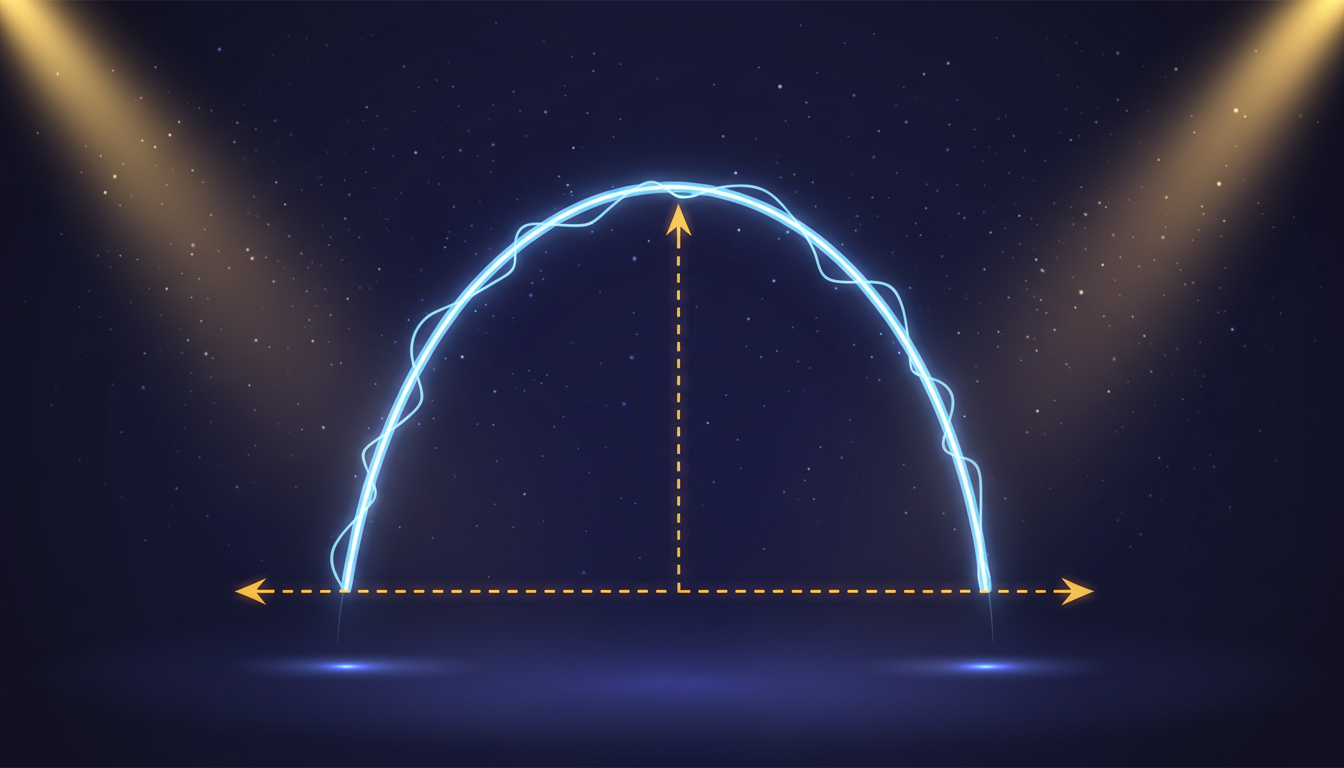
It causes the path to curve into a distinct parabolic shape.
Without gravity, the projectile would simply move in a straight line.
Velocity Changes Over Time
The initial vertical velocity is given by ##u_y = u \sin \theta##.
At the highest point, the vertical velocity becomes exactly zero.
After the peak, the vertical velocity becomes negative as it descends.
The time taken to reach the peak equals the time to descend.
This symmetry is a vital shortcut for solving time-related questions.
Calculating Time of Flight
Time of flight is the total time the projectile stays airborne.
It depends entirely on the vertical component of the initial velocity.
The horizontal velocity has no impact on how long it stays up.
We calculate it by analyzing the total vertical displacement over time.
For a level projection, the total vertical displacement is zero.
The Derivation Process
We use the kinematic equation
vertically.
Setting displacement to zero, we find the total time duration.
The resulting formula is
for the flight.
This formula assumes the launch and landing points are level.
Deriving it helps students remember the formula during high-pressure exams.
Factors Affecting Total Duration
The initial speed ##u## is directly proportional to the flight time.
A larger angle of projection also increases the total time airborne.
Gravity is inversely proportional, meaning stronger gravity results in shorter time.
Changing the mass of the projectile does not change the time.
NEET often tests this conceptual point about mass independence.
Determining Maximum Height
Maximum height is the highest vertical point reached by the projectile.
At this specific point, the vertical velocity component is zero.
However, the horizontal velocity component remains ##u \cos \theta## at peak.
Knowing this is crucial for calculating kinetic energy at the top.
The height depends on the initial vertical velocity and gravity.
The Vertical Peak Point
The projectile reaches its peak at exactly half the total time.
We use the third kinematic equation to find this maximum displacement.
The formula for maximum height is
.
This value represents the vertical limit of the object's trajectory.
It is a scalar quantity measured from the launch horizontal plane.
Relationship with Initial Velocity
Maximum height is proportional to the square of the initial velocity.
Doubling the launch speed results in four times the maximum height.
The sine of the angle also plays a critical role here.
A projection angle of 90 degrees yields the absolute maximum height.
Understanding these proportions helps in solving comparative ratio-based questions.
We Also Published
Measuring the Horizontal Range
The horizontal range is the total horizontal distance covered during flight.
It is the product of horizontal velocity and total flight time.
Range is often the most asked parameter in NEET physics exams.
It depends on both the speed and the angle of projection.
The formula assumes the landing point is on the same level.
Distance on Level Ground
The formula for the range is
.
This is derived by multiplying ##u \cos \theta## by the time.
Using trigonometric identities, we simplify the expression for easier use.
Range is zero if the angle is either 0 or 90.
It represents the total "reach" of the projectile across the field.
Maximum Range Conditions
The range is maximized when the term ##\sin 2\theta## equals one.
This occurs when the angle of projection is exactly 45 degrees.
At this angle, horizontal and vertical components are optimally balanced.
For any other angle, the range will be less than maximum.
NEET questions often involve finding the range for specific given angles.
The Equation of Trajectory
The trajectory equation describes the mathematical path of the projectile.
It relates the vertical position ##y## to the horizontal position ##x##.
This relationship is independent of the time variable in the motion.
The resulting graph is a downward-opening parabola in the coordinate plane.
This equation is vital for solving "point of impact" problems.
Parabolic Path Mathematical Form
The standard equation is
.
It shows that ##y## is a quadratic function of the distance ##x##.
This confirms the path is indeed a parabola for all projectiles.
Another useful form is
.
This second form is very efficient for range-related trajectory problems.
Interpreting the Trajectory Constants
The term ##\tan \theta## represents the initial slope of the path.
The second term accounts for the curvature caused by gravity's pull.
If gravity were zero, the path would be a linear line.
The constants ##u##, ##g##, and ##\theta## define the specific shape.
Students should practice switching between these two mathematical trajectory forms.
Impact of Projection Angle
The projection angle determines the distribution of the initial velocity.
It dictates whether the motion is high and short or long.
Small changes in angle can significantly alter the range and height.
Physics problems often compare two different angles for the same speed.
This is a favorite area for NEET examiners to test logic.
Complementary Angles of Projection
Two angles ##\theta## and ##(90 - \theta)## give the same range.
For example, 30 and 60 degrees result in identical horizontal distances.
However, their maximum heights and times of flight will differ.
The 60-degree projection stays in the air longer and goes higher.
The 30-degree projection is lower and reaches the target much faster.
Small vs Large Angle Effects
Small angles favor horizontal velocity over vertical lift and time.
Large angles provide high lift but very little horizontal progress.
At 45 degrees, the balance between these two components is perfect.
Understanding this trade-off is key to conceptual physics problem solving.
Always check the angle before applying the range or height formulas.
Energy in Projectile Motion
Energy conservation is a powerful tool for analyzing projectile motion.
Total mechanical energy remains constant throughout the flight of the object.
It consists of both kinetic energy and gravitational potential energy.
At the launch point, potential energy is usually considered to be zero.
As it rises, kinetic energy converts into potential energy smoothly.
Kinetic and Potential Energy
Initial kinetic energy is
at the start.
At maximum height, kinetic energy is
.
The potential energy at the peak is
using height.
Note that kinetic energy is never zero in projectile motion.
The horizontal velocity component ensures the object keeps moving forward.
Conservation of Total Energy
The sum of ##K.E.## and ##P.E.## is constant at every point.
This allows us to find speed at any height easily.
Speed at launch equals speed at landing on the same level.
The angle of impact also equals the angle of initial projection.
Using energy methods often simplifies calculations compared to using kinematics.
Common MCQ Traps in NEET
NEET often includes "distractor" options to catch unprepared students.
One common trap is the velocity at the highest point.
Students often wrongly assume the total velocity is zero at peak.
In reality, only the vertical velocity component becomes zero there.
The horizontal component remains active and constant throughout the flight.
Misinterpreting Velocity at Peak
Always remember that ##v = u \cos \theta## at the maximum height.
The acceleration at the peak is still ##g## directed downwards.
Many students confuse zero velocity with zero acceleration at the top.
Acceleration remains constant in magnitude and direction during the flight.
Clarifying this misconception is essential for answering conceptual MCQ questions.
Errors in Units and Dimensions
Ensure that the angle ##\theta## is used correctly in trigonometric functions.
Check if the question provides the angle with the vertical.
If so, use the complement angle for standard horizontal formulas.
Always convert units to the SI system before starting any calculation.
Dimensional analysis can help verify if your final formula is correct.
Effective Revision Strategies
Consistent practice is the only way to master projectile motion.
Start by deriving the three main formulas to understand them.
Solve a variety of problems ranging from simple to complex.
Focus on the relationship between variables like range and height.
Use visual diagrams to represent the motion before solving equations.
Memorizing Standard Formulas
Create a formula sheet for Range, Height, and Time of Flight.
Include the trajectory equation and the condition for maximum range.
Review these formulas daily until they become second nature to you.
Understand the conditions under which these specific formulas are valid.
Knowing when NOT to use a formula is also very important.
Solving Previous Year Questions
Analyze NEET papers from the last ten years for patterns.
Identify which sub-topics are most frequently tested in the exams.
Timed practice helps in improving speed for the actual test.
Review your mistakes to understand where your conceptual gaps lie.
Success in NEET Physics comes from clarity and repeated rigorous practice.
From our network :
- How to migrate to postgres using logical replication and cutover
- Bitcoin Hits $100K: Crypto News Digest
- How to design postgres partitions with native and hash methods
- How to secure postgres connections across VPC, VPN, and cloud
- Limits: The Squeeze Theorem Explained
- JD Vance Charlie Kirk: Tribute and Political Strategy
- Limit Superior and Inferior
- The Diverse Types of Convergence in Mathematics
- Bitcoin price analysis: Market signals after a muted weekend
RESOURCES
- PROJECTILE MOTION in ONE SHOT || ALL Tricks & Concepts
- Projectile Motion Questions for JEE/NEET | PDF - Scribd
- One Shot Projectile Motion | NEET 2025/2026 | Yawar Sir - YouTube
- Projectile Motion - Unacademy
- Projectile Motion Previous Year NEET Questions | By AJ Sir - YouTube
- Kinematics 2D(Projectile Motion) - NEET Previous Year Question ...
- Questions of Projectile Motion || Kinematics -6 || LIVE || Grade 13
- My friend sent me this intresting question of projectile motion. Can ...
- Projectile Motion - Quick and Easy Tricks || #ShortLecture - YouTube
- Projectile Motion - BYJU'S
- Projectile Motion PYQs | NEET 2024 Physics | Tamanna Chaudhary
- Do I need to practice a projectile on an inclined plane for the NEET?
- Projectile Motion Formulas - Pinterest
- KILLER VISUALISATION OF PROJECTILE MOTION IN IPL - Reddit
- Physics Projectile Motion - Pinterest