On This Page
- Kinematics: The Foundation of Motion
- Laws of Motion and Dynamics
- Work, Energy, and Power
- System of Particles and Rotational Motion
- Gravitation and Orbital Mechanics
- Properties of Bulk Matter - Elasticity
- Fluid Mechanics and Hydrodynamics
- Simple Harmonic Motion (SHM)
- Mechanical Waves and Sound
- Thermal Properties of Matter
- Effective Revision Strategies for NEET Physics
Kinematics: The Foundation of Motion
Kinematics is the starting point for any NEET aspirant, focusing on the description of motion without considering its causes. Understanding displacement, velocity, and acceleration is crucial for solving complex problems. This section simplifies the core equations needed for both one-dimensional and two-dimensional motion analysis during your final revision hours.
Rectilinear Motion Formulas
For motion in a straight line with constant acceleration, the three primary equations of motion are indispensable for calculation. You must remember
,
, and
to solve most kinematics problems. These formulas allow you to determine final velocity or displacement when time and acceleration are known variables in the problem statement.
Additionally, the distance traveled in the ##n^{th}## second is given by
, which is a frequent question type in NEET. Mastering these allows for quick substitution during the exam, saving precious time for more difficult sections. Always ensure units are consistent, typically in SI units, before performing any numerical calculations to avoid common errors.
Projectiles and Relative Motion
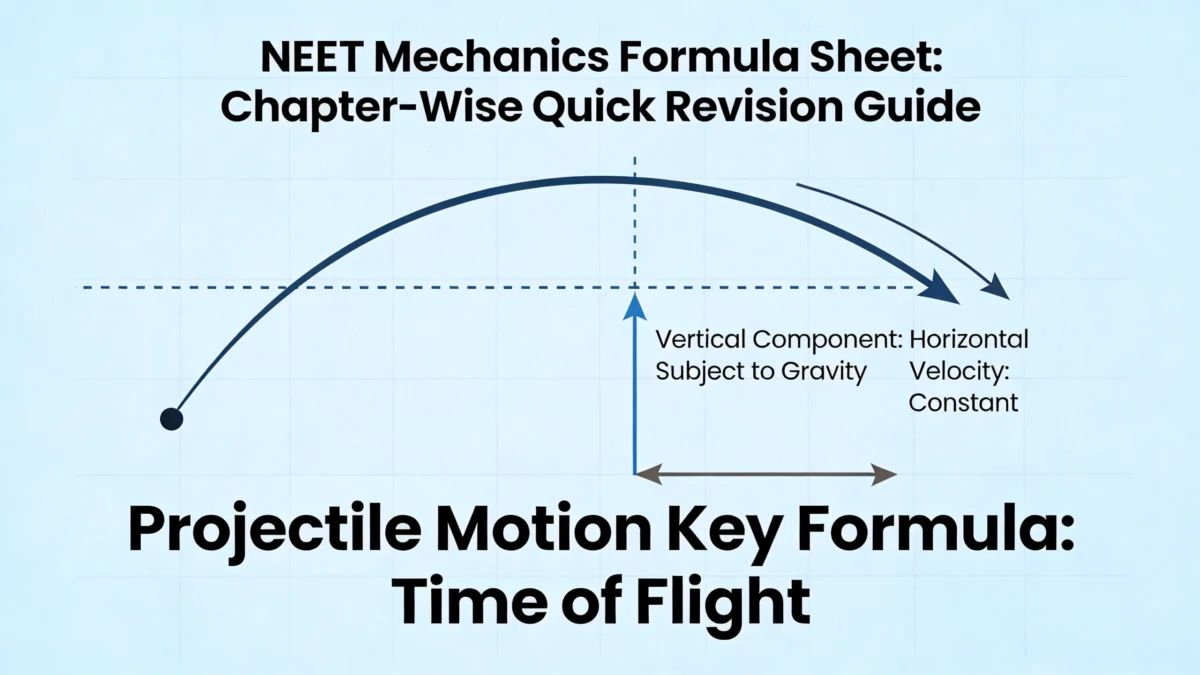
Projectile motion involves two-dimensional movement where the horizontal velocity remains constant while the vertical component is subject to gravity. Key formulas include the time of flight
and the maximum height
. Knowing the horizontal range
is also vital for predicting where an object will land.
Relative motion simplifies problems involving two moving objects, such as a swimmer crossing a river or two trains passing each other. The relative velocity of A with respect to B is expressed as ##\vec{v}_{AB} = \vec{v}_A - \vec{v}_B##. Using vector subtraction helps in visualizing the path of one object from the frame of reference of another, making complex scenarios much easier to solve.
Laws of Motion and Dynamics
Newton's Laws of Motion explain how forces influence the movement of objects, forming the core of dynamics. This chapter requires a clear understanding of Free Body Diagrams (FBD) and the application of force equations. A solid grasp of these principles is essential for tackling questions involving pulleys, inclined planes, and connected masses.
Newton’s Three Laws
Newton’s First Law introduces inertia, while the Second Law provides the quantitative definition of force as
. This relationship is the most used formula in dynamics, linking mass and acceleration to the net external force acting on a system. The Third Law reminds us that every action has an equal and opposite reaction, which is key for equilibrium problems.
Impulse is another critical concept, defined as the change in momentum, calculated using
. In many NEET problems, calculating the force exerted during a collision requires the use of the impulse-momentum theorem. Understanding that momentum ##p = mv## is a vector quantity ensures that direction is always considered in your final calculations.
Friction and Circular Dynamics
Friction is a resistive force that opposes relative motion, with the static friction limit given by
. Once motion begins, kinetic friction takes over, calculated as
, where ##\mu## represents the coefficient of friction. Identifying the normal force ##N## correctly in an FBD is the most common hurdle for students during the exam.
In circular motion, a centripetal force is required to keep an object in its path, defined as
. For a vehicle on a banked road, the optimum speed to avoid friction is
. These formulas are essential for solving problems related to planetary orbits, atomic models, and everyday engineering applications like highway design.
Work, Energy, and Power
The Work-Energy theorem is a powerful tool that often provides a simpler alternative to Newton's Laws for solving mechanics problems. It links the work done by all forces to the change in the kinetic energy of an object. This section focuses on the scalar nature of energy, which simplifies calculations by removing the need for complex vector analysis.
Work-Energy Theorem
Work is defined as the dot product of force and displacement, represented by the formula
. The Work-Energy Theorem states that the net work done on a body equals its change in kinetic energy:
. This principle is extremely useful when dealing with variable forces where direct integration of acceleration might be difficult.
Kinetic energy is calculated as
, while potential energy in a gravitational field is
. For a compressed or stretched spring, the elastic potential energy is given by
. Recognizing when to apply these formulas allows students to solve multi-step problems involving energy transformations with high accuracy and speed.
Conservation of Energy and Power
The Law of Conservation of Mechanical Energy states that in the absence of non-conservative forces, the sum of kinetic and potential energy remains constant. This is expressed as
, which is the go-to equation for objects falling or sliding without friction. It provides a quick way to find final velocities without needing to calculate time or acceleration.
Power is the rate at which work is performed or energy is transferred, defined by the formula
. In NEET, questions often ask for the power of an engine or the rate of heat dissipation, requiring these specific relations. Understanding the unit of power, the Watt, and its relation to Joules and seconds is fundamental for unit conversions.
System of Particles and Rotational Motion
Rotational motion is often considered one of the most challenging topics in NEET Physics due to its complexity and variety of formulas. It involves the study of rigid bodies where every particle moves in a circle around a common axis. Mastering torque, moment of inertia, and angular momentum is vital for scoring well in this high-weightage chapter.
Center of Mass
The Center of Mass (COM) is the point where the entire mass of a system can be considered to be concentrated for translational motion. For a system of particles, the position is
. Finding the COM of symmetrical objects or combined systems is a frequent task that requires students to apply this weighted average formula.
Velocity and acceleration of the COM follow similar linear combinations of the individual particle properties. If the net external force on a system is zero, the velocity of the center of mass remains constant, regardless of internal interactions. This concept is particularly useful in explosion or collision problems where internal forces are complex but the system's overall motion is predictable.
Torque and Angular Momentum
Torque is the rotational equivalent of force and is defined as the cross product
. It is also related to the moment of inertia and angular acceleration through the equation
. Calculating the moment of inertia for different shapes, such as discs, rings, and rods, is a prerequisite for solving these dynamics problems.
Angular momentum ##L## is the rotational analog of linear momentum, given by
or
. The principle of Conservation of Angular Momentum states that if the net external torque is zero, the total angular momentum remains constant. This explains why a spinning skater speeds up when pulling their arms in, a classic conceptual NEET question.
Gravitation and Orbital Mechanics
Gravitation is a universal force that governs the motion of celestial bodies and objects on Earth. The formulas in this chapter are highly structured and often mirror those found in electrostatics, making them easier to memorize. Focusing on Newton’s Law of Gravitation and planetary motion laws will ensure success in this predictable section of the exam.
Newton’s Law of Gravitation
Every mass attracts every other mass with a force directly proportional to the product of their masses and inversely proportional to the square of the distance. This is expressed as
, where ##G## is the universal gravitational constant. This inverse-square law is the foundation for calculating weight and the acceleration due to gravity on different planets.
The acceleration due to gravity ##g## on Earth's surface is
, which decreases with altitude and depth. At a height ##h##, it becomes
, and at a depth ##d##, it is
. Understanding these variations is essential for solving problems related to weightlessness and the physical properties of different planetary environments.
We Also Published
Satellite Motion and Potential
Satellites in circular orbits require an orbital velocity given by
to maintain their path. The time period of a satellite’s orbit is related to its radius by Kepler’s Third Law, which states
. These relationships allow students to calculate the height of geostationary satellites or the speed of GPS units orbiting the Earth.
Escape velocity is the minimum speed needed for an object to break free from a planet's gravitational pull, calculated as
. Gravitational potential energy is always negative, defined as
, representing the bound state of the system. Total energy of an orbiting satellite is the sum of its kinetic and potential energies, which is always negative.
Properties of Bulk Matter - Elasticity
Elasticity deals with how materials deform under stress and return to their original shape once the load is removed. This chapter is relatively short but contains specific definitions and constants that are frequently tested. Understanding the relationship between stress and strain is the key to mastering the mechanical properties of solids.
Stress, Strain, and Modulus
Stress is defined as the internal restoring force per unit area, while strain is the fractional change in dimensions. Hooke’s Law states that within the elastic limit, stress is proportional to strain, leading to the definition of Modulus of Elasticity. Young’s Modulus,
, is the most common constant used for wires and rods.
Bulk Modulus ##B## describes volume elasticity, while Shear Modulus ##G## describes shape deformation without volume change. The relationship
is vital for understanding how fluids and solids react to pressure changes. Students should be comfortable with these ratios to solve numericals involving the stretching of wires or compression of materials.
Energy Stored in Elasticity
When a material is deformed, work is done against the internal restoring forces, which is stored as elastic potential energy. For a stretched wire, this energy is given by
. This formula is often used to calculate the energy density or the total work required to reach a certain elongation.
Energy density, or energy per unit volume, simplifies to
. This expression highlights that energy storage depends on the material's stiffness and the square of the deformation. Many NEET problems ask for the ratio of energy stored in different wires, making this a high-priority formula for your quick revision sheet.
Fluid Mechanics and Hydrodynamics
Fluid mechanics covers the behavior of liquids and gases at rest and in motion. This chapter introduces concepts like buoyancy, pressure, and flow rates which are essential for understanding biological and mechanical systems. The formulas here are intuitive but require careful application of conservation laws like Bernoulli’s principle.
Pressure and Pascal’s Law
Pressure in a fluid at rest increases with depth due to the weight of the fluid column above, given by
. Pascal’s Law states that pressure applied to an enclosed fluid is transmitted undiminished to every portion of the fluid. This principle is the basis for hydraulic lifts, where a small force on a small area produces a large force.
Archimedes' Principle states that the buoyant force on an object is equal to the weight of the fluid it displaces:
. This force determines whether an object floats or sinks and is used to calculate the density of unknown substances. Mastery of these static fluid principles is necessary for solving problems involving submerged bodies and manometers.
Bernoulli’s Principle and Viscosity
For an ideal fluid in steady flow, the Equation of Continuity states that the product of area and velocity is constant:
. Bernoulli’s Equation,
, expresses the conservation of energy for flowing fluids. It explains phenomena like the lift of an airplane wing and the flow of blood through arteries.
Viscosity represents the internal friction of a fluid, with the viscous force given by
. Stokes' Law describes the drag force on a sphere moving through a viscous medium as
. Terminal velocity, the maximum constant speed reached by a falling object in a fluid, is calculated using the balance of gravity, buoyancy, and drag.
Simple Harmonic Motion (SHM)
Simple Harmonic Motion is a specific type of periodic motion where the restoring force is directly proportional to the displacement. It is a fundamental concept that appears in various branches of physics, including waves and optics. Understanding the mathematical representation of SHM is essential for predicting the behavior of oscillating systems.
Kinematics of SHM
The displacement of a particle in SHM is typically represented as
, where ##A## is the amplitude and ##\omega## is the angular frequency. Velocity is the derivative of displacement,
, reaching its maximum value at the equilibrium position. Acceleration is always directed toward the center, calculated as
.
Angular frequency is related to the time period and frequency by the relations
. For a mass-spring system, the angular frequency depends on the mass and spring constant:
. These relationships are the building blocks for solving any oscillation problem, whether it involves springs, pendulums, or floating objects.
Energy and Pendulums in SHM
Total energy in SHM is conserved and is the sum of kinetic and potential energies, given by
. Kinetic energy is maximum at the center, while potential energy is maximum at the extreme positions. Understanding this energy exchange helps in visualizing the motion and solving problems related to speed at specific displacements.
A simple pendulum consists of a mass suspended by a string, with a time period of
for small oscillations. For a physical pendulum, the formula involves the moment of inertia:
. NEET often tests how the time period changes with length or gravity, making these formulas critical for the formula sheet.
Mechanical Waves and Sound
Waves transfer energy from one point to another without the permanent transfer of matter. This chapter covers the properties of strings, pipes, and the Doppler effect, which are frequent topics in competitive exams. A clear understanding of wave speed and interference patterns is necessary for solving acoustic and mechanical wave problems.
Wave Speed and Intensity
The speed of a transverse wave on a stretched string depends on the tension ##T## and linear mass density ##\mu##:
. For longitudinal waves in a medium, the speed is determined by the bulk modulus and density:
. These formulas link the physical properties of the medium to the propagation speed of the disturbance.
Intensity of a wave is the power per unit area, which is proportional to the square of the amplitude and the square of the frequency. For sound waves, intensity levels are measured in decibels using the logarithmic scale
. Recognizing these relationships allows students to calculate how loudness changes with distance or source power adjustments.
Doppler Effect and Superposition
The Doppler Effect describes the change in frequency observed when there is relative motion between a source and an observer. The apparent frequency is
, where ##v## is the speed of sound. Correctly choosing the signs for the velocities of the source and observer is the most critical step in applying this formula.
Superposition leads to interference, beats, and stationary waves. Beats are produced by two waves of slightly different frequencies, with the beat frequency given by
. For standing waves in a string fixed at both ends, the frequencies are harmonics of the fundamental:
. These patterns are essential for understanding musical instruments and resonance.
Thermal Properties of Matter
Thermal physics deals with heat, temperature, and the expansion of materials. While often categorized separately, the mechanics of heat transfer and thermal expansion are integral to the broader study of matter. This section provides the necessary formulas for calorimetry and heat conduction calculations.
Calorimetry and Expansion
When a substance absorbs heat, its temperature increases according to
, where ##c## is the specific heat capacity. During a phase change, the temperature remains constant, and the heat absorbed is
, using the latent heat of fusion or vaporization. Calorimetry problems rely on the principle that heat lost by hot bodies equals heat gained by cold ones.
Thermal expansion describes how the dimensions of an object change with temperature. Linear expansion is given by
, while volume expansion follows
. For isotropic solids, the coefficients are related by ##\gamma = 3\alpha##. These formulas are vital for calculating gaps in rails or the overflow of liquids in heated containers.
Heat Transfer and Newton's Law of Cooling
Heat transfer occurs via conduction, convection, and radiation. The rate of heat conduction through a slab is
, where ##k## is the thermal conductivity. This formula is analogous to Ohm’s law, where temperature difference is the potential and thermal resistance is ##L/kA##, facilitating easier problem-solving through circuit analogies.
Newton’s Law of Cooling states that the rate of loss of heat is proportional to the temperature difference between the body and its surroundings. It is often used in the form
for practical calculations. This approximation is useful for predicting how quickly an object will cool down in a room environment.
Effective Revision Strategies for NEET Physics
Having a formula sheet is only half the battle; knowing how to use it effectively is what differentiates top scorers. Revision should be active and consistent, focusing on the application of formulas rather than just rote memorization. These strategies help in retaining complex mechanical concepts right up until the final exam day.
Using Formula Sheets Daily
A compact formula sheet should be reviewed daily to build muscle memory for the equations. Instead of just reading, try to derive the formulas occasionally to understand the underlying physics and constraints of each equation. This deepens your understanding and helps you remember which formula to apply when a problem presents unusual conditions.
Categorize formulas by their application, such as "energy-based" versus "force-based," to help in quick decision-making during the exam. Use color coding for different chapters to make the sheet visually engaging and easier to navigate during stressful study sessions. Consistent exposure ensures that you don't blank out on basic constants or signs during the actual NEET paper.
Solving Numerical Problems
Formulas are best learned through practice; solve at least ten numerical problems for each major formula every week. This helps in understanding the units, the typical values of variables, and the common traps set by examiners. Pay special attention to vector directions in Mechanics, as a simple sign error can lead to an incorrect answer choice.
Mock tests are the ultimate ground for testing your formula recall and application speed. After each test, analyze which formulas you forgot or applied incorrectly and update your revision guide with "usage notes" to prevent repeat mistakes. This iterative process of learning, testing, and refining is the most effective way to master NEET Mechanics and secure a top rank.
From our network :
- Limits: The Squeeze Theorem Explained
- Bitcoin Hits $100K: Crypto News Digest
- How to design postgres partitions with native and hash methods
- Bitcoin price analysis: Market signals after a muted weekend
- Limit Superior and Inferior
- How to migrate to postgres using logical replication and cutover
- How to secure postgres connections across VPC, VPN, and cloud
- JD Vance Charlie Kirk: Tribute and Political Strategy
- The Diverse Types of Convergence in Mathematics
RESOURCES
- Fluid Mechanics Formula Sheet - Pinterest
- Here's my Fluid Mechanics Formula Sheet for the midterm, what do y ...
- Fluid Mechanics Formula Sheet | PDF - Scribd
- Formula Sheet: Mechanical Properties of Fluids - Filo
- A-Level Mechanics Formula Sheet | PDF | Force - Scribd
- Fluid Mechanics Formula Sheet — NEET-UG - Super Tutor
- PHYSICS FORMULA SHEET – NEET 2026 One page = Full chapter ...
- Formula Sheet for Physics Mechanics - Edubirdie
- Surface Tension: Formula Sheet #hydrostatics #physics - Pinterest
- PHYSICS FORMULA BOOKLET - GYAAN SUTRA INDEX - Resonance
- Comprehensive physics formula sheet - Facebook
- SATHEE: Physics Formula Sheet - Mechanics - IIT Kanpur
- Physics formula sheet for Class 10 - Facebook
- NEET Physics Formula Sheet 2026 FREE PDF | Vedantu
- AP Physics C Mechanics Formula Sheet | Complete Guide