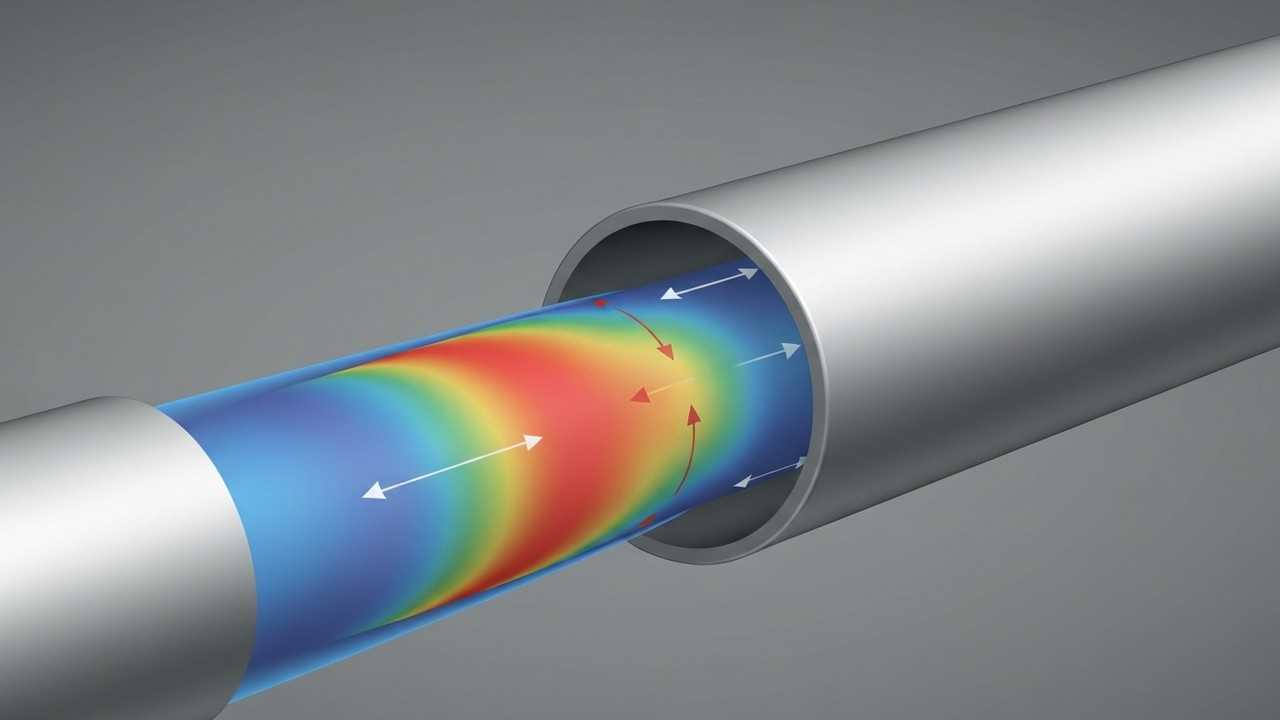
To apply Bernoulli's equation effectively in fluid dynamics, one must grasp its underlying assumptions and real-world implications. This guide helps you to apply Bernoulli's equation by breaking down its components and demonstrating how it predicts pressure changes in flowing systems, ensuring accurate analyses in engineering projects.
On This Page
We Also Published
Understanding Bernoulli's equation is fundamental for analyzing fluid flow in various engineering applications, from designing pipelines to optimizing aircraft wings. This principle connects pressure, velocity, and elevation, providing insights into energy conservation in moving fluids.
Unveiling the Bernoulli Equation's Core Principles
The Bernoulli equation states that for an incompressible, inviscid fluid in steady flow, the sum of pressure energy, kinetic energy, and potential energy per unit volume remains constant along a streamline. This conservation law explains how changes in fluid speed affect pressure, enabling predictions in fluid dynamics. It is derived from Newton's second law applied to fluid elements, emphasizing energy transformations without friction losses.
Defining Pressure and Velocity Relationships
Pressure drops as fluid velocity increases in a horizontal flow, a phenomenon known as the Venturi effect. This occurs because the kinetic energy component rises at the expense of pressure energy, maintaining the total energy constant. Applications include carburetors and atomizers, where controlled pressure changes facilitate mixing or spraying.
Incorporating Elevation Effects in Fluids
When elevation changes are considered, potential energy alters the energy balance, affecting pressure distributions in systems like water towers or dams. Higher elevations reduce pressure if velocity is constant, impacting designs for hydraulic structures. This aspect is crucial for ensuring stability and efficiency in gravity-fed systems.
Practical Applications in Engineering and Design
Applying Bernoulli's principle helps analyze fluid behavior in real-world scenarios, from aerospace to civil engineering. Engineers use it to calculate lift forces on wings or flow rates in pipes, optimizing performance and safety. Misapplications can lead to errors, such as neglecting viscosity in high-friction environments.
Enhancing Aerodynamic Lift Calculations
Aircraft wings exploit Bernoulli's principle by shaping airfoils to create lower pressure above the wing, generating lift. This design relies on faster airflow over the curved top surface, reducing pressure compared to the bottom. Accurate calculations prevent stall conditions and improve fuel efficiency in aviation.
Optimizing Pipeline and Venturi Meter Designs
In pipelines, Bernoulli's equation aids in sizing conduits and placing Venturi meters to measure flow rates without intrusive sensors. By constricting flow, pressure differences indicate velocity, allowing for non-disruptive monitoring. This method is preferred in industries like oil and gas for its reliability and low maintenance.
Synthesizing Fluid Dynamics Insights
Bernoulli's equation remains a cornerstone in fluid mechanics, bridging theoretical concepts with practical innovations. Its limitations, such as ignoring viscosity and compressibility, highlight the need for complementary models in complex flows. Mastery of this principle empowers engineers to solve fluid problems effectively.
RESOURCES
- Applying Bernoulli's Equation for Fluid Flow Video - YouTube
- Bernoulli's principle - Wikipedia
- Understanding Bernoulli's Equation - YouTube
- Learn All about Bernoulli Equation and Its Applications
- Does Bernoulli's equation apply to the cardiovascular system? : r/Mcat
- 14.8: Bernoulli's Equation - Physics LibreTexts
- When does Bernoulli not apply? : r/FluidMechanics
- Bernoulli's Principle | NASA
- How to Apply Bernoulli's Theorem in Fluid Mechanics | System ...
- fluid dynamics - Why does Bernoulli's equation only apply to flow ...
- What are the conditions that should be met to apply Bernoulli's ...
- Bernoulli's Equation
- The Most General Applications of Bernoulli's Equation | Physics
- Bernoulli's Principle & Equation
- Bernoulli's Principle: Real-World Applications | AstroCamp
From our network :
- JD Vance Charlie Kirk: Tribute and Political Strategy
- How to secure postgres connections across VPC, VPN, and cloud
- How to migrate to postgres using logical replication and cutover
- Limits: The Squeeze Theorem Explained
- Bitcoin Hits $100K: Crypto News Digest
- How to design postgres partitions with native and hash methods
- Limit Superior and Inferior
- The Diverse Types of Convergence in Mathematics
- Bitcoin price analysis: Market signals after a muted weekend