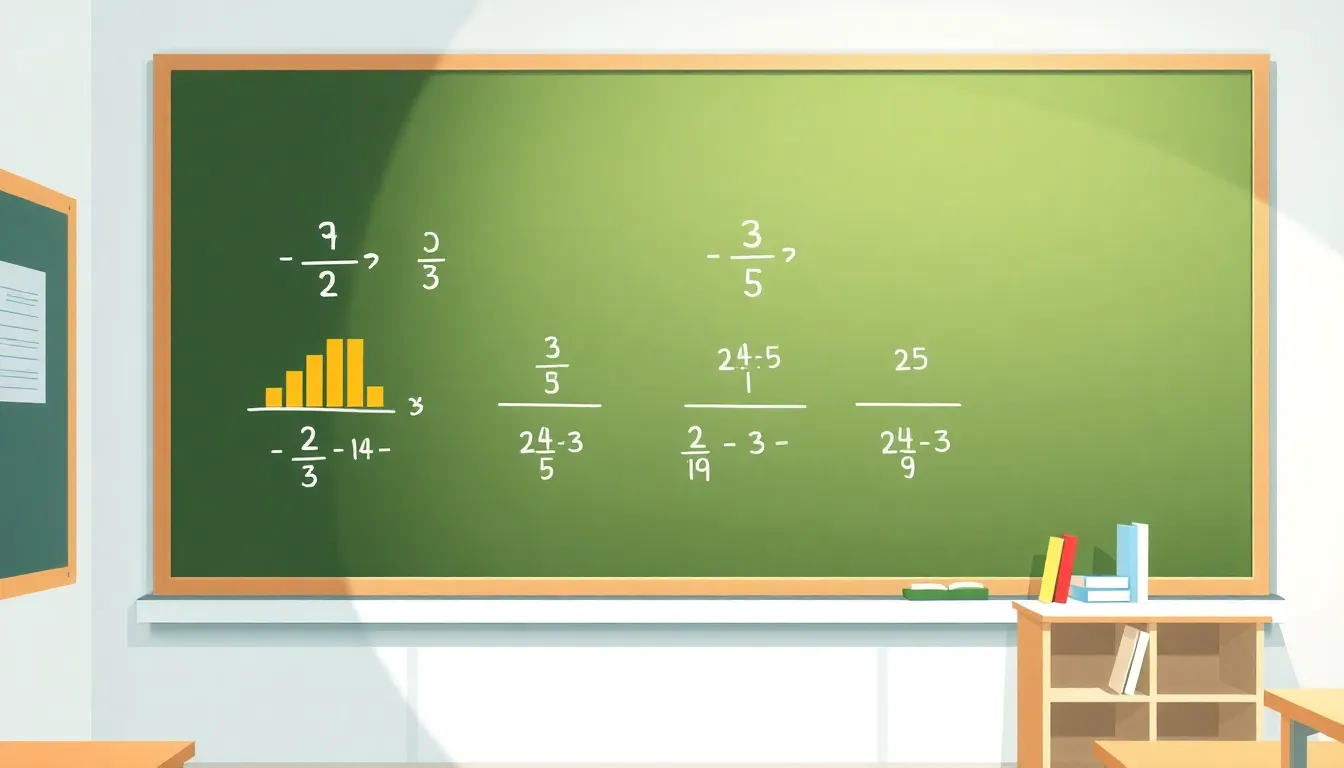
Master fractional operations by tackling five illustrative problems that build from basic addition to complex conversions. Each example includes step-by-step solutions to clarify common pitfalls and reinforce your understanding, making fractions less intimidating and more manageable in everyday math.
On This Page
We Also Published
Fractions are essential building blocks in mathematics, used in everything from cooking to advanced calculations. This guide helps you to master fractional operations by walking through practical problems with step-by-step explanations, building confidence and skills.
Problem 1: Adding Unlike Fractions
Adding fractions with different denominators requires a common baseline. This foundational skill unlocks more complex mathematical operations.
Step-by-Step Solution
Take the fractions one half and one third. To add them, find a common denominator, which is the least common multiple of two and three, yielding six. Convert one half to three sixths and one third to two sixths.
Add the numerators: three plus two equals five. The sum is five sixths, which can be simplified if needed, but here it's already in simplest form.
This method ensures accuracy in combining fractional parts, crucial for real-world applications like measuring ingredients or splitting resources.
Problem 2: Multiplying Mixed Numbers
Multiplying mixed numbers involves converting to improper fractions first. This approach streamlines the process and reduces errors in calculations.
Step-by-Step Solution
Consider multiplying one and one half by two and one third. Convert one and one half to three halves and two and one third to seven thirds. Multiply the numerators: three times seven is twenty-one.
Multiply the denominators: two times three is six. The product is twenty-one sixths. Convert back to a mixed number: twenty-one divided by six is three and three sixths, simplifying to three and one half.
Understanding this conversion helps in scenarios like scaling recipes or calculating areas in geometry, where mixed numbers often appear.
Problem 3: Dividing Fractions by Whole Numbers
Dividing fractions by whole numbers leverages the reciprocal rule. This technique is vital for sharing quantities evenly and solving rate problems.
Step-by-Step Solution
Divide three fourths by two. Rewrite the whole number as a fraction: two over one. Multiply three fourths by the reciprocal of two over one, which is one half.
Multiply numerators: three times one is three. Multiply denominators: four times two is eight. The quotient is three eighths, representing the fraction of the whole after division.
This method is applied in everyday situations, such as dividing a pizza among friends or allocating time in schedules, emphasizing practical utility.
Similar Problems with Quick Solutions
Problem 4: Subtracting Unlike Fractions
Subtract two thirds from three fourths. Common denominator is twelve; convert to nine twelfths minus eight twelfths, result is one twelfth.
Problem 5: Finding Fraction of a Number
What is two fifths of twenty? Multiply two fifths by twenty, yielding eight, as twenty divided by five is four, times two is eight.
Problem 6: Simplifying Complex Fractions
Simplify the fraction six eighths. Divide numerator and denominator by two to get three fourths, the simplest form.
Problem 7: Comparing Fractions
Compare one half and three fifths. Convert to common denominator ten: five tenths versus six tenths, so three fifths is greater.
Problem 8: Converting Fraction to Decimal
Convert three fourths to decimal. Divide three by four to get zero point seven five, useful for decimal-based calculations.
Key Takeaways
Mastering fractional operations enhances mathematical fluency and problem-solving abilities. Practice these steps to build a strong foundation for advanced topics. You'll learn to master fractional operations with ease, applying these skills in academic and real-world contexts for greater accuracy and understanding.
| Problem Type | Example | Key Steps |
|---|---|---|
| Adding Unlike Fractions | 1/2 + 1/3 | Find common denominator, convert, add numerators |
| Multiplying Mixed Numbers | 1 1/2 × 2 1/3 | Convert to improper fractions, multiply, simplify |
| Dividing Fractions by Whole Numbers | 3/4 ÷ 2 | Use reciprocal, multiply numerators and denominators |
| Subtracting Unlike Fractions | 3/4 - 2/3 | Common denominator, subtract numerators |
| Finding Fraction of a Number | 2/5 of 20 | Multiply fraction by number |
RESOURCES
- Fractional Order PI- Adaptive PI- Regular PI Based Master-Slave ...
- How to master HR operations with Fractional HR | Vanessa ...
- 14 CFR Part 91 Subpart K -- Fractional Ownership Operations
- Fraction Operations
- Master Improper Fractions and Mixed Numbers Conversion | StudyPug
- Fractional Leaders - Breakthrough Scaling | Masters of Scale
- Fractional COO Rates: A Comprehensive Guide for Business ...
- Master Minimum Equipment Lists (MMEL)
- 5 Illustrative Problems to Master Fractional Operations with Ease ...
- Fractional CFO for Clubs: Master Your Finances, Boost Member ...
- Fraction Challenge - Didactoons
- The Master® Fraction Ruler - Grade Bundle
- What to Do When Students Struggle with Fraction Operations
- Fractional Masters
- Hougen 11085 RotaCut Hole Cutter Master Kit - Fractional 21 Piece ...
From our network :
- How to design postgres partitions with native and hash methods
- Limit Superior and Inferior
- Bitcoin price analysis: Market signals after a muted weekend
- The Diverse Types of Convergence in Mathematics
- How to migrate to postgres using logical replication and cutover
- Bitcoin Hits $100K: Crypto News Digest
- How to secure postgres connections across VPC, VPN, and cloud
- Limits: The Squeeze Theorem Explained
- JD Vance Charlie Kirk: Tribute and Political Strategy